
This page lists brands beginning with the letters "P" and "Q" for which we currently have limited information. See also the List of German Motorcycles.
Pan 1924-1925
Panther of Magdeburg 1903-1907
Paqué 1921-1925
Patzner 1954~57
Paul Süße
Built at Josephstraße 33 Leipzig using F&S 98cc engines during the 1930s, around 60 of these were built of which only one remains.
Source: motorräder-aus-leipzig.de
Pawa 1922-1924
Pawi
Manufactured in 1922-1924* by Paul Victor Willke of Berlin-Reinickendorf, these bespoke motorcycles were powered by 492cc boxer twins from BMW. The firm also built automobiles.
*Wikipedia says motorcycles were built in 1921 only. (2018)
Sources: GTU Oldtimerservice, Wikipedia DE, Tragatsch.
Pax 1918-1919
PE
1923-24
Built their own 132cc two-stroke engines which were mounted in lightweight frames.
Source: Tragatsch p247
Pegasus
Pegasus mopeds were marketed by the ZEG association. These were built by Kynast in Quakenbrück, which manufactured mopeds for many retail organisations.
Models include the 1984 Model 25 with Sachs 505 2-speed 50cc engine.
Source: sonnengelber.de
Penz Sidecars
Manufactured by Hans-Joachim Penz (1963 to 1988)
Penz was head of development at Magura and designed the Clipper sidecar in 1961.
The chassis had adjustable torsion bar suspension and an ATE disc brake. Two types were offered, Touring and Sport. The machines were marketed by Hans Schmelzer and later by Rudolf Müller. They were fairly expensive and sales were slow.
Oldtimer-Markt magazine has an article on the marque in issue 10/93, page 210.
Sources: Gespann-Lexikon. et al
PER 1924-26 (see also Pawa)
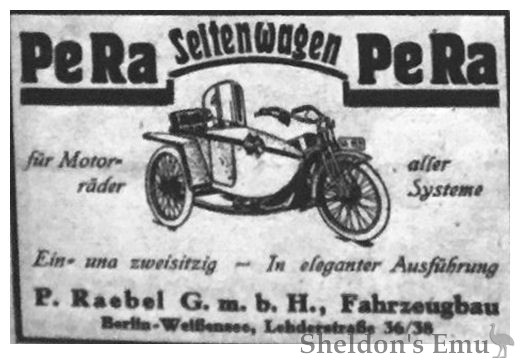
PeRa Sidecars
Manufactured by P. Raebel GmbH, Fahrzeugbau, Berlin Weißensee. 1924
Sources: Wikipedia DE, et al
Perkeo
Built in Berlin by Henry Feilchenfeld from 1924 to 1926, the 170cc two-stroke machine is known largely from reports on its unenviable reputation.
Source: GTU Oldtimerservice
Permo
1952-54
Mopeds with engines supplied by Victoria.
Source: Tragatsch p248
Perscheid
Motorradhaus Perscheid, Wesseling
zweirad-perscheid.de
Vespa sidecars manufactured in the 1980s by Hans Perscheid, whose family business began in the motorcycle trade in 1932 and continues to this day. Hans also collaborated in the construction of a rather attractive Vespa trike, the Triky.
Sources: mvc-brenig.de, sidecar-cz.com, et al
Peters
Manufactured by Peters, Steingrüber & Co. of Berlin 1924-1925
Belt-driven lightweights powered by a 143 cc DKW engine.
Unrelated to the Isle of Man machine of the same name and period.
Source: GTU Oldtimerservice
Pfeifer Sidecars
During the 1980s and 1990s Zweirad Pfeifer of Aßlar developed the OP-AL front wheel swing arm with continuously adjustable caster.
Conversions used the Jeaniel Lynx sidecar body and subframe components from Walter.
The rear wheel was modified to accept a Beringer (from Orion) composite rim to which is fitted an automotive tyre.
Source: SidecarPassion.com.
Phantom 1921-1928
Phönix (1932)
There were two German companies which used the name Phönix
The first built lightweight two-strokes and was taken over by Ruhrtal-Motorradwerke R.M.W. of Neheim around 1932, who continued to produce the Phönix in a new factory built in Wenholthausen, Sauerland. See RMW.
Phönix 1935-39 (Bielefeld)
Pimph 1924-1926
Pohl Sidecars
Manufactured by Pohl Metallbildner
Markus Pohl
Am Sonnenhang 16
94344 Wiesenfelden
pohl-metallbildner.de
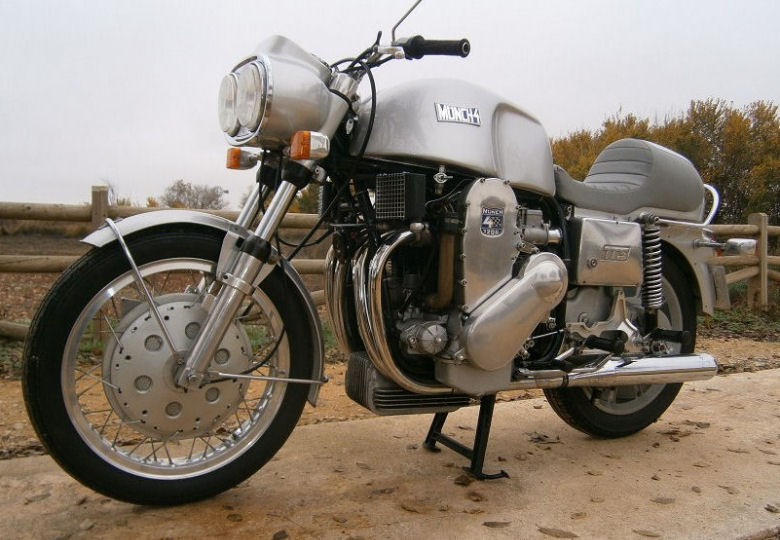
Active as a sidecar constructor since about 2018, numerous magnificent examples displayed on the website include KTM 1290 Super Duke, BMW twins and Munch Mammut.
Sources: Gespann-Lexikon; pohl-metallbildner.de.
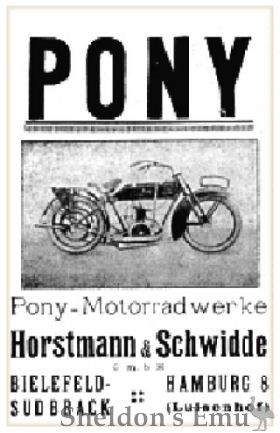
Pony
Manufactured by Horstmann & Schwidde of Bielefeld, 1923-1925
The company built motorcycles with 143cc DKW and 233cc König two-stroke engines. It had long footboards, belt drive, a two-speed gearbox, and a rim brake on the rear wheel belt drive pulley.
Source: GTU Oldtimerservice
Postler 1920-24
Potthoff
1924-26
Built light motorcycles fitted 185cc Norman engines from England.
Source: Tragatsch p251
PSW
1924-1929
Built their own engines of 247cc with inlet and exhaust ports both at the front of the engine. Also built motorcycles using JAP and Blackburne engines 249 to 490cc. They also built minicars or microcars, and motorcycles for children with 98cc engines.
Arnold Stölting of Hamburg raced a 250cc PSW in 1927, near Rotenburg.
Source: Tragatsch p253, nac-bremen.de
Quelle
Quelle Versandhaus GmbH, Nuremberg
In the mid-sixties the Quelle mail-order company of Fürth sold lightweights under the name Quelle Bonance.
The Mars brand name was acquired by Quelle around 1958, and they sold machines of this name built by Solo of Sindelfingen.
Sources: GTU Oldtimerservice, meisterdinger.de
Rarer German Marques