
This page lists brands beginning with the letter "R" for which we currently have only an historical precis.
For a more complete listing visit the German Index.
R. & F.
Manufactured by Kraftfahrzeugwerk München AG, run by Paul Reuter and Emil Fischer who had previously managed MFZ.
The motorcycle was produced in sports and touring versions both powered by a 349cc unit-construction four-stroke engine. It had a dual-tube frame with chain drive to the rear wheel, and drum brakes fore and aft.
The touring model had a top speed of 80 km/h, and the sports model, which was presented at an exhibition in Stuttgart in May 1924, was capable of some 105 km/h.
Production ceased in July 1924, and the company was dissolved early in 1925.
Source: Motopedia
Raakete c.1919
Räbiger Sidecars
Manufactured by Horst Räbiger of Homberg/Ohm between 1988 and c.1995.
Examples of his conversions include a Transalp off-road sidecar based on a 1989 TA. An aluminum box serves as the seat, and a 25L fuel tank is installed beneath the box. It has leading link forks, and tyres are 145/60-15 at the rear, 4.00-18 at the front, and 3.50-16 on the sidecar wheel. Another conversion consists of an EZS TPSL sidecar adorning a GL1500.
Motorradfahrer (01/1993) features a Suzuki GSX-R 1100 Räbiger-Gespann of 138PS.
Sources: Gespann-Lexikon, et al.
Rambola
Manufactured by Rambola, Fabrikations- und Vertriebsgemeinschaft, Munich, 1924 to 1925
In 1924 the Gebrüder Rammel filed a patent application for an electric motorcycle which was demonstrated by racing cyclist and aviator Bruno Büchner at the local cycling track. The 24-volt electric motor was mounted below the seat and drove the rear wheel via a chain.
At a Nuremberg hillclimb event a Rambola with a passenger defeated an 11 hp Mars.
Due to the batteries, the machine was a good deal heavier than its petrol-engined competitors. No more was heard of it after 1925.
Source: Motopedia
Rapier
Manufactured in 1953 and 1954 by Rapier Fahrradfabrik, Märkische Straße 23, Bielefeld. Initially they offered kits into which appropriate engines from JLO, Sachs and Zundapp could be installed, and also produced complete mopeds.
Sources: Moped Archive, GTU Oldtimerservice
Ratingia 1923-1925
Rattenfänger
A small advertisement believed to be from the 1920s reads:
RAHMEN
für Motorräder und Eubaumolnen, in verschied. Modelleo, Lekbtsrader mit und ohne Motor, Lenker,
Sanelstützen Gepäcaräger ans laufender Fabrikation liefern
Rattenfänger-Werke Fr. Mestmäcker, Kdt-Cies,
Aerzen bei Hameln.
"FRAME
for motorcycles and bicycles, in various
models, bicycles with and without motors,
handlebars, seatposts, luggage racks supplied by Rattenfänger-Werke Fr. Mestmäcker,
Kdt-Cies, Aerzen near Hameln."
Notes. 1. "Der Rattenfänger von Hameln" translates to "The Pied Piper of Hamelin". 2. The marque is mentioned in Leichtmotorrad Fotoalbum by Lars Sachteben.
Raumo
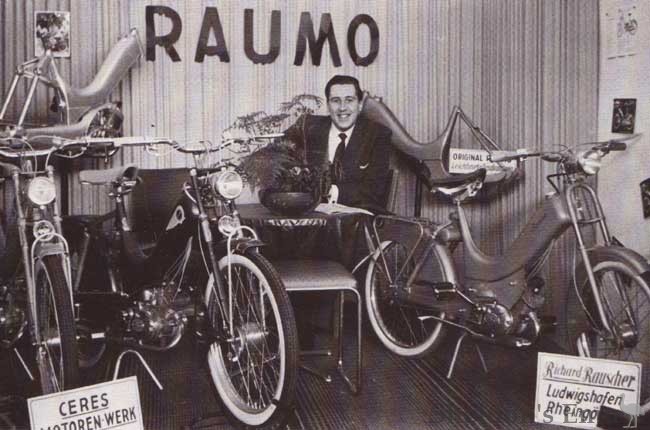
Richard Rauscher of Ludwigshafen built Raumo mopeds from 1953 to 1956. Four models were built using 48/49cc Sachs, JLO and Zundapp engines
Ludwigshafen is on the Rhine between Frankfurt and Strasbourg.
Source: mo-ped.se, et al.
Record
Mercur Motoren GmbH, Berlin NW 7, Neue Wilhelmstraße 6
In the years 1922-1924 the firm built basic machines using two-stroke 147cc engines of their own construction. The engine was mounted high in the triangle of a strengthened bicycle frame, with belt drive to the rear wheel.
Sources: Tragatsch p259; motor-hist-foto.de; Motopedia.
Reform
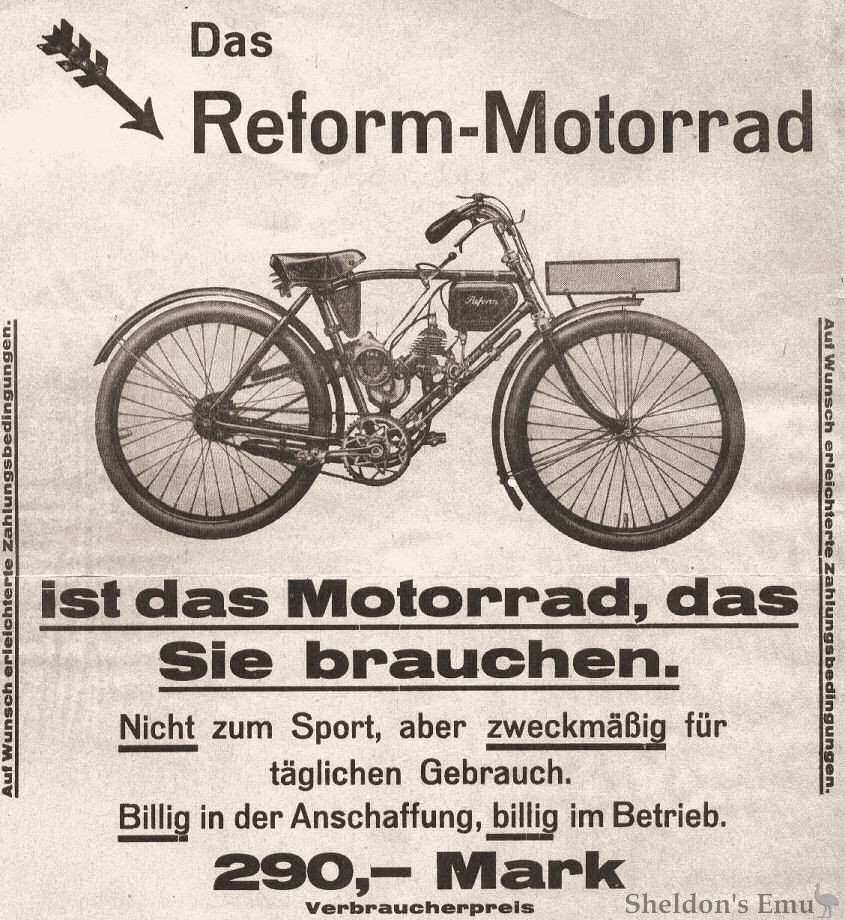
The Reform-Motorrad of 1930 is very similar to the Fels of 1931 and the 1930 Presto Ballon.
Source: oldsachsmotor.de
Rehling
Founded by Carl Rehling of Bielefeld in 1919, the company changed ownership but not the name and produced 247cc motorcycles in 1924 and 1925.
Source: GTU Oldtimerservice
Rennsteig 1925-30

Rewaco
Manufactured by Rewaco Spezialfahrzeuge GmbH, Lindlar
Website: rewaco.com
The company built their first trike in 1991, powered by a 53 hp VW Beetle engine.
They produced converted trikes from Suzuki, Victory and Triumph motorcycles until 2016.
Their website states that in 2023 the company will employ a total of around 90 people in Germany, Poland and China.
Rex of Behringersdorf
Rex Kraftfahrzeug GmbH, Behringersdorf near Nuremberg. 1923 - 1925
The company produced a small number of two-stroke motorcycles. At least one remains, and has chain drive to the gearbox and belt-drive to the rear wheel, which has a rim brake. No front brake.
Source: meisterdinger.de
N.B. Several firms used the Rex brand.
Rheinko
Manufactured by Rhein & Co., Elberfeld 1925-1926.
Robert Rhein built motorcycles and engines. The Rheinko was a two-stroke rated at 3.5 hp of probably 350cc. An advertisement for a used machine of this brand powered by a 350cc Blackburne engine appeared in 1927.
Source: Motopedia
Ribi
Manufactured by Binnewies & Roeder, later Binnewies & Sprecher, Weberstraße 40b Berlin, in the years 1923 to 1926.
These were quality machines of 200 and 250cc which took advantage of the tax and licence-free laws then in effect. They had kickstarter, clutch and a two-speed gearbox.
The first of them was produced in 1923 powered by a 200cc engine with belt drive to the rear wheel. These engines were offered to other manufacturers.
Arnold von Sprecher joined the business in April 1924, replacing Hermann Röder, and the company was renamed. Added to the range was a machine with a 249cc engine, and chain final drive and hub brakes were soon introduced. That year the machines did well in competition, winning two major races in the Berlin area.
Production ceased soon afterwards, and the company was wound up in August 1926.
Sources: GTU Oldtimerservice; Motopedia.
Rinne 1924~1930
Rinnerberger 1927-1929
Riwina
Manufactured by the Ridder Brothers of Bielefeld, 1923-1924
Herford König supplied 233cc engines for these machines.
Source: GTU Oldtimerservice
Roadrunner Gespanne
Sidecars manufactured by Armin Plaumann, 2026.
team Allee 14
24392 Süderbrarup
Germany
roadrunner-motorradgespanne.de
Source: Gespann-Lexikon
Robako
1924-26
Berlin firm which fitted Bekamo 129cc and MGF 132cc engines to lightweights.
Source: Tragatsch p272
Roco 1922-1925
Roeder
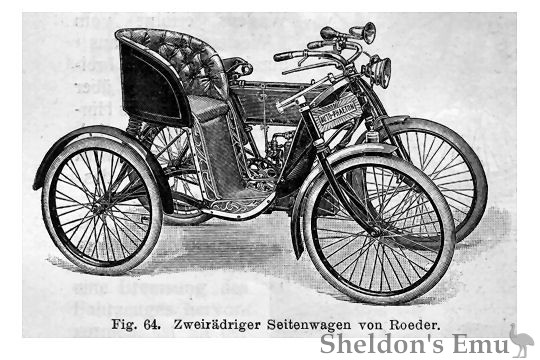
Manufactured by Roeder & Co., Hanover, 1906-1914
Known as Auto-Phaetons, these were effectively two heavy bicycles running side by side with an engine in one and a seat or carrier in the centre, driving via a chain.
Source: GTU Oldtimerservice
Roland
Manufactured by Hugo Marschin in Berlin, 1923-1924.
These were light motorcycles with 132cc Bekamo and 175cc DKW engines.
Source: GTU Oldtimerservice
N.B. Roland of Dessau, automobile manufacturer 1924-26, is unrelated.
Rolifix Leifer-Dreirad 1956-1958
Rollfix 1923-1936
Römer Sidecars
Peter Römer operated in Hagenbach, Germany from c.1985 to 2005 using the name Römer Team. He built dnduro sidecars conversions for both competition and road use based on BMW motorcycles.
Source: Gespann-Lexikon
Roter Teufel
1923-25
Bismarck Motoren GmbH, Berlin-Charlottenburg, Bismarckstraße 102
Berlin firm which fitted their own 170cc four-stroke sidevalve engines to light motorcycles.
Source: Tragatsch p263
RS
Two different German companies built motorcycles under the RS marque concurrently.
Rogge & Stiller of Berlin built two-stroke engines 1924-1925
Scheid-Henniger of Karlsruhe built RS motorcycles 1925-1928. These were also marketed under the SH brand.
Source: GTU Oldtimerservice, Tragatsch p272.
RUD
1927-30
Dresden firm which built handsome roadsters using Kuhne, MAG and JAP engines of 348cc to 748cc.
Source: Tragatsch p265
Ruko
Sidecars manufactured by RUKO Fahrzeugtechnik GmbH & Co. KG, 72555 Metzingen until c.2022.
ruko-fahrzeugtechnik.de ✝
Models: RF, RF1 Targa, Shark, Sportivo, Vector, Xplorer.
Source: SidecarPassion.com
Ruppe 1928-1932
RUT
August Gernet, Motorfahrzeugbau, Nürnberg
Built motorcycles with an external flywheel 132cc two-stroke engine.
Source: meisterdinger.de
Runge 1923-1926
Ruwisch
Karl Ruwisch of Cologne built a light scooter powered by a Victoria 32cc two-stroke mounted above the front wheel, 1949-1959(1).
Notes: 1. Dates vary with some sources giving first production as early as 1947, which would make it Germany's first post-war scooter. Tragatsch gives 1948-49, Wikipedia NL 1948-59.
Source: GTU Oldtimerservice
RWN 1927-1930
Rarer German Marques