This page lists brands names beginning with the letter "S" for which we currently have only an historical precis.
For a more complete listing visit the German Index.
Sahib
The Sahib sidecar was a joint production by Sageder of Bavaria, Heigl and Iwan Bikes.
sageder-online.de ✝
Sources: SidecarPassion.com, et al.
SAR by Maschinenfabrik Raetsch, 1923-1930
Sarge and Sabeck 1902
Saxonia
Sidecars manufactured by Robert Waldmann since 2019 in collaboration with Sven Altmann.
Schafstallweg 3, D-01917 Kamenz - OT Liebenau, Germany
sidecar-saxonia.de
Specialists in BMW R18 sidecar conversions. They carry a wide range of accessories for the R18 from BMW, Jekill & Hyde, Wunderlich and Wunderkind. They also build Armec-Sidewinder conversions, and replicas of Wünsche sidecars.
Sources: Gespann-Lexikon; sidecar-saxonia.de.
Schajor Sidecars
The firm built sidecar combinations using mostly Italian motorcycles. Active in the sidecar sector from around 1980 to 2000, it appears they also built various performance accessories such as Guzzi induction manifolds and enduro sump guards.
Source: Gespann-Lexikon
Schepsky & Ebbert GmbH
Michael Schepsky
Philippsweiler - Borenpfad 5
54649 Oberpierscheid
zoccolettoria.de
Sidecars manufacturers from about 1986 to 1993. They built the Pera sidecar until the early 1990s, then company ceased operations. Construction continued by Michael Schepsky; the company name became ROS, and later changed to Zoccolettoria UG.
The Pera was a two-seater which allowed a child to sit behind an adult. Designed by Michael Dominicus, it was fitted to Moto Guzzi, BMW twins and fours, Honda Gold Wing and Yamaha XS 1100, among others.
Source: Gespann-Lexikon
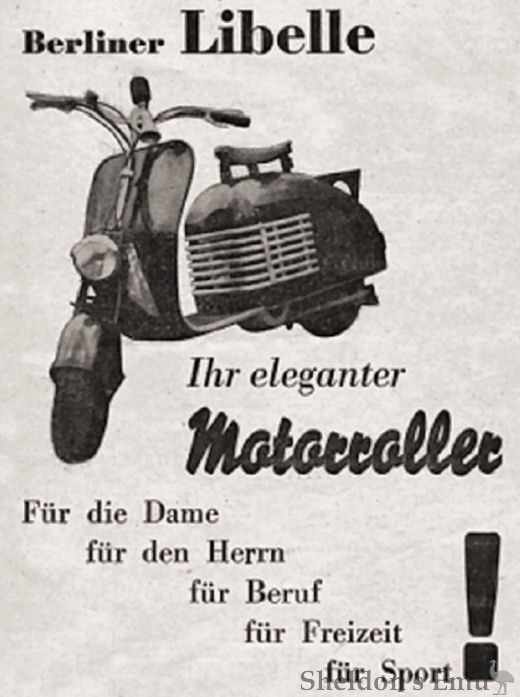
Sarolette, Libelle
Manufactured by Herbert Schulze, Berlin, 1949-1952
The Sarolette scooter was introduced in 1949 with a 100cc Sachs engine. The following year the Libelle 100 (Sachs) and Libelle 120 (JLO) scooters appeared, only to disappear into the mist two years later.
Source: GTU Oldtimerservice
NB. Several manufacturers used the brandname Libelle.
Sartorius
Bunzlau firm built machines with 195cc sidevalve and 348cc ohv Kühne engines between 1924 and 1926.
Source: Tragatsch p269
Schwalbe
GOVECS AG
Brunnstraße 1, 80331 Munich
Described as an environmentally friendly city bike, the machines are built at a factory in Wrocław, Poland with a claimed output of between 20,000 and 30,000 units annually.
Website: my-schwalbe.com
SiDeCon
Sidecars manufactured by Heino Gniza since 1998.
Jenhorst 19, 31604 Raddestorf, Niedersachsen
www.sidecon.de
Models include Beaver, Nugget, Sandy and Spirit.
Sources: Gespann-Lexikon, sidecon.de.
Saturn 1908-1927
Schliha 1924-1933
Schlimme
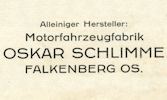
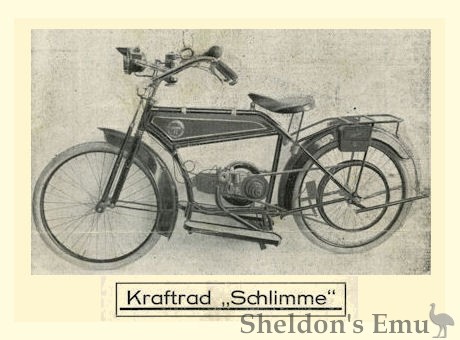
Based in Falkenberg OS, Oskar Schlimme Mechanikermeister built lightweight motorcycles powered by DKW 142cc and 175cc two-strokes in the years 1924-1925. The firm was almost certainly a victim of the devastating effects which hyperinflation inflicted on the German economy.
Sources: Tragatsch p270; Period advertising.
Schlör 1960
Schmid, Karl
Sidecars manufactured by Gespanntechnik Karl Schmid from Mickhausen (established c.1984) who has been building motorcycle sidecars for 40 years. Bodies are available in both aluminium and sheet steel.
Web: gespanntechnik-schmid.de
Schmidt, EB
Manufactured by Ehrhardt B. Schmidt in Leipzig, 1924.
It appears to have been a lightweight, single-speed belt drive motorcycle with pedal start.
Source: motorräder-aus-leipzig.de
Schmidt, RS
Robert Schmidt of Leisning and Berlin, 1921-1924
These were lightweight 200cc motorcycles with the engine inclined at 45 degrees offered by Schmidt under his own name and also his initials, RS. Similar machines were marketed by AMAG and it is unclear which of the firms manufactured them.
Source: GTU Oldtimerservice
Schminke 1953-1970s
Schmitz
Manufactured in 1938 by Gebr. Schmitz, Jacobsstr. 1, Trier, established 1908.
These were delivery tricycles based on a motorcycle with a goods container mounted on two wheels at the front. They were also available in pedal tricycle format, without engine.
Source: Axel Oskar Mathieu Archive
Schneider
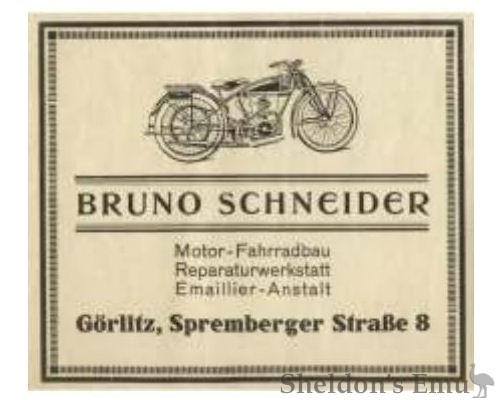
Manufactured by B. Schneider, Motor- & Fahrradbau, Görlitz, Spremberger Straße, 1924 to 1926.
Fitted DKW 142cc 175cc and 206cc two-stroke engines to their own lightweight motorcycles which had belt drive, two block brakes in the rear wheel, and footboards.
Sources: Tragatsch p270; Motopedia.
Schnell-Horex 1952-1954
Schroff-Record
Manufactured by Georg Schroff of Berlin 1923-1925
These were bespoke motorcycles with engines from Franz Krause. They had chain drive and two-speed gearbox, and were available in red or black. The same - or very similar - machines were marketed under the G.S. brand.
Source: GTU Oldtimerservice
Schüler
Manufactured by Luftreederei Max Schüler of Osnabrück, 1923-1925
Source: GTU Oldtimerservice
Schunk
1926-1928 Zella-Mehlis (Thüringen)
Source: wikipedia.de
Schütt
1933-1934
Paul Schütt of Flensburg designed and built these interesting machines using a transverse-mounted 196cc two-stroke in a Duralumin frame.
Source: Tragatsch p270
Schürhoff 1923~1953
SCK
Manufactured in Cologne 1924-1925
SCK Motorradwerke GmbH, originally a garment company, built motorcycles using 350 and 500cc engines from JAP and MAG fitted to British frames. Sales were slow.
Source: GTU Oldtimerservice
Securus 1906
Seegard
Manufactured in Berlin by Fietz, Paul & Co, 1924-1925
These were motorcycles with 150cc and 200cc engines from Cambra, Alba and Rapid, according to customer choice. Unfortunately, the customers chose not to.
Source: GTU Oldtimerservice
Seel 1974-1990
Seith
Manufactured in Hof (Saale) in the 1950s, these were children's motorcycles powered by 38cc Victoria two-stroke engines. They are believed to be sought after by collectors.
Source: GTU Oldtimerservice
Sept & Unger (S&U)
1925-1926. Michael Sept and Fritz Unger of Schwabacher Straße 67 in Nürnberg
The firm acquired ENAG (Erle und Nestler AG) in 1925 built 348cc machines developed from the Enag and badged with the S&U logo. It is possible that they also marketed motorcycles using the original Enag marque.
Sources: meisterdinger.de, wikipedia.de
Servos Biene 1952
Sewüt
Schweinfurt und Würzburg, 1924-1926
Built lightweight motorcycles fitted with DKW 142cc 175cc and 206cc two-stroke engines
Source: Tragatsch p272
SFM Bikes
Marketed by SFM Bikes Distribution GmbH
Strawinskystr. 27 b | D-90455 Nürnberg
Website: sfm-bikes.de
ebikes and scooters.
"The scooter is equipped with a low-maintenance and powerful 4,000 W motor with 165 Nm."
SFW
1924-1926. The company resumed manufacture of the 2.5hp two-stroke motorcycles which Nordstern had built before it became bankrupt in 1924.
Source: Tragatsch p272
Sieg 1922-1930
Siemens-Schuckert 1899-1908
Sigurd 1954-56, Cassel
Silvania
Manufactured in 1923 by Friedrich Wilhelm Schmidt, a bicycle dealer in Düsseldorf established before the Great War. The motorcycle was probably a rebadged Snob.
Source: Motopedia
Simplex
Manufactured by Orion Aktiengesellschaft of Berlin, 1921-1925
Later known for their Orionette and Motorette marques, the Simplex had a 98cc bicycle auxiliary engine. The "Orion-Simplex" appears in a catalogue for 1922.
N.B. Several firms used variations of the Simplex brand.
Sources: GTU Oldtimerservice; motor-lit-berlin.de.
Snob 1921-25

SOL
Pocket Rocket electric motorcycles
Website: sol-motors.com
Pocket Rocket electric motorcycles
"In the heart of Stuttgart, the cradle of mobility, we are developing the Pocket Rocket 150 years after the invention of the first motorcycle."
Solomobile
Manufactured by Solomobil GmbH in Berlin 1920 to 1923.
The firm built a tricycle with an air-cooled engine, and also produced an automobile.
Source: motor-car.net
Sommer
Manufactured by Jochen Sommer Motorradmanufaktur, Eppstein, 2002-2026
motorradmanufaktur.de
With considerable experience as a trader in Indian Enfield motorcycles since the 1990s selling original units along with modified Scrambler and Clubman versions, the firm began building their own machines using Sommer Diesel 462 engines with German frames and Enfield componentry.
Sources: GTU Oldtimerservice, motorradmanufaktur.de
Sortimo
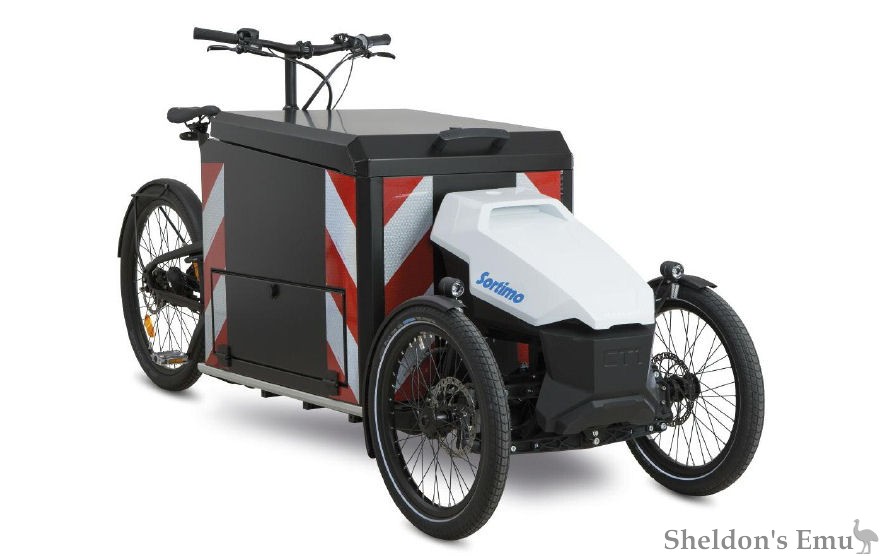
The ProCargo CT1 electric cargo tricycle was a joint venture by bicycle firm HNF Heisenberg and Sortimo.
Introduced in August 2017, production ceased around 2020.
Sources: velostrom.de, mysortimo.de.
Spindler
Kassel, 1922-25
Built lightweights using Bekamo 149cc two-stroke engines
Source: Tragatsch p276
Spiess
Manufactured by Otto Spiess in Berlin 1902 and 1907, the motorcycles had singles and twin-cylinders engines from Minerva, Zedel and Fafnir.
Source: GTU Oldtimerservice
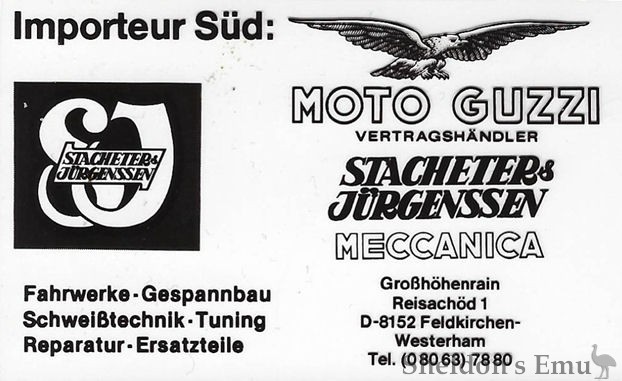
Stacheter & Jürgenssen
Thomas Stacheter and Jochen Jürgenssen were sidecar manufacturers, Moto Guzzi dealers and Armec dealers from c.1984 into the 1990s. They also built a Schwenker-Guzzi leaner outfit around 1995.
Addresses: 83620 Feldkirchen-Westerham, and Reisachöd 1, o -83620 Größhöhenrain.
Later the firm became Thomas and Markus Stacheter based in Reisachöd, specialising in Guzzi restorations for which they were highly regarded.
Sources: Gespann-Lexikon et al
Staiger 1956-1969
Standard of Lüneburg 1933
Star
The firm was established by HF Günter in Berlin, 1920, and was sold the following year to Deutsche Werke AG (D-Rad), also of Berlin.
The Star was a 391cc horizontally opposed twin.
See also D-Rad.
Source: GTU Oldtimerservice
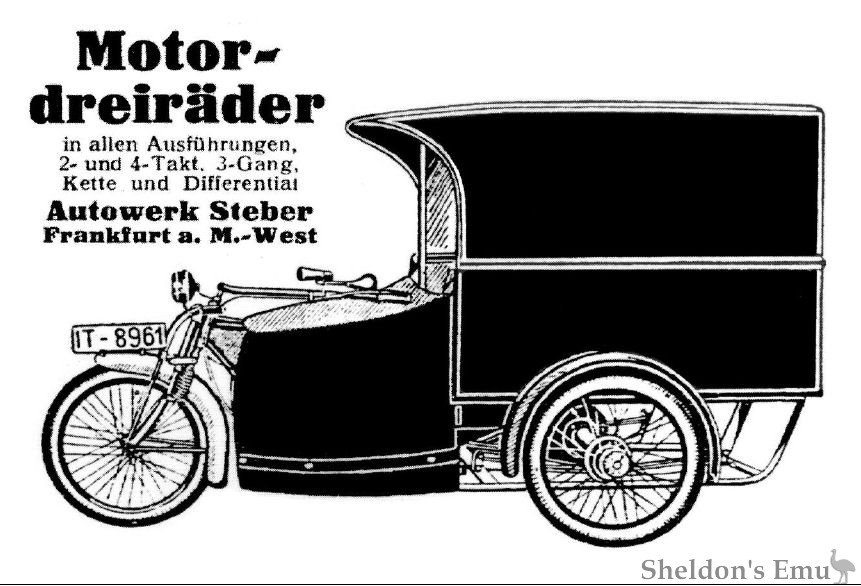
Steber
Three-wheeler deliver vans (Motor-dreiräder) built in Frankfurt 1926-1927 using two-stroke and four-stroke engines.
An obscure marque of which little is known.
Source: Axel Oskar Mathieu Archive
Steidinger 1925-27
Steido
Dobben & Steinbuß Fahrzeugbau GmbH
Bergen 11, 48465 Samern / Schüttorf
Website: steido.de
Facebook: fb.com/steidotrikes
Founded in 1990, the firm was previously known as Dobben.
Steido manufacture trikes, sidecars, and trailers. They have employed VMC and Hanningan sidecars, and have been EML importers of sidecars and trikes for over two decades. Many of their more recent offerings use Harley-Davidson for the conversions.
Sources: steido.de, et al
Steigboy 1921-1930
Steinbach
Manufactured by Franz-Josef Steinbach of Saarbrücken, 1984-1989
Known as the Steinbach-Rotax, the 500S was powered by a 504 Rotax and late in the piece the 600S with a 560cc Rotax was built. The frame was designed by Walter Baumgarten, or based on it, and closely resembled the Egli.
The FJS machines were available in race-tuned guise suitable for SOS racing.
Sources: GTU Oldtimerservice, et al.
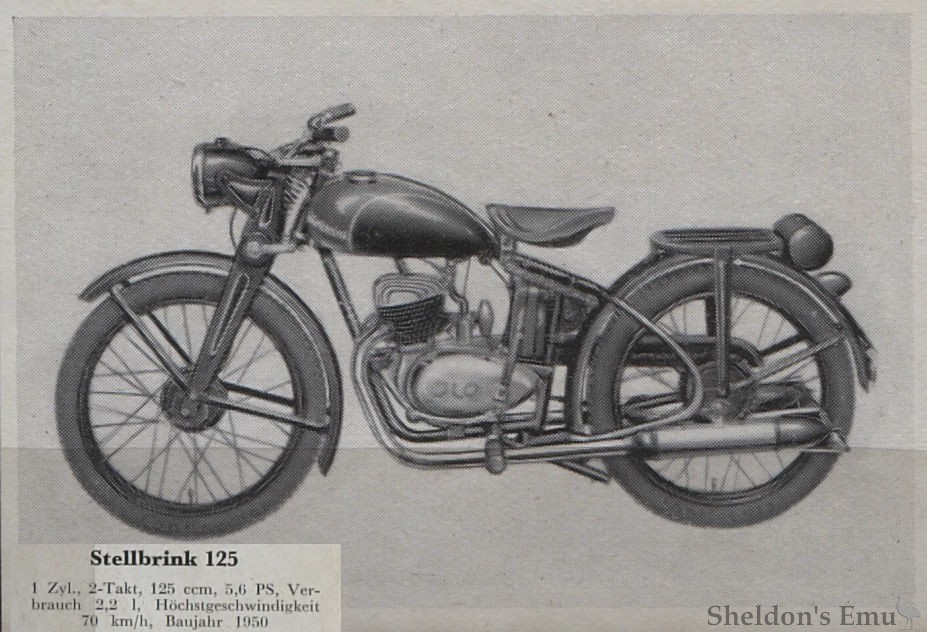
Stellbrink
Manufactured by Stellbrink Fahrradwerke of Hillegossen, near Bielefeld, 1934-1950
A limited number of Sachs-powered motorcycles were built before the war, with production resuming in 1945. Post-war models included the MF 98 with a JLO engine, and the MG 125E also with a JLO. There were also mopeds with Zundapp engines.
Sources: GTU Oldtimerservice, Moped Archive
Stemler
motorrad-stemler.de is listed as having built sidecars, but their website makes no mention of this. They are suppliers of vintage parts for BMW and many other makes.
Stemler specializes exclusively in classic sidecars, and its range is very extensive. Stemler builds various Steib reproductions... LS 200, Sport GP, TR 500. The Ural is also offered as its own design, the Klassik.
Sources: Sidecar Club Praha; motorrad-stemler.de.
Steudel 1908-1927
Sticherling
Manufactured by Kraftfahrzeugwerke W. Sticherling & Co., Engeln bei Magdeburg, 1922-1926
The firm's primary and probably only model G 26 was a fairly basic motorcycle powered by a 173cc DKW two-stroke engine, with belt drive and long footboards.
Source: GTU Oldtimerservice, Tragatsch p278, motorradphoto.de
Stock of Liepzig
Manufactured by W. Stock, Fahrzeugbau GmbH, Leipzig W33
These were commmercial three-wheelers built around 1932, believed to have been sourced from DKW and FRAMO
Source: motorräder-aus-leipzig.de
Stoewer 1904-1905
Stolco
1922-24
Manufacturer: Stollstein & Co., Stuttgart, Ostendstraße 83
Using Grade 148cc two-stroke engines they built lightweights similar to a great many others of the early 1920s.
Sources: Tragatsch p278
Stolzenberg
Sidecars manufactured by Hans Köpsel of Frankfurt in the years 1969 to 1975. Some 30 to 35 units were built. It is believed to be the first sidecar model with a boat made of GRP manufactured and registered in Germany.
Sources: motos.autos-markt.com, et al.
Stoppa Sidecars 1930-1933
Stricker 1931-1955
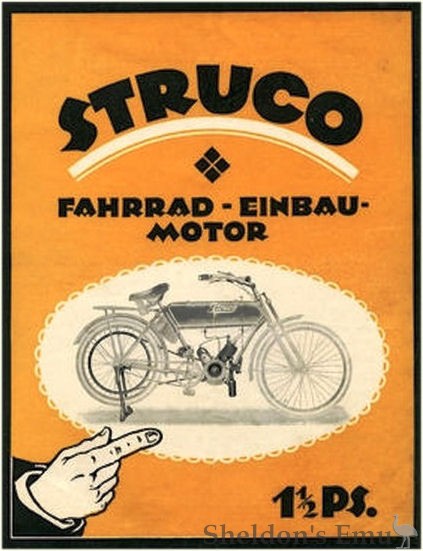
Struco
Manufactured by Struchtemeier & Co. of Bielefeld, 1921-1924
Founded in 1901 as a bicycle manufacturer, the firm built clip-on engines and powered bicycles. Their two-speed auxiliary bicycle engines drove the rear wheel via chain and were sold to many other companies in the area, among them Jean Fuchs.
Source: GTU Oldtimerservice
Stukenbrok 1914~1925
Sturm 1923-25
Sturmvogel 1907
Sudbrack 1949-1951
Superia
1925-1928
Built and raced by Adolf Kornmannn of Karlsruhe using 348cc and 498cc Kürchen ohc engines, and also a 496cc sv engine from ECE. Established endurance records with Erich Stolz as co-rider.
Source: Tragatsch p280
There was also a Superia manufactured in Belgium. See disambiguation
SUT 1921-27
Rarer German Marques