
This page lists brand names beginning with the letter "F" for which we currently have only an historical precis.
For a more complete listing visit the German Index.
Fadag 1921-25
Falke, Albert 1896-1908
Falke 1923
1923-25
Built lightweights with Grade 142cc and DKW 145cc two-stroke engines.
Source: Tragatsch p133
Falke 1950s
Seitenwagen manufactured by VEB Metallbearbeitung Falkensee Berlin, Staaken Feldstraße 7, between 1951 and 1959. Models were suitable for lightweights up to 350cc, and they also built road-racing and off-road sidecars.
Source: projekt-eindruck-le.de
Falz
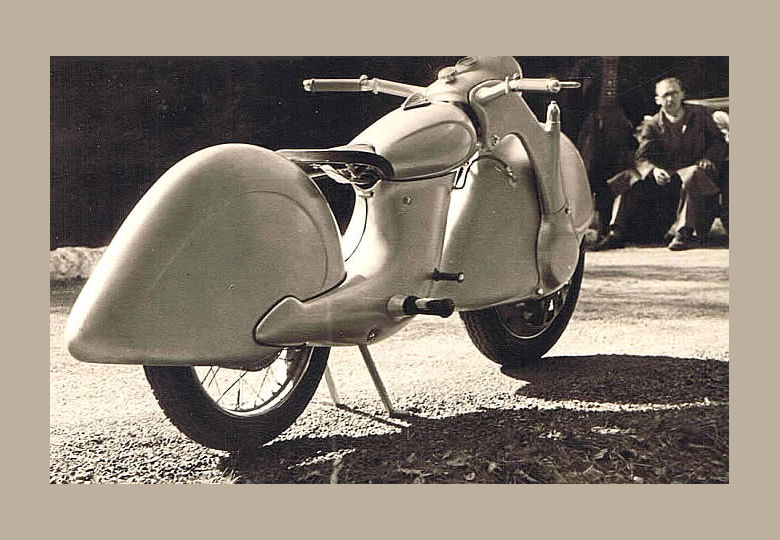
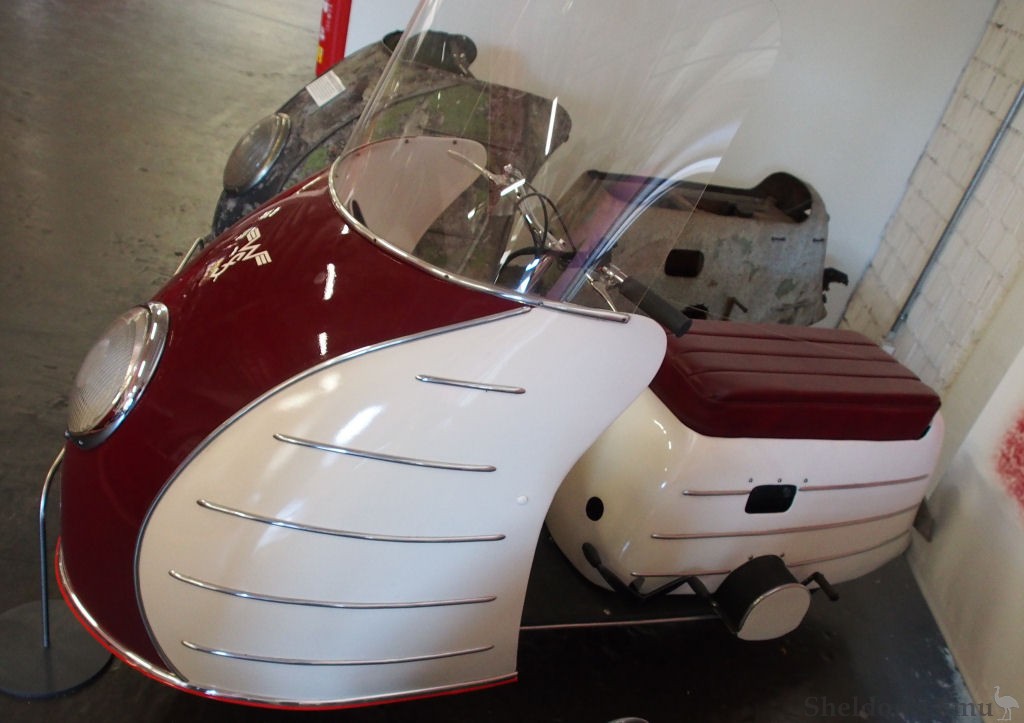
The Falz Sibylle was built by August Falz of Döbeln in the GDR, in 1954. Powered by a 175cc CZ engine, it was the fourth scooter he had built since 1950 and was intended for production, but finding a manufacturer in East Germany at that time proved difficult.
Sources: de.wikipedia.org, nl.wikipedia.org
Fama
Established with a capital of 6 trillion marks during the hyperinflation period Germany was experiencing in 1923, Fahrzeug und Motoren-Gesellschaft of Kiel-Friedrichsort manufactured motorcycles using the Fama brand. Their machines employed 190cc OHV and 420cc SV engines of their own manufacture along with two-stroke Rohöl (crude-oil) engines designed by Julius Löwy and supplied by Albertus Schweröl Einbaumotor.
Production of the Fama ceased in 1924. The company experienced numerous changes to its name, owner and board membership, and factory changed its location during this tumultuous period of German history.
Leifa
The Fama was now named Leifa, and the lightweights were built at a new location from 1924 to 1925. They continued to utilise the Löwy engine.
The firm also produced a small two-seater Rohöl-engined car which was displayed at the Leipzig Fair in early 1925.
Sources: Tragatsch p133 & p192; Wikipedia DE; allcarindex.com; Motopedia.
Famo
Famo built 127cc Fahrrad motoren - bicycle engines, 1923-1926.
See also Forster
Source: François-Marie Dumas, Tragatsch p133
Favorit 1933-1938
FB
Manufactured 1923-1925
269cc two-strokes, then JAP and Blackburne 348cc and 498cc sv and ohv models. Designed by Friedrich Benz, there were at least two models, Type I and Type II, both of 3 PS. They are also known with the Meteor brand on the tank.
Source: Tragatsch p133, motor-hist-foto.de
Fechtel
Manufactured by Heinrich Fechtel Motorradfabrik, Gütersloh, 1923-1925
The motorcycles used pressed-metal frames and Boge (or possibly Hansa) engines.
Sources: GTU Oldtimerservice, Tragatsch p134
Fels 1931~1955
FEX
1923-24
Lightweights with DKW and Bekamo engines. Initially used engines of their own manufacture but these proved unreliable.
Source: Tragatsch p134
FHG 1927-29
Fiamc
Constructed in the years 1951 to 1953
The firm built 123cc two-stroke motorcycles and scooters using the same engines
Source: Tragatsch p134
FIX
Constructed in the years 1922-1926.
Motorcycles of this name using 3hp two-stroke engines were built by Ottmar Cramer's firm, Lloyd of Bremen.
Sources: Tragatsch p135; Motopedia.
FKS 1920s and 1950s
FLH
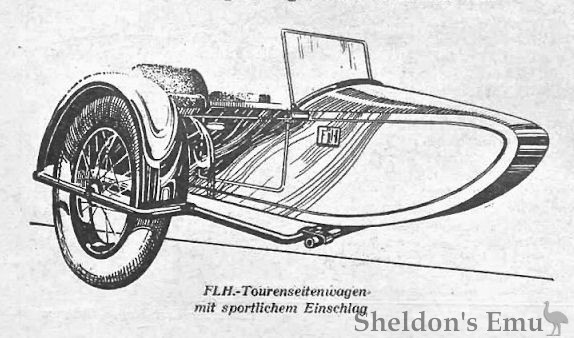
Manufactured by Fahrzeugbau Luther & Heyer GmbH, Berlin, 1922-1939.
At some point they produced an FLH motorcycle with a side-valve Bosch-Douglas engine. It had Druid-style front forks, a Burman gearbox and belt drive to the rear wheel. Few were built.
In 1927 the firm began building sidecars. That venture did not progress for long.
From the early 1930s until the war they manufactured Lastendreiräder (cargo tricycles) powered by DKW in a variety engine sizes and styles, along with trailers.
Sources: Motopedia, Automobilia 85-45.
Flink Hilfsmotor 1950s
Flux
Manufactured by Flux Kraftrad GmbH, Berlin, 1923-1924
Built a 200 cc lightweight in very small numbers.
Source: GTU Oldtimerservice
FM
Manufactured, most probably, by Ferdinand Müller of Ratingen, in 1925-1926. May have been a one-off.
The Ratingen reliability trial of 1925 250cc class was won by H. Poensgen on an FM.
Source: Motopedia
N.B. Unrelated to Ferdinand Müller of Düsseldorf (1920-1924).
Forelle
Manufactured 1955-1958
An established bicycle factory which built mopeds using Sachs and JLO engines.
Source: Tragatsch p138
Fortonia
Manufactured by Fortonia Motoren Werke GmbH, Schloss-Holte, 1924-1925
Fortonia used frames from Hofmann & Imsange of Bielefeld fitted with 226cc two-stroke engines of their own construction. The company closed, as did so many others in that year, due to hyperinflation.
Source: GTU Oldtimerservice
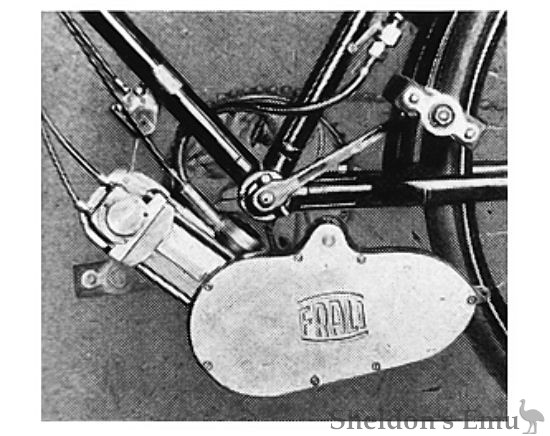
Frali
Manufactured by Franz Philipp Motorenbau, Berlin, 1951-1952
The company built a 25cc auxilliary bicycle engine with roller drive similar to that of Lohmann which although technically superior to its rivals failed to compete.
Source: GTU Oldtimerservice
Franke Autoroller
Manufactured by Walter Franke of Maschen near Hamburg in 1951.
Powered by a JLO 147cc engine which produced 7 h.p., it had a top speed of 80km/h. Some 50 of these were produced.
Sources: auto-und-uhrenwelt.de; wikipedia.
Frankonia
1923-25
DKW-powered lightweights of 145cc, and larger machines using JAP sidevalve and 350cc OHV engines. At least one was available in Damen version.
Sources: Tragatsch p139, motor-hist-foto.de.
N.B. There was an earlier firm, Frankonia-Automobilwerke
G.m.b.H., 1905-1911. Built cars, cabs and utility vehicles. ~ Axel Oskar Mathieu Archive
Freco
Manufactured in Hanover by Freco Motorradbau, Kurt Freiberg & Co., 1923 to 1925
Built a variety of motorcycles using DKW 145cc and 173cc two-strokes, Runge sv engines, and also competition machines fitted with 173 and 247cc OHV Blackburne powerplants.
As with so many other small companies, they could not survive the hyperinflation of the mid-1920s.
Sources: Tragatsch p139, et al
Freital
Manufactured by Freital-Kraftfahrzeugwerk, probably a division of the DKW factory in Zschopau, produced motorcycles using this name in 1925-1926. Models included Type BG, and Type L with a DKW Type M2 148cc engine.
These were apparently also marketed as FG and Fagard.
Sources: Tragatsch p132, p139; et al
Fagard
1923-25
Also marketed as FG, the firm built lightweights with 145cc DKW two-stroke engines.
Source: Tragatsch p132
N.B. Martin Fagard was a famous French rider closely associated wtih Sarolea. It is possible that the name of the marque was chosen for this reason.
Freia
Manufactured in Greitz, Vogtland, their first machine was a three-wheeler (Dreiradfahrzeug) with a single wheel at the rear (tadpole style) driven by a twin-cylinder two-stroke. The two-seater did not achieve success, and the firm moved on to four-wheelers until the economic crisis brought production to a standstill in 1927.
Source: Oldtimerclub Lachendorf
Frima
Manufactured by Friedrich Marquardt, of Friedberg in Bavaria, 1923-1924
Built unremarkable lightweights powered by 269cc two-stroke engines.
The Marquardt name is associated with the Mawi marque, and also with Ge-Ma-Hi. In the latter case it was Karl Heinrich Marquardt and Max
Marquardt.
The name "Frimo" was in use by VIS of Munich.
Sources: OTTW, wikipedia.de, et al
Frischauf 1928-33
FTI
Created in 1947 by French designer Louis Lepoix who later worked with many companies in Germany during reconstruction, this simply beautiful machine is based on a 750cc BMW R12.
See Louis Lepoix
FUBO
Manufactured 1923-1925
Fuchs and Börner of Falkertstraße 71, Stuttgart, built lightweights with 170cc and 269cc two-stroke engines of their own manufacture and also from Baier, and their larger motorcycles were fitted with Blackburne 247 and 347cc sv and ohv engines. There is also a listing for a machine with a 110cc Cockerell.
Sources: Tragatsch p140, motor-hist-foto.de, wirtemberg.de, et al.
Furch
1924-1925
Built light motorcycles using two-stroke engines of 1.5ps and 2.5ps. Both were tax and licence free, the larger machine having a two-speed gearbox.
Sources: das-leichtmotorrad.de, et al.
Rarer German Marques