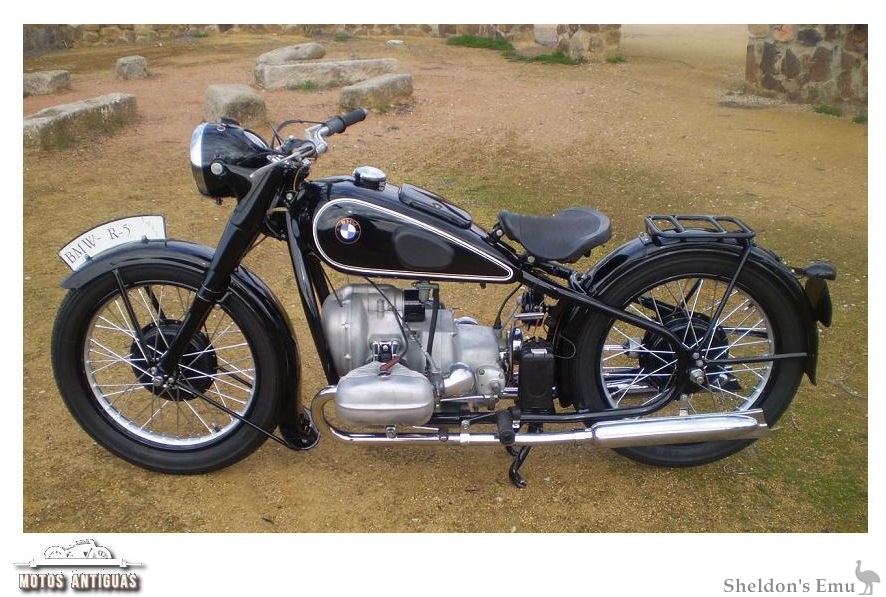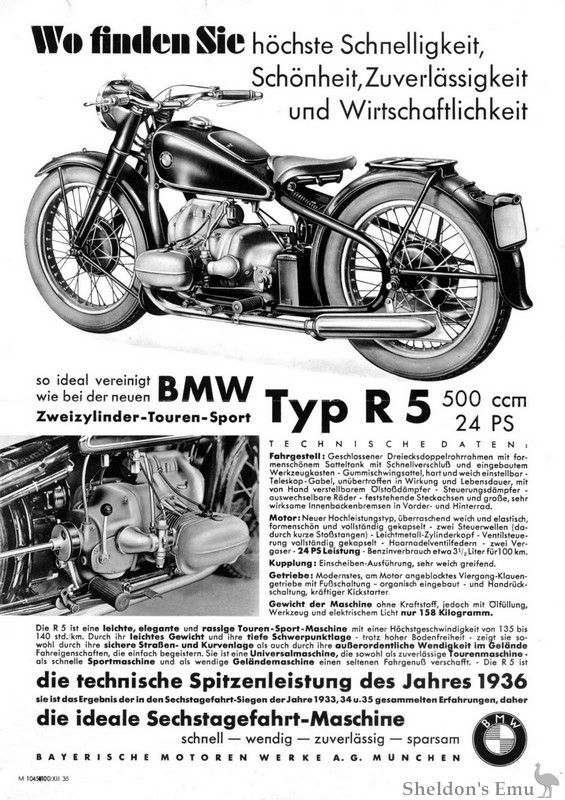

At the 1936 Berlin Motor Show BMW introduced a completely new model with considerably more power than its predecessors, achieved by employing two chain-driven camshafts which allowed much shorter pushrods to the overhead valves, with a significant increase in maximum RPM as a result.
It also used hairpin valve springs from BMW's racing machines rather than the traditional coil-type valve springs, and had more advantageous valve angles.
The newly designed engine used a tunnel-type crankcase similar to the R2 single; following the introduction of the R5, this style of crankcase became standard on all air-cooled BMW motorcycle engines.
The R5 marked a departure from the the heavy pressed-metal frame design in favour of a strengthened version of the tubular frames employed on BMW racers. The sophisticated hydraulic forks again appeared, now featuring a control for adjusting damping characteristics. The R5 still had no rear suspension, but featured the sprung saddle from the R7 concept bike. The new design retained a vestigial hand-shift lever protruding from the transmission case. Although this lever was essentially useless for anything other than finding neutral when coasting to a stop, it survived until 1955.
This was by far the most advanced motorcycle BMW had ever produced, and is considered by many to be among the finest road-going machines built during the 1930s.
The R5 engine was also used after the war, with minor changes, in the model designated R-51/2.
Source: desmodromics.co.nz via archive.org, et al