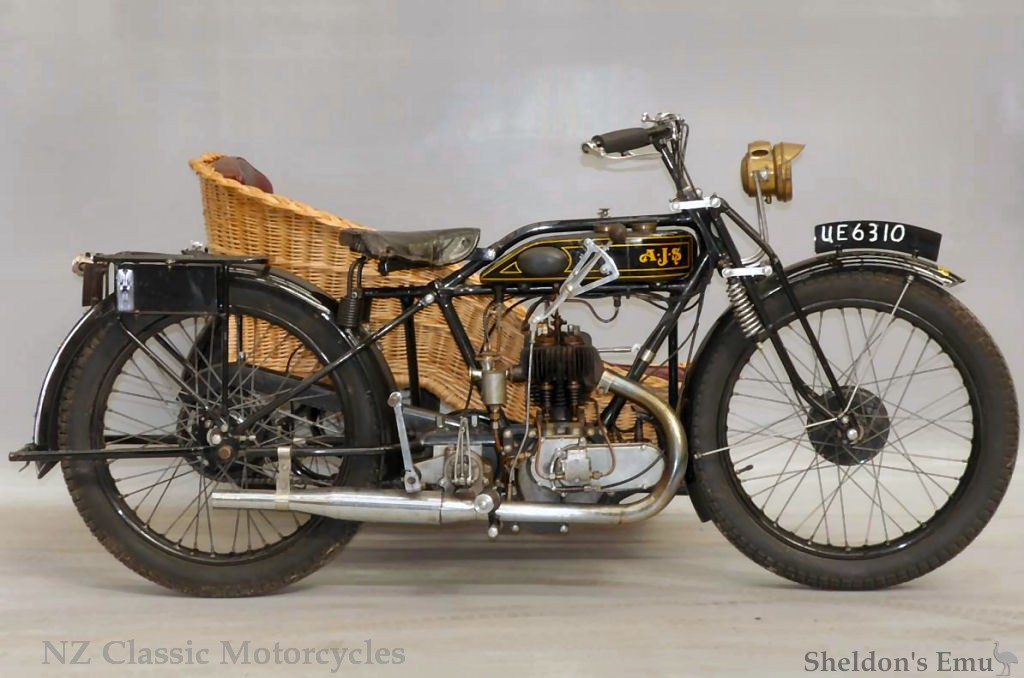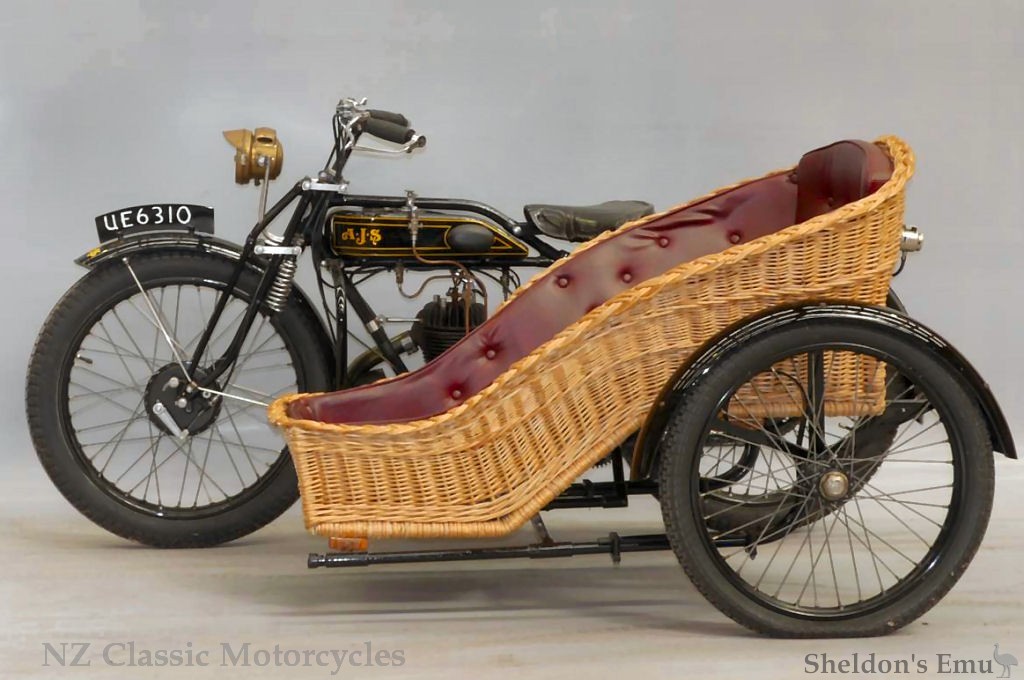
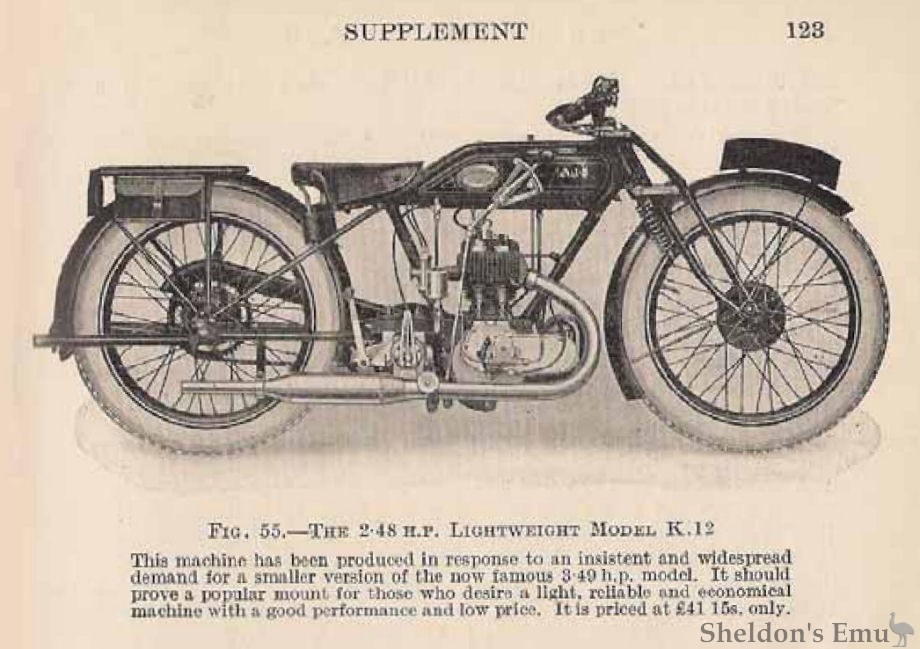
This machine has been produced in response to an insistent and widespread demand for a smaller version of the now famous 3.49 h.p. model. It should prove a popular mount for those who desire a light, reliable and economical machine with a good performance and low price. It is priced at £41 15s, only.
This newcomer to the A.J.S. range has a specification follows – as
ENGINE. A.J.S. design and manufacture. Single Cylinder (65 x 75 mm. bore and stroke, 248 c.c. capacity), fitted with detachable head, aluminium piston, roller bearing big end of connecting rod. Mechanically-operated side-by-side valves. Adjustable valve tappets. Efficient cooling. Enclosed valve lifter.
CARBURETTOR. Binks.
TANK. 1¼ gallons petrol, 3 pints oil.
LUBRICATION. Semi-automatic hand pump. (Mechanical lubrication, as illustrated, can be fitted to order at £1 extra.)
IGNITION. Lucas magneto. Handlebar control.
CHAINS. "Hans Renold," ½ in. pitch x 3/16in. wide. An efficient shock absorber is fitted to the engine shaft.
CHAIN GUARDS. Semi-enclosed type, giving easy access to the transmission.
GEAR-BOX. A.J.S. Counter-shaft three-speed gear, fitted throughout with ball bearings. Operated by an improved gate-change. Ratios 6.1, 10.3, and 15.8 to 1.
CLUTCH. Hand-controlled.
TYRES. 25 in. by 3 in. wired-on, Dunlop cord heavy non-skid.
MUDGUARDS. Improved design, affording excellent protection.
BRAKES. Front and rear internal expanding type. Rear operated by pedal on left-hand side of the machine. Front by lever on handlebar. Both are extremely powerful and smooth acting.
FORKS. Latest A.J.S. design. All links are adjustable taking up side play.
HANDLEBARS. Semi T.T. pattern.
FOOTRESTs. Adjustable, allowing the rider to procure the most suitable riding position.
STAND. Fitted to rear wheel.
TOOL CASES. Two pannier bags, with full kit of tools.
STARTING. Improved design foot-starter gives very easy starting.
SADDLE. Terry spring seat No. 2.
MEASUREMENTS. Wheel base 4 ft. 2 ¾ in. Height of saddle 26 in.
TAX. 30s.
Source: The Book of the AJS (1927-1928), by W.C. Haycraft. Pitmans.
The K12 was designed for general work and was aimed at both male and female customers, and with its light weight and low saddle position was deemed especially suitable for women.
It features total loss lubrication and a three-speed, hand-change gearbox, and although its limited power output would have provided only modest performance people had lower expectations regarding the performance of motorcycles and motor vehicles in the 1920s. Roads were mostly unsealed and rutted and the quality of petrol commonly available was not high.
Source: NZ Classic MC Museum.