
From Pitmans Book of the AJS, 1927-28.
THE 3.49 H.P. STANDARD SPORTING MODEL H5
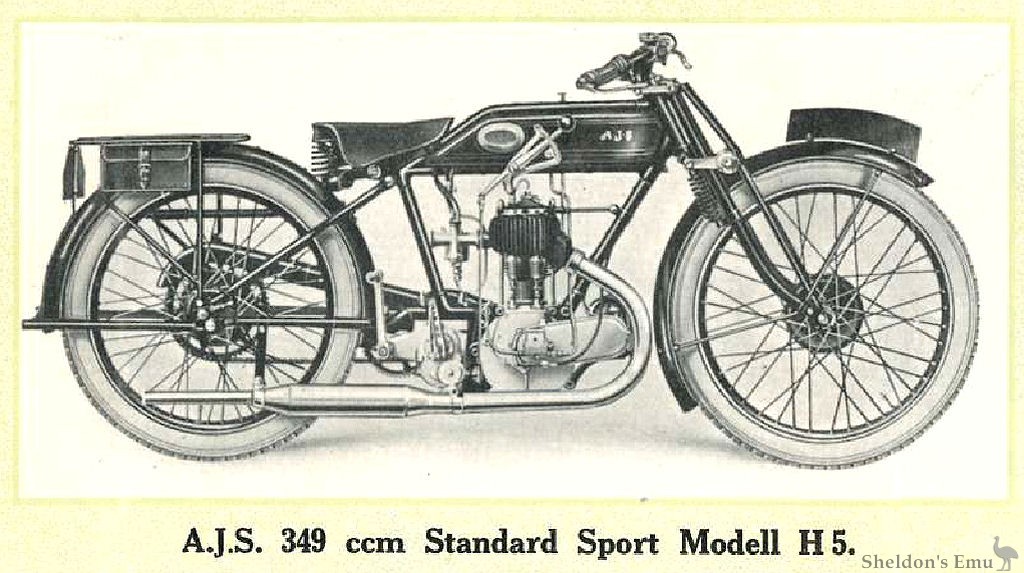
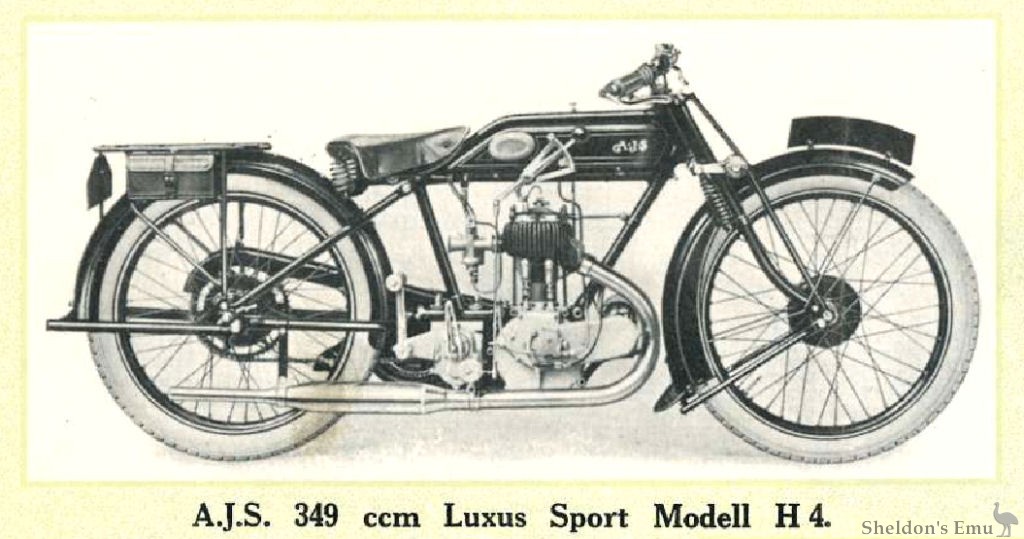
This machine (shown by Fig. 1) is probably the most popular the sports range. A very similar machine is the De Luxe Sporting Model H4 (shown by Fig. 2), fitted, unlike the H5, with mechanical lubrication and quickly detachable rear wheel. seems well advisable to pay the extra £4 10s. involved to include in the specification these items, together with other refinements. However, at the cost of £1, mechanical lubrication can be fitted to order on Model H5. Mechanical lubrication undoubtedly relieves the rider of a source of constant anxiety and annoyance; and also saves him no small amount of money in the long run on the score of economy in engine oil. Moreover, correct lubrication ensures the minimum production of carbon deposits on the cylinder head and combustion chamber, and thereby gives the maximum mileage before the rather odious, but nevertheless easy. job of decarbonization becomes necessary. This mileage should approximate 2,000. In practice, however, the owner usually "decokes" as soon as an appreciable loss of power and tendency to "knock" becomes manifest.
The Standard Sporting Model H5 is a general-purpose, medium power sports machine, capable of maintaining high average speed under normal conditions. Owing to the extremely low figure at which it is catalogued, namely, £44, it makes a very strong appeal to the man of limited means who desires a lively mount with a good all round performance. Its specification, which applies also to all the other 3:49 h.p. machines, with certain modifications, is as follows –
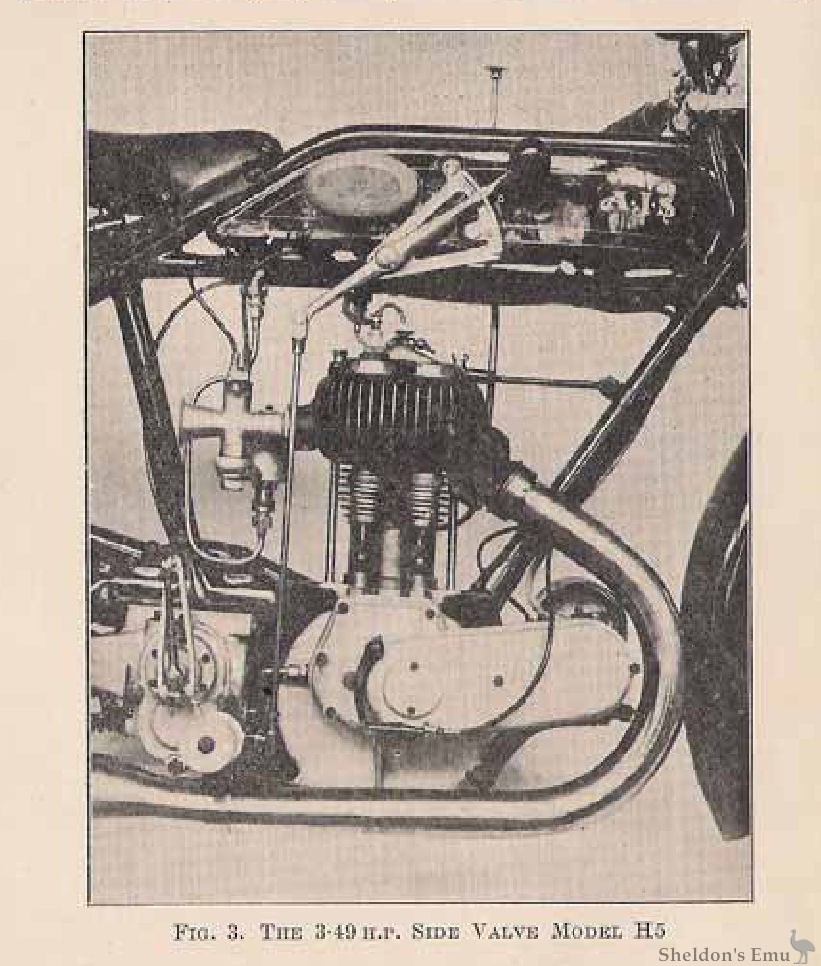
ENGINE. This, like all the other engines, is of A.J.S. design and construction. The keynote of the design is simplicity and sturdiness. It is a side valve, vertical single cylinder, four-stroke engine of 74 mm. bore, and 81 mm. stroke, giving a capacity c.c., or (according to A.C.U. rating) 3.49 h.p. A four-ring aluminium-alloy piston reciprocates in a cast-iron cylinder with vertically finned detachable head, both being held down by bridge piece and two long bolts. The head on the H5 cylinder departs from G5 (1926 model) practice in that it is provided with finned and extended exhaust port, thereby giving superior cooling; and the exhaust pipe has its connection via union nut instead of being a push-on fit (seen clearly in Fig. 3). In this head two large interchangeable and mechanically operated valves of heat-resisting alloy steel are placed side by side in deep removable guides. The large area of these valves ensures perfect charging and scavenging of the cylinder, besides giving good heat dissipation and freedom from distortion and pitting of the valves themselves. The tappets operating these valves have, of course, adjustable heads to give correct clearances of .006 in. and .008 in. in the case of the inlet and the exhaust valves respectively; and all 1927 tappet guides have external oil retaining cups in order to counteract the undue excretion of lubricating oil from these guides over the crankcase. New type valve springs are employed.
Within the cast aluminium crankcase is the crankshaft assembly, comprising two heavy rimmed cast-iron flywheels, with their main shafts running in roller bearings, and the crankpin upon which the big end roller bearing of the connecting rod is mounted.
The timing gear is extraordinarily simple, and therefore does its duty in a noiseless and trouble-free manner. It consists of the engine main shaft small pinion and two large half-time cam wheels. The cams act directly on the tappets. Tappet and valve stem centres are slightly offset, so as to produce automatic rotary movement and even wear of the surfaces in periodic contact when the engine is running.
The new type cylindrical silencer is very effective in reducing the exhaust noise, and should absolutely guarantee the rider against police prosecution for noise, which has recently become so prevalent. The principle employed consists of the use of blind ended, and drilled, extensions to the two pipes; and it is thus utterly impossible for the gases to flow straight through. This system was thoroughly tried out before being standardized for use with the H1. H5, and H6 engines, and it was found that the resultant back pressure was negligible. Both silencer and exhaust pipes are heavily plated. A union nut now replaces a clip-fastening on the induction pipe for the carburettor.
CARBURETTOR. A No. 344 Binks, 2 jet, 2 lever, semi-automatic carburettor with bottom petrol feed is fitted, and the respective jet sizes are – pilot jet, 1; main jet, 6; with spares, 0 and 5. This combination gives fierce acceleration and perfect slow running.
IGNITION. The current is generated by a H.T. Lucas, variable ignition, type K.S.A.1 magneto, chain driven off a sprocket keyed to the exhaust camshaft. The other sprocket is a push-on taper fit on the armature shaft, and has a Vernier adjustment for securing accurate timing. Actually, the flash across the plug electrodes is timed to occur in. before the top of the compression stroke, on full advance. The sparking plug used is of the single point type. The magneto is a well-protected instrument, and has, of course, a clockwise armature rotation, viewed from the contact breaker side.
LUBRICATION. This is effected by a semi-automatic handpump. Oil is pumped into the crankcase about every 5 miles. The flywheels splash it on to the cylinder walls, and oil mist also finds its way into the timing case, and thence back to the crankcase. Mechanical lubrication can be fitted to order at £1 extra (as previously indicated). The makers recommend the use of only the highest quality oil for lubrication.
FRAME AND FORKS. These two supplementary units have been designed to give, together, a wheel base of 4 ft. 5 in., and a saddle height of 28 in. Special care has been taken to ensure good general stability at speed and on treacherous road surfaces. The A.J.S. forks are of very robust construction, and efficient shock absorbers are incorporated at the forward end of the lower fork links. The links are adjustable for side play. Integral with one of the fork spindle casings are two sockets which permit of a lamp being bracketed in a very low position that greatly enhances the appearance. The diameter of the steering head has been considerably increased for 1927, and large ball bearings are included.
This produces excellent steering without looseness, and, if a proprietary steering damper were indulged in, the machine would be absolutely perfect in this respect. The forks are provided with grease-gun lubrication. The frame itself is of orthodox triangular form of high tensile steel.
GEAR-BOX. The gear-box is an A.J.S. countershaft three-speed gear, fitted throughout with ball bearings, and is standard for all models. It is operated by a right-hand gate change lever, affixed to the tank (as shown in Fig. 3); and it gives gear ratios of 5.5. 9.3, and 14 to 1. A close ratio gear-box can be had if desired.
Intermediate gear is by pinion engagement, and the remainder by dog clutch engagement. Moving the lever forward from rear to front position, the consecutive gears engaged are – low: neutral; middle; top. On to an extension of the new splined main shaft, which has a redesigned thrust bearing on the driving side, are fitted two sprockets – one small and one large for primary and secondary drive, respectively. The larger sprocket, incidentally, is part of the clutch (actually the teeth are on the periphery of the centre disc), which is of the multiple plate and cork insert type, and has handlebar control on the left-hand side. Adjacent to the clutch and pegged to the outside clutch plate is a ratchet wheel with which the kick-starter quadrant engages. The kick-starter lever (seen in Fig. 1) is in a position such that ample leverage can be exerted upon it with the foot while astride the saddle. Only a high grade oil made by a firm of repute should be used for gear-box lubrication, and the oil level is indicated by a small shutter on the side of gear-box.
TRANSMISSION. Both primary and secondary drive is by substantial in. pitch by in. wide Hans Reynold roller chain. The chain of the former is covered by a guard, while that of the latter has a protecting guard on the upper half only, gives easy access to the chain for inspection and lubrication purposes. These guards are designed to protect both rider and chains from dirt.
An efficient shock absorber on the engine mainshaft allows the power to be absorbed gradually, and thereby eliminates" snatch," which soon ruins any chain. As things stand, it is a very rare occurrence for a properly tensioned and lubricated chain to break the road. The chain wears out completely long before this happens. on
BRAKES, WHEELS, AND TYRES. Large diameter, internal expanding, brakes are fitted to both front and rear wheels, which are tyred with 26 in. by 2.375 in., wired-on, heavy type non-skid Dunlops with Schrader valves. The rear brake is operated by a foot pedal on the left-hand side; and the front brake is controlled by a handlebar lever on the same side. Both brakes are very smooth and powerful in action.
TANK. A handsome, black enameled, and bulbous nosed tank is secured by two tank straps to the bottom frame tube, and has a capacity of 13 gallons of petrol and 1 quart of oil. The filler caps are of large screw-on type. On to two special tank projections are rigidly attached good quality rubber knee-grips.
MISCELLANEOUS DETAILS. The semi-"T.T." racing type handlebars have celluloid grips; and just below the gear-box are two rubber footrests, adjustable for position. This combination gives a very comfortable and natural riding position. The saddle itself is a Terry Spring Seat No. 3. Non-valenced racing mudguards are fitted. Over the rear mudguard is a strong carrier capable of safely supporting a passenger; but it is not exactly flapper-bracket (to use the latest newspaper description of pillion seat); it is really intended for luggage. At its sides are secured two pannier bags with a full kit of tools. A rear kick-up stand only is fitted. The general finish, including the handlebars, is black enamel on a special anti-rust process. The usual parts are all heavily plated. All oil and petrol cocks are of the quick action, push type.
Electric lighting can be fitted to order at £6 15s. solo, and at £7 5s. extra for a combination. This applies to all A.J.S. mounts.
WEIGHT. Approximately 210 lb.
MAXIMUM SPEED. Approximately 60 m.p.h.
THE 3.49 H.P. DE LUXE SPORTING MODEL H4
The specification of this machine is identical to that of model H5, other than the following -
The engine is specially tuned, and mechanical lubrication fitted in place of the hand pump; the rear wheel is quickly detachable; better type valenced mudguards and saddle are provided; there are stands for both front and rear wheels.
THE 3.49 H.P. OVERHEAD VALVE SPORTING MODEL H6
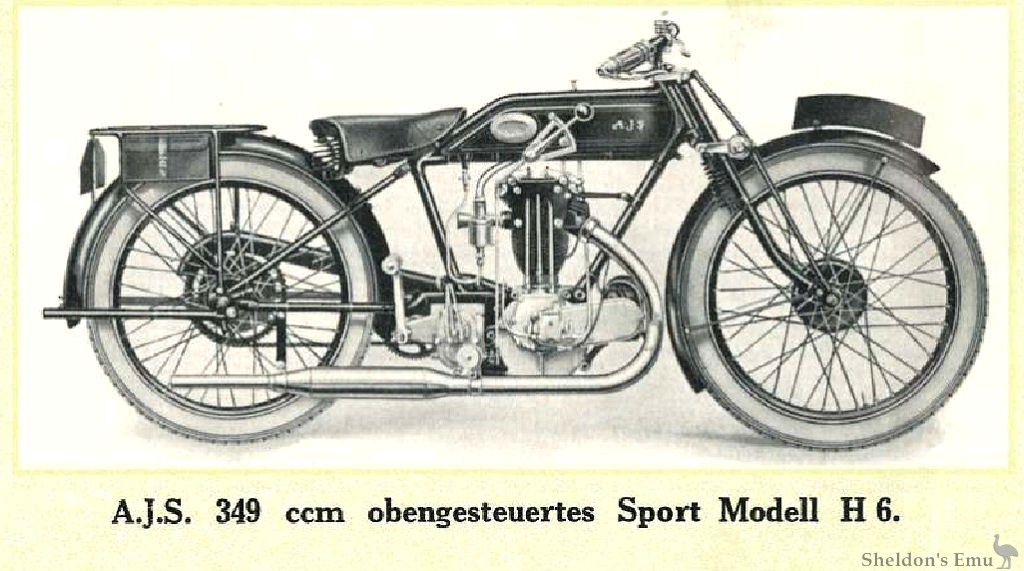
Next in order of popularity is the O.H.V. 349 c.c. Model (see Fig. 4). This machine, which is a fast mount possessing an admirable competition record, embodies all those improvements incorporated on the 1927 Model H4. It is, in fact, a replica of this mount with certain important modifications.
ENGINE. The power unit is of the overhead valve type. Two large diameter, alloy steel, tulip valves, hollowed out for lightness. are symmetrically placed at 824 to each other in the detachable cylinder head so that, when seated, their heads are roughly flush with the walls of the hemispherical combustion chamber; slightly in front, on the left-hand side of the cylinder, is a sparking plug with its electrode points pocketed within the chamber. This arrangement is ideal, having regard to instantaneous combustion, good cylinder charging and exhaustion, and last, but by no means least, good turbulence.
The valves are operated by polished duralumin rockers, mounted on the spindles between the two massive steel rocker plates, and carrying at their extremities grub screws and lock-nuts, which enable tappet adjustment to be effected at the top of the push rods, instead of at the bottom, as previously. The cylinder holding down bolts are in a position different from that of the S.V. cylinder retaining bolts (as may be seen by comparing Fig. 3 with Fig. 5, which shows the 3.49 O.H.V. engine). Clearance between inlet valve and rocker is .006 in., and the exhaust valve clearance is .008 in. Grease gun lubrication is provided for these rockers, which have large area plain bearings. The crankcase valve actuating mechanism is, of course, the same as on the H4 engine. The valve springs are noteworthy, being of the two-in-one variety. The valve movement slightly overlaps the piston stroke, and in consequence two small segments are cut out of the piston head dome to prevent fouling of the valves.
The piston is of aluminium alloy, and has four narrow width rings, the bottom ring being primarily designed to prevent ingress of oil into the combustion chamber. The gudgeon pin is hollow, and is secured in position by two small springs. This piston, unlike many of its type, does not suffer from that distressing malady, " piston slap." An alternative high compression piston can be obtained from the makers by those desiring to get the last ounce out of the engine for racing purposes. The magneto is a Lucas type K.L.1. Ignition timing is 9/16 in. before T.D.C. on full advance.
CARBURETTOR. The carburettor is a No. 448 Binks, 2 jet, 2 lever, semi-automatic model with bottom petrol feed and twist grip control.
GEAR-BOX. This is a close ratio type of gear-box giving ratios of 5.52, 6.8, and 10.3 to 1, with a 21-tooth sprocket; but a wide ratio type of box may be had if required.
Beyond the fact that mudguards are of the racing pattern, Model H6 does not further differ materially from Model H4 in specification.
WEIGHT. About 220 lb.
MAXIMUM SPEED. Close on 70 m.p.h.
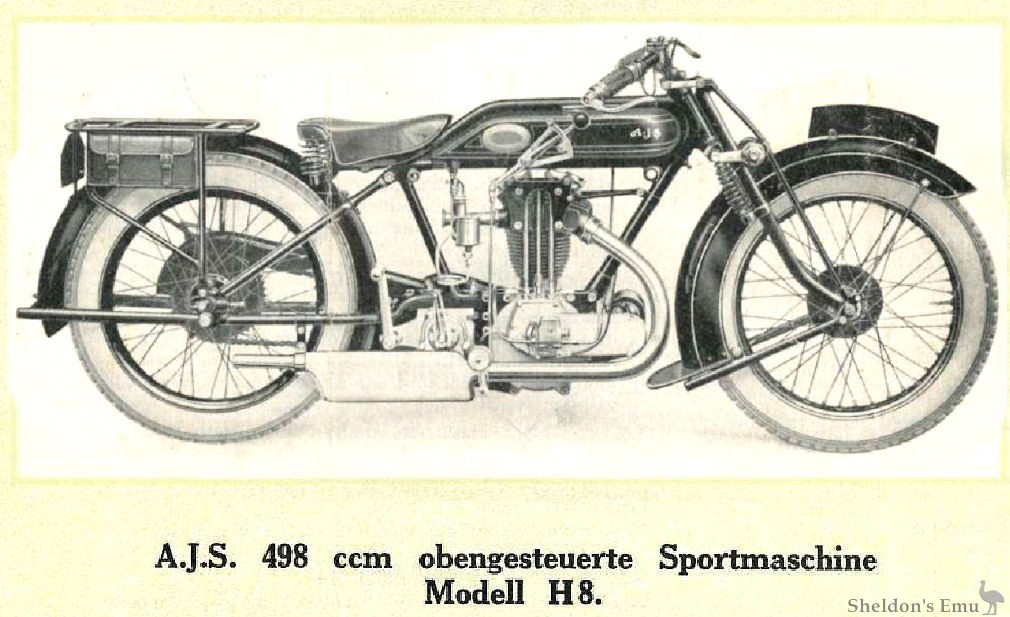
THE 4:98 H.P. OVERHEAD VALVE MODEL H8 (Fig. 6)
This machine is the last of the sports range. Owing to its great speed and immense power reserve, this model essentially belongs to the sports class; but it is not, however, a pure sports mount. It is rather a dual purpose machine suitable also for long distance high speed touring. To this end ample mudguarding is provided. A racing version of this machine, the H10 (as previously mentioned), is obtainable. A Mr. Karmody, on one these machines, attained a speed of 93 m.p.h. on the Mourabra [sic] Speedway, Sydney, New South Wales, on 6th February, 1926.
Model H8 has a wheel-base slightly greater than that of any of the models hitherto described. It is 4 ft. 8 in. The saddle height remains unaltered, namely, 28 in., while the ground clearance is 4½ in. 1927 modifications to this mount, which was introduced in 1926, include larger sized tyres (26 in. by 3.25 in.), strengthened forks, the substitution of a gate change speed lever for the bell crank system previously employed, valve clearance adjustment at upper ends of push-rods instead of at lower ends, new type of engine bearings, and a splined main shaft and redesigned thrust bearing in the gear-box. These gear-box improvements apply to all models.
ENGINE. The general lay-out of this engine, which has performed so creditably in the Tourist Trophy Races, is similar to that of the 3.49 h.p. O.H.V. engine; some parts are actually interchangeable, chief among which are valves, valve actuating mechanism, magneto drive and main shafts. It is of 84 by 90 mm. bore and stroke, giving 498 c.c. capacity. Like Model H6 engine, it is fitted with a detachable cylinder head, enclosed valve lifter mechanism, an aluminium alloy piston with non-segmented dome, and compound type valve springs. The correct valve clearance is .006 in. for the inlet, and .008 in. for the exhaust valve, and the ignition advance, 7/16 in. before T.D.C. The big end bearing, having regard to the high stresses that it can be subjected under full throttle on this machine, is of compound type. large box type of silencer is fitted in the same position as cylindrical ones on the 3.49 h.p. models. The plated exhaust system is thus very imposing.
LUBRICATION. A Pilgrim, type "F" sight mechanical oil pump, supplemented by an auxiliary hand-pump, is provided.
GEAR-BOX AND TRANSMISSION. The gear-box, of the same type as mounted on all the other machines, gives ratios of 4.6, 8.4. and 15 to 1. A close ratio gear-box may be fitted as an alternative. Transmission is by 5/8 in. pitch by 3/8 in. wide, Hans Reynold chains.
FRAME AND TANK. The frame is of best quality steel tubing, scientifically constructed, with sidecar lugs integral. The tank holds 1 gallons of petrol, and 3 pints of oil. The remainder of the equipment specification is identical with that of the 3.49 h.p. O.H.V. model.
WEIGHT. Approximately 274 lb.
MAXIMUM SPEED. Roughly 70 to 75 m.p.h
THE TOURING MODELS
These are models H3, H9, H2, and H1, and their respective prices are, £48 10s., £ 56, £80, and £95. The first two are solo mounts, while the remainder are twin cylinder sidecar outfits. Besides these combinations there are listed several attractive sporting and touring sidecars that may be attached to any of the A.J.S. models, and some that can be fitted to certain models only. We will deal briefly with the solo mounts first, and the sidecars afterwards in the above-placed order.
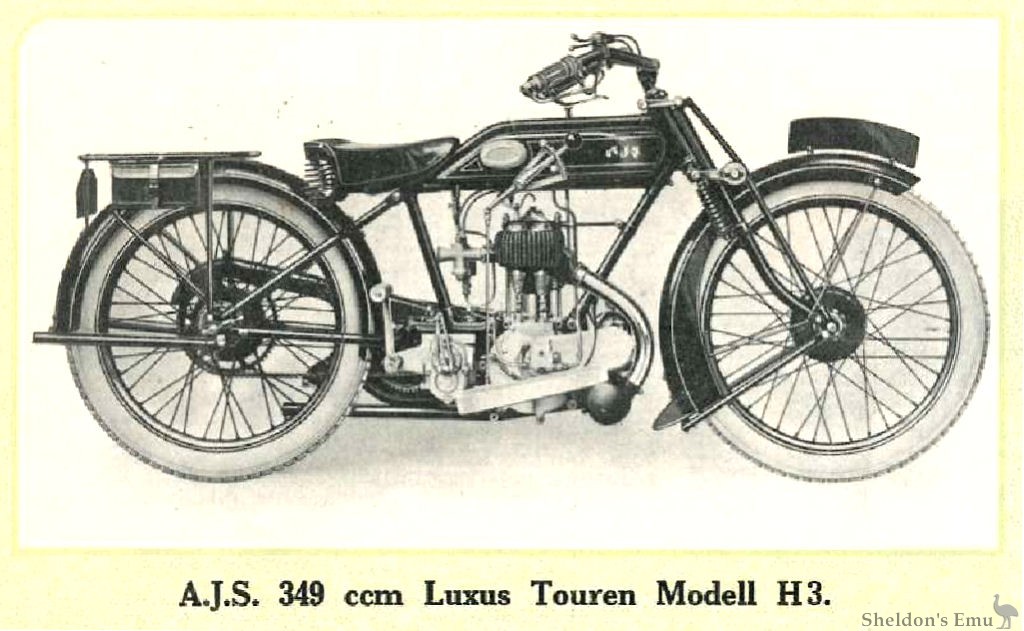
The 3:49 h.p. De Luxe Touring Model H3.
This machine (shown in fig. 7) differs from the De Luxe Sporting Model H4 only in that the engine is not specially tuned for speed; footboards replace footrests; touring pattern handle-bars are fitted; the silencer is fitted in front of the engine.
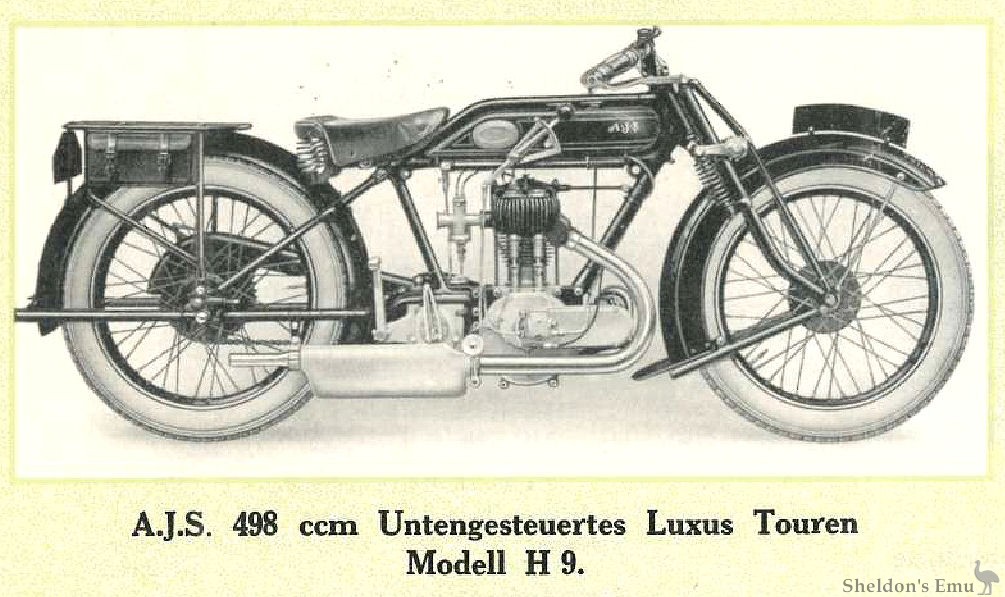
The 4.98 h.p. De Luxe Touring Model H9 (Fig. 8).
This 4.98 h.p. S.V. model. which made its debut at Olympia in 1926, is exactly the same as the 4.98 h.p. O.H.V. model with the overhead valve mechanism replaced by side valves. Thus marketed, Model H9 has exactly the same weight as Model H8, while the former cheaper than the latter by £6 10s. The speed of the S.V. machine is appreciably lower than that of the O.H.V. machine (which is best described as concentrated "pep"), but its performance is, nevertheless, very remarkable.
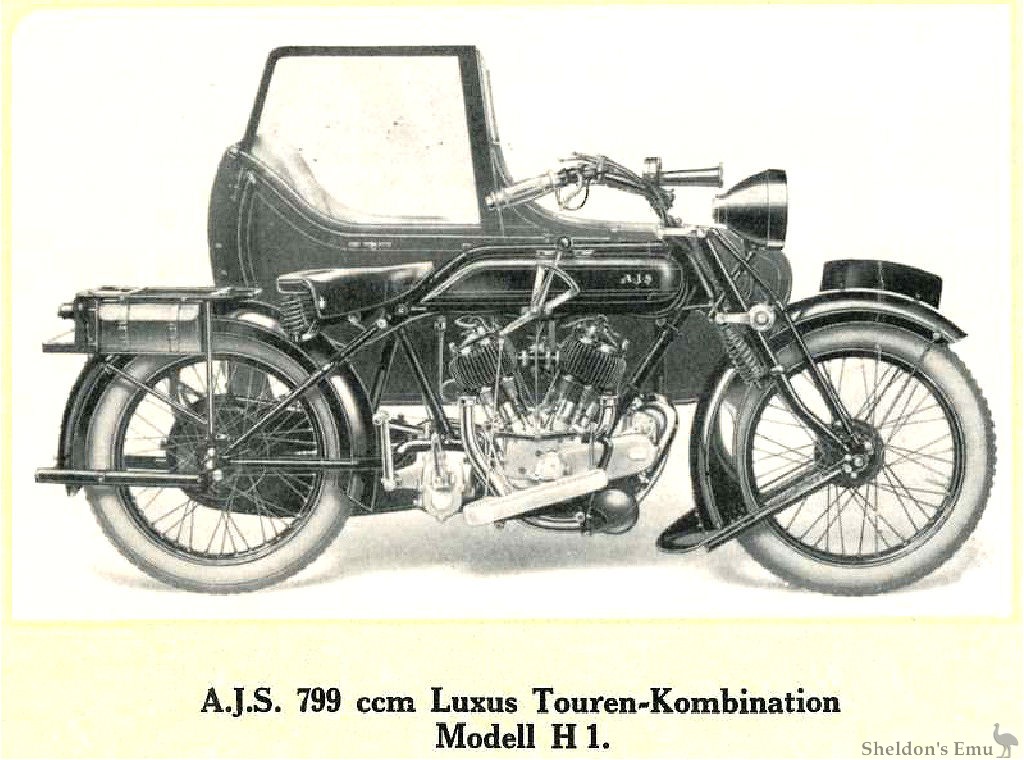
THE 7.99 H.P. DE LUXE PASSENGER COMBINATION MODEL H1
This combination, a luxurious outfit (shown in Fig. 9), should satisfy, not the man who wants room for an occasional"flapper," but the man whose "flapper" has " come to stay" – in other words, the family man. Owing to its high horse-power and low bottom gear, this machine is capable of going practically anywhere. At the same time it has a good turn of speed. Comfort and reliability have been taken as the primary considerations in design. The "Vee" twin cylinder engine, which provides the motive power, is fitted to this model and the standard passenger combination model 12 alone. This engine closely follows general A.J.S. practice, but it has several noteworthy features. The specification is as follows –
ENGINE. Rated at 7.99 h.p., this S.V. engine, with cylinders placed at 50° to each other, and provided with detachable heads, has a 74 mm. bore and 93 mm. stroke. The cylinders, of similar type to those fitted on the small S.V. engines, have a common induction manifold to which the carburettor is attached. They are held down in position in a very neat manner by three bolts, one of which is a compound bolt of" Vee" form (clearly shown in Fig. 10), and two bridge-pieces. Cylinder gaskets are fitted to this engine alone. Pistons are of aluminium alloy and valves are of standard pattern, having clearances of 006 and .008 in the case of the inlet and exhaust valves respectively. Ignition timing 3/8 in. before T.D.C. on full advance. The connecting rods, to which the pistons are attached, are mounted independently, side by side, on the crankpin. There is no fork-ended master connecting rod (see Fig. 32). This is rather unorthodox practice; but results have justified its adoption. Roller bearings are fitted to connecting rods big ends and main shafts. The valve timing gear comprises the small main shaft pinion, two half-time exhaust camwheels driven off the same, and a double inlet cam wheel driven off the front exhaust cam wheel. One toggle only is used, this being interposed between the double cam wheel and front inlet tappet. On this engine, owing to the increased load on the drive, the "Magdyno" sprocket is keyed to the armature shaft; on all the others it is a friction fit. The other sprocket is splined to the exhaust camshaft. A large cylindrical silencer is fitted below the magneto platform. All external engine details are well illustrated by Fig. 10.
CARBURETTOR. This is a No. 426 Binks. Jet sizes – pilot jet, 2; main jet, 6; spares, 0, 2, and 5.
IGNITION. Lucas magneto with Vernier timing adjustment. Lodge H.C.1 sparking plugs.
LUBRICATION. Pilgrim mechanical oil pump with sight feed, and auxiliary hand pump.
TRANSMISSION. 5/8in. pitch by ¾in. wide, Hans Reynold chain, totally-enclosed chain cases, shock absorber on engine mainshaft.
CLUTCH AND GEAR-BOX. The clutch is of the multiple plate and cork insert type, hand controlled. Gear-box is a three-speed bottom bracket type with ratios of 5, 9, and 16 to 1.
WHEELS, TYRES, AND BRAKES. All three wheels quickly detachable and interchangeable, with 26 in. by 3.25 in. wired on, heavy type, non-skid Dunlop cord tyres. Brakes of internal expanding type Both brakes are operated by foot pedals situated on the left and right-hand sides respectively, that on the left controlling the rear.
TANK. This has capacity for 2 gallons of petrol and 1 quart of oil. Petrol injectors to cylinders.
MUDGUARDS. Well valenced and fitted with drip channels. Rear: 7 in. wide.
MISCELLANEOUS. Included in specification are – Terry Spring Seat No. 3 De Luxe, rubber foot rests with deep tread and heel rest, stands to front and rear wheels, and a complete set of tools.
WEIGHT. Approximately 336 1b.
Here is the sidecar specification
BODY. Constructed of steel paneling and beautifully upholstered. Seat and back fitted with springs. Standard equipment includes windscreen, sidescreens, storm proof apron and luggage carrier.
CHASSIS AND SUSPENSION. Special underslung type chassis duplex axle tubes. Back and front are laminated "Cee" leaf springs. with
COLOUR. Black. No deviation from this colour.
FURTHER PASSENGER MODELS
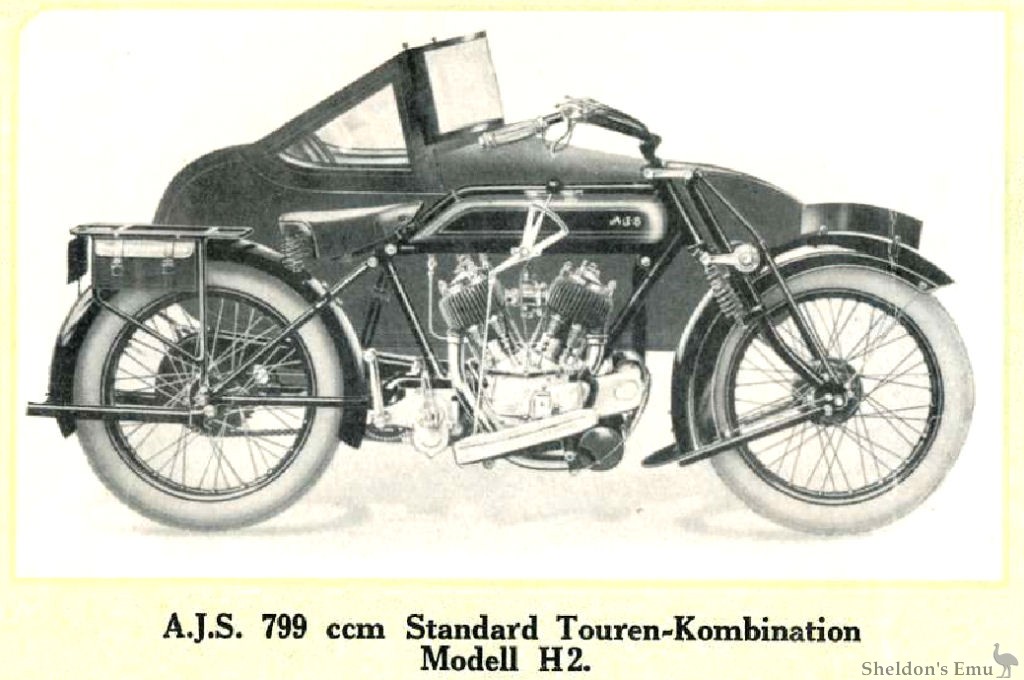
The 7.99 h.p. Standard Passenger Combination, Model H2.
This machine, which sells £15 cheaper than Model H1, is a less luxuriously equipped edition of the same machine. It has no lighting set, and no electric horn. Only the motor-cycle wheels are interchangeable and quickly detachable. The above are the principal points on which the specification differs from that of the previously described machine. Model H2 (which is illustrated by Fig. 11) weighs 316 lb. The maximum speed of both machines is approximately m.p.h.