

Albion Gearboxes

Albion gearboxes were fitted to AJW, Bianchi, Calthorpe, Coventry-Eagle, Excelsior, Francis-Barnett, Greeves, MM, Pen-Nib, Rex-Acme, Royal Ruby, Royal Enfield and many others.
Bozier gearboxes were fitted to veteran French machines including the 1906 David, and to early Enfields.
Brown and Hingston
Built by R. T. Shelley, a company owned by Bob Shelley who was instrumental in the founding of Norton Motors.
Brown and Hingston Improved Two-speed Gear.
This gear was shown at the 1910 Olympia Motor Cycle Show, and has this year been undergoing tests and alterations, with the result that Messrs. R. T. Shelley, Ltd., have laid down a plant for its manufacture in the improved form.
The gear is a somewhat unusual type of epicyclic. The belt rim drum B is driven by the engine, and the power is conveyed to the hub-shell through the expanding clutch I (shown best in fig. 3), normally held in engagement by springs V acting through toggles W. When this clutch is expanded it locks the drum B direct to the hub shell, thus giving a direct drive without passing through gears. On moving the lever P the cone T is caused by a cam action to slide along the spindle L, thus, through rollers U. forcing apart the toggle levers W and causing the clutch I to contract. This gives the neutral position. To bring the low gear into action a fibre-faced brake band is contracted on the drum K, thus preventing the pinion J from revolving. The low gear works as follows: the eccentric portion D, which is driven by the belt rim, carries round with it the internally-toothed ring G, This ring, which is in engagement with the locked pinion J, consequently rolls round the pinion in the same direction as D, and since the internally-toothed ring has twice the number of teeth possessed by the pinion, it revolves at half the speed of the belt rim B, and as the forward movement of G is transmitted to the hub shell A by small cranks H, the shell A is driven at half the speed of the belt rim B. The hub spindle is prevented from turning by the end being squared to fit a slotted fork end.
The clutch can be adjusted by turning the screw M. which actuates a micrometer adjustment, so allowing for any wear on the fibre clutch segments. The screw-driver is inserted through a hole in the hub-shell, which is capped. The hub must, of course, be turned until the head of the screw comes opposite the hole in the hub-shell.
An important feature is that the engine may be started by pedalling with the gear in neutral. It will be noted that there are only two gear wheels in the construction of this hub gear.
1911 Olympia Show - The Motor Cycle October 26th, 1911. Page 1128
Burman Gearboxes were fitted to a good many marques built in Britain, continental Europe, Australia and elsewhere.
Campbell three speed gearboxes were fitted to Pierton motorcycles and to the Automoto AL9.
Cedos of Northampton built their own gearboxes.
Dugdale
A COUNTER-SHAFT VARIABLE BELT GEAR.
We have been favoured with a description of a counter-shaft variable belt gear, invented and made by Mr. L. Dugdale, 96, Dall Street, Burnley.
A is the pulley which runs on ball bearings on the stud E, carried by the actuating rod B. This rod can be fixed at its lower extremity to the bottom bracket or to a lug brazed on to the frame.
DD at the fixed flanges, and C the movable flange which is made to slide but not to turn upon A. The pulley is shown in its low gear position. It will be noticed that as the lever H is moved backwards the change in belt tension will cause the flange C to move to the left, thus raising tha gear both from engine to counter-shaft and from counter-shaft to back wheel. No jockey pulley is needed, as the movement of the lever B does not affect belt tension. Mr. Dugdale says that he does nut find the belts slip, and that the gear does all he claims for it. He makes it to give six speeds, the lever B being held in six positions by slots in the quadrant F. It is obvious that quite a low gear is attainable with the usual engine pulley.
1911 Olympia Show - The Motor Cycle October 12th, 1911. Page 1069.
Hermes-Getriebebau
Hermes-Getriebebau of Wuppertal built gearboxes which were fitted to 1935 Ardie 505, 1920s Tornax and TWN Triumph, amongst others.
Hurth of Germany built gearboxes used by many manufacturers, among them Hiekel, Zeus, Zehnder, Imperia and Standard.
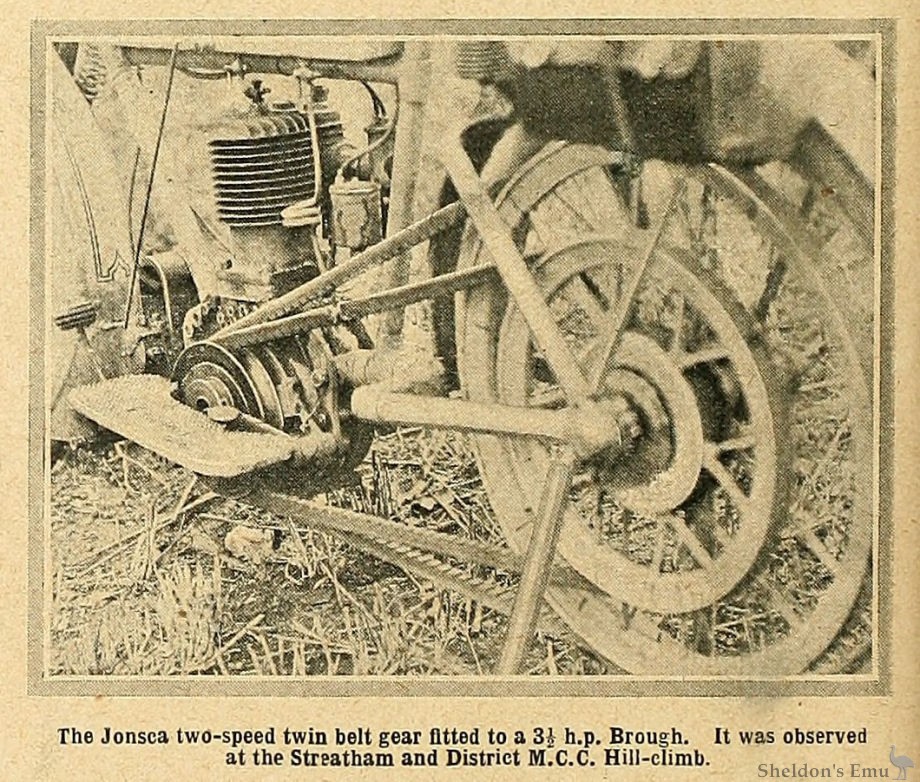
Jonsca
The Jonsca Two-speed Gear.
This gear, which was seen fitted to a 3½ h.p. Brough at the Brasted Hill-climb, consists of a double belt drive in combination with a selective clutch in the back hub. The pulleys are geared down at the engine-shaft to enable them to give a low gear and yet be of large diameter. The selective clutches, which are of the expanding type, are operated by pedals, and bring the required belt rim into connection with the back wheel, the other running loosely. One of the advantages of this gear is that practically any ratios can easily be obtained. Both gears are, of course, equally direct. Mr. John Scarborough, the inventor, also has a very simple starting device on the lines of a spring steel tape.
1911 Olympia Show - The Motor Cycle October 5th, 1911. Page 1044
Juckes engines and gearboxes, Wolverhamption 1902-1925
LMC gearboxes by Lloyd Motor Engineering of Birmingham.
Moss Gearboxes were fitted to the New Hudson 1932 350cc, and to the Ruby of Manchester.
Nexus
Believed to have been manufactured in Adelaide c.1910-1920, the Nexus 3-speed countershaft gearbox was derived from the Sturmey Archer CS gearbox of 1914. A.N.A. Motorcycles of Victoria employed this gearbox on some models.
Source: Robert Saward
Pullin of London built a 2-speed gearbox.
Royal Enfield built gearboxes in the early years.
Sarolea made its own gearboxes from 1927 on.
Staub Gearboxes
French; also manufactured engines.
Sturmey-Archer Engines and Gearboxes
Sunbeam of Wolverhampton built their own gearboxes.
Thornton
Another Two-speed Hub Gear.
The broad principle claimed for the Thornton two-speed hub is that a free engine can be obtained without disturbing the mechanism which operates the high or low gear. The clutch consists of a phosphor bronze ring D which is split and engages the hub shell H by means of cone E. pinion carrier C and lever F2 working on spiral F1. The normal ratio is obtained by locking gear wheel B to the belt hub K through the intermediary of clutch D and pinion carrier C, the gear wheel B being locked to the carrier by four pegs or keys. The low gear position is arrived at by sliding B along the shaft until it engages with pegs or keys L. the reduction in gear being effected through pinions J. On the underside of G is attached the free engine mechanism. This consists of teeth cut on plate G engaging with corresponding indentations on D and C; when the clutch ring is contracted the engine can be pedalled with rear wheel resting on the ground with either high or low gear engaged. The makers, W. J. Glover and Co., 32 King Street, Leicester, claim that the gear is absolutely proof against damage through bad handling.
1911 Olympia Show - The Motor Cycle November 2nd, 1911. Page 1157
Velocette employed numerous gearboxes of their own construction.
If you have information or a query about a Motorcycle Gearboxes not yet listed, please contact us