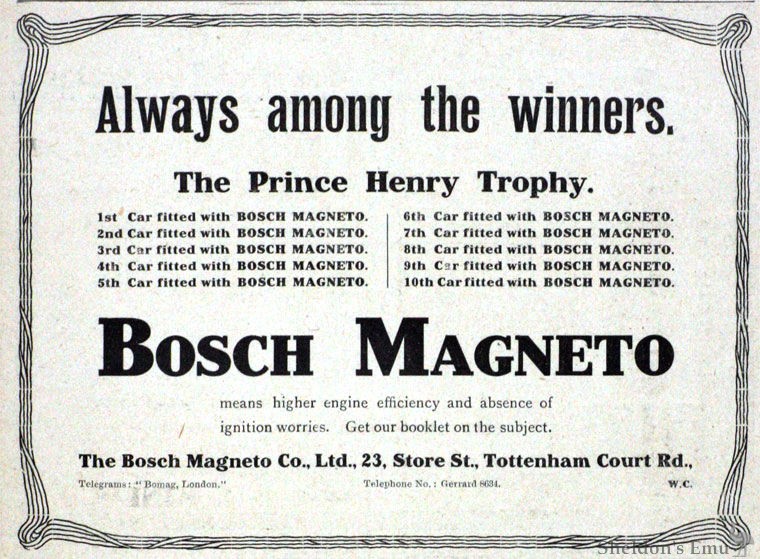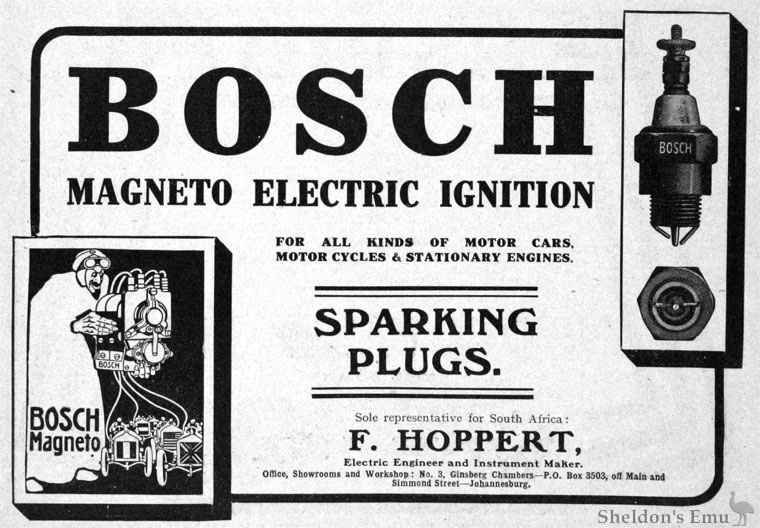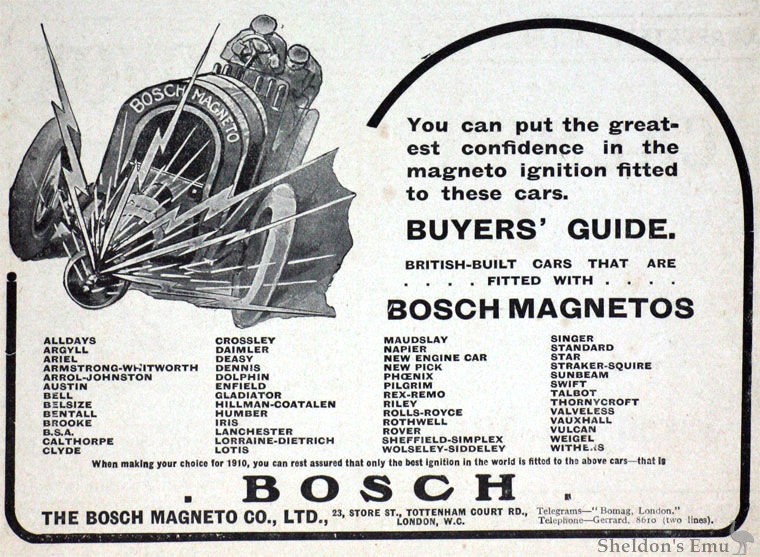


Bosch UK of 40 and 42 Newman Street, Oxford Street, London, W. (1914)
Robert Bosch GmbH is a German corporation.
1886 Company started by Robert Bosch in Stuttgart, Germany.
1906 Company established in London.
1914 Manufacturers of magnetos etc. Employees 70.
Robert Bosch AG built Bosch-Douglas engines Bosch-Douglas engines. The rights to this were sold to SMW who supplied the engine to Helios. Helios was the prececessor of BMW, who brought the Bosch-Douglas to international fame as the BMW M2B15 flat twin.
In 1924 Bosch Ltd. was formed as a wholly owned subsidiary of Robert Bosch A.G. to distribute Bosch products in the United Kingdom.
In 1931, following a manufacturing and market sharing agreement made between Lucas and Robert Bosch A.G., Stuttgart (Bosch) the well known German manufacturer of electrical equipment for motor vehicles, the name of C. A. Vandervell and Co (in which Bosch had acquired a 49 per cent, interest from Lucas) was changed to C.A.V.-Bosch Ltd. By the agreement made in 1931 between Lucas and Bosch the ownership of Bosch Ltd. was transferred to C.A.V.-Bosch Ltd.
In 1937 Lucas bought back for £294,000 Bosch's interest in C.A.V.-Bosch Ltd.
1937 Bosch electrical equipment.
In 1939 changed its name to C.A.V. Ltd. This company is still concerned almost entirely with the production and supply of electrical and other equipment for heavy vehicles.
In 1954 Lucas sold Bosch Ltd. back to Bosch for the sum of £25,000.
1963 Motor Show exhibitor. Bosch Electrical equipment including starters and fuel injection systems.
Source: Graces Guide
The Bosch Magneto for 1912.
If there is one part of a motor cycle which goes wrong less than any other it is certainly the magneto, and hence it is a somewhat difficult thing to see how, having arrived at its present high stage of reliability and efficiency, it can be improved. In spite of this, the 1912 type of Bosch magneto is certainly an advance, both in design and construction, on any machine that has yet appeared, and we have no doubt that motor cyclists will appreciate the practical and well-thought out improvements it contains.
The first and most obvious one is clear from our sketch, from which it will be seen that the whole of the magneto is now entirely enclosed: at the driving end by a separate detachable under-plate, and at the contact breaker end by an extension to the existing plate. The whole of the base and under-plates is of aluminium alloy, and as a result the weight of the machine has been increased only a negligible amount. The advantages, however, are by no means small, inasmuch as any separate water and dust-proof cover for the magneto is now rendered entirely unnecessary.
On the edges of the aluminium plates are sunk fillets of felt which make an almost gas-tight joint between the plates and the edges of the magnets.
The attachment of the high-tension cable, Which has hitherto proved a rather weak point where bad weather was concerned, is in the new machine carried out in a most ingenious way, which entirely overcomes the likelihood of any such troubles arising. The upper extension of the driving end cover plate carries, as shown m the drawing, a vulcanite bush through the hole in the centre of which the high-tension cable is thrust into a tubular extension of the vulcanite high-tension collector brush housing. The latter, together with the cover-plate to which it is fixed, is shown in more detail in the second sketch.
The high-tension cable is attached in a very simple yet thoroughly effective manner. When it is home in its tube, it is simply transfixed with the set screw as shown. The terminal joint is thus rendered perfectly water-tight, as the cable makes a fairly tight lit with the holes of the bush through which it is thrust. The only external terminal is that for the earthing wire of the contact breaker, and in this case consists of a very neat vulcanite headed binding screw, which screws down into the vulcanite bush, in the side of which is cut a slot for the earthing wire to pass through. When once screwed down there is no possibility of the wire coming loose.
It is not often that practical improvement in motor cycle mechanism is accomplished by an enhancement in outward appearance, but in the case of the 1912 Bosch magneto this is certainly the case, as the cast aluminium cover-plates on each end give it a neat, workmanlike, thoroughly finished appearance, which is a desirable attribute to any machine.
1911 Olympia Show - The Motor Cycle September 28th, 1911.
The Bosch Two-spark Magneto.
Some correspondence recently appeared on the "Question, and Replies" pages respecting the use of two plugs in one cylinder. The Bosch Magneto Company has now given us the opportunity of publishing a description of the Bosch two-spark motor cycle magneto, which has been introduced to give two simultaneous sparks at two ordinary plugs. This device will be shown at the coming Olympia Show.
The instrument is larger than that usually fitted to a motor cycle. The illustration shows the armature withdrawn about half an inch from the pole pieces. This armature is not of the normal type, and it will be seen on referring to the drawing that, instead of one end of the secondary winding being earthed, both ends are brought independently to two segments in the slip ring. These two segments, which are 180° apart, come in contact simultaneously with the two carbon brushes which carry the current to the plugs, and consequently two sparks occur at the moment when the points of the contact breaker open.
The high-tension switch which is also illustrated is designed to fit on to the top tube of a motor bicycle. With this high-tension switch, when the lever is upright both plugs are working simultaneously; when it is moved to the left or right one or other of the plugs is cut out, and the magneto gives a single spark only.
1911 Olympia Show - The Motor Cycle November 2nd, 1911. Page 1154
If you have further information or a query related to this page, please contact us.