
Page 1153
A Dream of the Show by Ixion.
Alldays and Onions, Ltd., Birmingham
(Stand 113).– Several motor bicycles are exhibited here, some being of 2½ h.p. and the others of 3½ h.p.
Continued: Alldays & Onions 1902-1904
Anglian Motor Co., Ltd., Beccles (Stand 372).– 2¾ h.p. genuine De Dion engine and carburetter are still retained for the heavier and more powerful type of motor bicycle.
Continued: Anglian Motor Bicycles
The Ariel Cycle Co., Ltd., Birmingham (Stand 143), have, as may be expected, a very handsome display of their motor bicycles and tricars. The workmanship is, as usual, superb, and the finish splendid. One of the attractions on this stand is a 3½ h.p. tricar ...
Continued: Ariel 1903-1904
The Ascot Motor Co., 212, Pentonville Load, N. (Stand 117).–Three Ascot motor bicycles are shown here, one being of last year's pattern, and the other two of this.
Continued: Ascot Motorcycles
The Ashford Motor and Cycle Works, Ashford, Middlesex (Stand 121), are exhibiting two forms of tricar, one having a frame of the drop pattern. The engine is a 3 h.p. Fafnir, and the transmission is by a chain running direct from the engine to the back wheel.
Continued: Ashford
Geo. A. Barnes, Algernon Road, Lewisham, S E. (Stand 105)–This is an interesting exhibit of smart little machines. First we have the new runabout, which is built with a drop frame of special design, and fitted with a 4 h.p. motor.
Continued: Barnes 1904-1906
The Bat Motor Mfg. Co. Penge, S.E. (Stand 169).–The unique feature of this exhibit is perhaps its comprehensiveness, for there are to Le seen here machines which should appeal to every class of motorcyclist.
Continued: BAT 1902-1904
Bayliss, Thomas, and Co., Ltd., Coventry (Stand 124), seem to be thoroughly alive to the possibilities of the tricar, and are showing one of a particularly sensible design.
Continued: Bayliss, Thomas & Co.
J. F. Bentley, New Bridge Street, E.C. (Stand 205).–A two-seated runabout or tradesman's sample cart is fitted with Fafnir 3½ h.p. engine.
Continued: Bentley, J.F.
Hobart Bird and Co., Ltd., Coventry (Stand 104).–Four motor bicycles and one forecar are exhibited here.
Continued: Hobart Bird 1903-1904
Bradbury and Co , Ltd., Oldham (Stand 125)–The Bradbury tricar this year has not been altered in any way since the time when this excellent machine took part in the 1,000 miles trials.
Continued: Bradbury 1903-1904
W. P. Brough, Kettering (Stand 139).–A 3½ h.p. Marsh motor bicycle is here shown.
Continued: Marsh Motorcycles
The Campion Cycle Co., Ltd., Nottingham (Stand 153).– An ordinary type of 2¾ h.p. engine motorbicycle which does not present any special features...
Continued: Campion Cycle Co
The Centaur Cycle Co., Ltd, Coventry (Stand 112).– This exhibit includes two motor bicycles and a tricar, all showing the splendid workmanship and finish for which the company is so justly famous.
Continued: Centaur 1902-1904 Models
Chase Motors, Ltd., Anerley, S.E. (Stand 141).–
Several types of the Chase motor bicycle from the 2¾ h.p. touring machines to the 6 h.p. single-cylinder racing machine are to be seen here.
Continued: Chase Brothers
The East London Rubber Co., 211, Shoreditch, E.C. (Stand 149).–
Kerry motor bicycles and forecars do not exhibit any very special features in advance of the 1904 types. A very neat tandem is staged with a 3½ h.p. water-cooled engine fitted with a Crypto type two-speed gear and chain drive.
Continued: Kerry Motor Bicycles
The Enfield Cycle Co., Ltd., Redditch (Stand 136).–The Royal Enfield Cycle Co. have an imposing exhibit of nine of their new 1905 motor bicycles.
Continued: Royal Enfield 1903-1905
Griffon Motors, Ltd., Martin's Lane, W.C. (Stand 22, Minor Hall).–Four motor cycles fitted with the Zedel engine and air cooled motors of the same make.
Continued: Griffon Motors UK
W. R. Heighton, Ltd., Peterborough (Stand 127).–
This firm is exhibiting a 3 h.p. air-cooled tricar, fitted with a Fafnir engine, governed on the inlet by means of a finely-adjusted ratchet quadrant ...
Continued: W. R. Heighton
Hubbard's Motor and Engineering Co., Ltd., Coventry (Stand 338).
A well-considered tricar is exhibited here. The frame is much on ordinary lines, the engine of 4½ h.p., and water-cooled...
Continued: Hubbard Motor Tricycles
Page 1160
Humber, Ltd., Beeston (Stand 132 and Stand 18, Minor Hall).–
Several alterations have been made for next season. These alterations chiefly lie in the direction of weight. On one of these machines...
Continued: Humber 1902-1904
Page 1161
The International Electrical Eng. Co. (Stand 371, Berners Hall) show two samples of motor bicycles with what appear to be very highly finished engines. The valves, which are both mechanically operated, are placed forward and across the frame. The ignition is high tension magneto with the armature shaft driven by a bevel wheel off the half-time shaft. The latest pattern Longuemare carburetter is supplied, and is attached just behind the cylinder. We understand that the machines are built in Liege.
King and Co., Cambridge (Stand 98).–
Three motor bicycles and two trailers are exhibited here. The centre of the stand is devoted to the motor bicycle with which the firm won the Brown trophy and the 1,000 miles trial...
Continued: King and Co.
Lake and Elliot (Stand 254, Gallery) are showing a 3 h.p. motor bicycle fitted with an engine made by themselves...
Continued: Lake and Elliot
The Lindsay Tricar, Clerkenwell Road, E.C. (Stand 120a). –
Only one machine is exhibited here, but it is well worth very close attention.
Continued: Lindsay Tricars
Mabon Motors, Clerkenwell Road, E.C.
(Stand 159).–
Three ordinary types of the Mabon motor bicycle are here shown.
Continued: Mabon and Co, London
W. R. McTaggart, Ltd., Dublin (Stand 140).–
A most interesting exhibit here is the new four-cylinder F.N. motor bicycle, two patterns of which are shown. One of these has a spring fork, and the other has the ordinary type of front fork.
Continued:
Minerva Motors, Ltd., Holborn Viaduct, E.C. (Stand 148).–
The principal feature, of course, is the two-speed gear engine...
Continued: Minerva (Great Britain)
The Mars Motor and Cycle Co., Ltd., Finchley (Stand 165).–
The Mars Curette is a machine which bears evidence of having been designed with a definite end in view. We have very recently given some detailed particulars of this, and it is therefore unnecessary to go to great length in a description of this machine. A 4 h.p. White and Poppe water-cooled engine gives the propelling power and actuates the rear driving wheel through a chain drive and two-speed gear.
The water cooling arrangement is very nicely carried out, there being a tank placed flat beneath the seat and rigidly attached to the frame, and behind that, in a position to catch all the air draught necessary, is placed a combined water tank and radiator, the circulation being obtained by means of a slow running positive pump. The driver's seat is a very comfortable arrangement of the bucket type, and an ample footboard is provided. Beneath this footboard are placed two very convenient lockers, etc., that on the left for the reception of tools, the accumulators being carried on the right.
The usual control is fitted, the clutch pedal being placed beneath the left foot of the driver, and the pedal actuating the band brakes on the front wheels is on the right. There is also a band brake on the hub of the rear wheel. The steering is by handle-bar, and is very well carried out in all its details, the steering sockets being particularly strong. The front seat is coach-built, and a variety of designs are offered.
Mason and Brown (Stand 364, Berners Hall).–
A special light motor bicycle with a horizontal engine. The combustion head is fixed forward, and a rather curious formation in the place of radiator ribs is the jacket around the cylinder. This is bored with horizontal holes, through which the air can pass. The crankshaft is in one piece, and the flywheel is of large diameter, fitted outside the crank chamber.
The principal novelty about the engine lies in the fact that there is no carburetter in the ordinary sense. The pipe is led from the storage tank on to the inlet valve stem. Above the inlet stem is a casing pierced with holes, through which the air is drawn in a constant quantity, the petrol feed being variable by means of a needle valve, which is governed by a long lever on the top tube. This firm are also showing a new two-way switch, operated from the handle-bar, Spalding belts, accumulators, coils, plugs, and a charging board.
Mills and Fulford, Coventry (Stand 102).–
This firm are particularly well known as manufacturers of forecars, sidecars, trailers, and passenger carriers generally.
Continued: Mills-Fulford
The Neofold Cycle Mfg. Co., 159, Battersea Rise, S.W. (Stand 96), show the Neofold folding tricycle, which we illustrated and described last week in our forecast. This should be examined by all motor cyclists who require a tricycle with a collapsible frame, as the maker, Mr. Clark, is willing to make it specially for motorists' use to order.
The N.S.U. Motor Co., Ltd., Hatton Wall, E.O. (Stand 325), have a most imposing exhibit of N.S.U. motor cycle engines and parts and complete bicycles and tricars.
Continued: NSU UK
F. H. Parkyn, Ltd., Wolverhampton (Stand 164).–
The 2¾ h.p. Olympic motor cycle does not exhibit any particularly novel feature, but has been considerably improved in many small details for 1905. The machine last year gave such satisfaction that it was not deemed necessary to make any radical departure from its original lines. The motor is fitted in the usual vertical position, and owing to the height of the motor and the clearance given between the bottom of the crank chamber and the ground, the accumulators, etc., are carried in separate cases placed behind the seat tube. The control is on the exhaust valve, and a handy switch is fitted to the right-hand side of the handle-bar.
Phoenix Motors, Ltd., Caledonian Road, N. (Stand 147), are showing an attractive exhibit in the shape of a Trimo fitted with a canopy having a celluloid screen in front...
Continued: Phoenix 1903-1904
J. A. Prestwich and Co. (Stand 177).–
An attraction here is the new pattern sociable. This has already been mentioned, and parts of it have been illustrated in our pages.
Continued: JAP 1903-1904
The Quadrant Cycle Co., Ltd., Birmingham (Stand 145). –One 3 h.p. Quadrant motor bicycle fitted with a surface carburetter. Two 3 h.p. and two 2 h.p. machines with spray carburetter.
Continued: Quadrant 1903-1904
The Raleigh Cycle Co., Ltd., Nottingham (Stand 123).–
Two motor bicycles and a Raleighette tandem.
One of the bicycles has, in addition to the members of the usual diamond frame, a tube running from the head to about halfway down the seat tube.
Continued: Raleigh 1902-1904 Models
Page 1165
Rex Motor Mfg. Co., Ltd., Coventry (Stand 17, Minor Hall).–
A fine example of a tubular frame tricar chassis is shown. The engine is a 5 h.p. water-cooled one, the cooling being effected on the thermo-syphon system, a large tank with through tubes at each side and wind scoops on the forward end giving a large cooling surface. The tank is continued to the rear of the second seat, and has a capacity of just over three gallons. The petrol tank and the lubricating oil tank are separate, and are carried beneath the front passenger's seat. The manipulation of the vehicle is from the rear seat, the rear passenger sitting immediately over the engine. The carburetter is a Longuemare, and the throttle is actuated from a right-hand lever fixed on the centre of the steeling stem. The ignition is operated from a similar lever on the left-hand of the steering stem. A positive make and break type of contact-maker and high-speed trembler Guenet coil are fitted. An automatic inlet valve is also fitted. The lubrication is on the splash system, the oil being fed to the crank chamber by means of a force pump attached to the steering stem immediately under the hand of the driver.
The engine can be started by means of a starting handle on the right-hand of the machine, and a two-speed gear of the sliding clutch variety is. fitted. A large size leather faced cone clutch is provided, and can be operated by a left pedal, the rear band brake on to the driving wheel hub being operated by the right foot lever. This band brake drum and also a large driving chain wheel are secured to the rear hub in a similar manner to the sprocket of a push-pedal bicycle. The drive is transmitted from the drivingshaft to the rear axle chain wheel by means of a Renold roller chain. The frame is made up of steel tubing, being supported beneath by means of truss girder stays right from the front to the rear, a centre cross girder also acting as a strut. The engine is bolted by means of four bolts to lugs brazed to this cross strut at the forward end, and to another cross member at the rear, and the frame is further braced at the rear by means of two splayed tubes brazed to the rear spring hanger bracket, and to lugs at the forward end. Four semi-elliptical springs are fitted. Thus the whole body, frame, and engine is spring mounted, as in car construction. Two side radius rods are fitted to limit the movement of the rear wheel, and also to adjust the chain when required. The front steering wheels are supported on inclined pivot pins, and ball joint steering connections are fitted, an inclined steering stem and wheel being fitted, as in car practice.
Band brakes equally balanced are applied to the front-wheel brake drums by means of a right-hand side lever working on a notched quadrant. These bands acting on the drums are lined with Gandy belting. All the wheels are mounted on ball bearings, and the front axle, which is tubular, is fitted with a cross plate spring, the body also being attached to this. Excessive side rolling is thus prevented. The gear case and engine case are made up in one aluminium casting. The induction coil and buttery are carried on the left side of the rear driver's seat, immediately beneath it.
Five complete Rexettes in different styles of finish are shown, and most efficient protection is provided from dirt by means of very wide wings to the front wheels and gear case to the rear driving chain. The torpedo shaped finish behind gives a smart appearance to the machine. Accessibility to the engine and all the parts has been provided for by special side doors, and the back casing can also be raised by simply removing wing nuts.
Ribble Motors, Southport (Stand 160).–
This firm are showing a somewhat unique form of tricar which is fitted with a 4½ h.p. water-cooled motor with mechanically operated valves.
Continued: Ribble of Southport
The Richards Beau Ideal Cycle Co., Ltd., Wolverhampton (Stand 107).–
At the time of our call three Beau Ideal motor bicycles were on view here. These were all fitted with the well-known Fafnir engine of 3 h.p.
Continued: Beau-Ideal
The Riley Cycle Co., Coventry (Stand 135).–
This firm's tricars did much during the past season, and next season's models seem likely to behave equally well. The design and workmanship are both excellent. Three machines are on view on this stand, and the third which is fitted with two cylinders is, of course, the one which excites the keenest interest. The single-cylinder machine is fitted with a 4½ h.p. engine, and has two speeds and chain drive. The water circulation system has been particularly well looked after, as a large tank and radiator combined is placed across the front of the machine. A centrifugal pump is used, and is geared direct mi the engine. On either side of the tank two boxes are fitted, one containing the coil and accumulators and the other tools.
Two comfortable footboards are placed on either side of the frame. The foot levers operating the front brake and clutch are of ample size–a point which has not been sufficiently considered by many other makers. A powerful band brake is fitted on to the back wheel, and is operated by means of a lever placed conveniently near the driver's hand. The ordinary type of pump is fixed on to the tank, but it is fitted with a three-way cock, to guide the oil to the engine or to the gear box.
One of the most interesting features on these machines, which is fitted both to the bicycles and tricars, is a switch worked by means of a twisting handle and Bowden wire. This switch in the case of the tricars is fitted on to the lid of the coil box, and works as follows: A plunger is contained in the tube, and when the left handle is twisted works against a spiral spring. When the handle is screwed up this makes firm contact on a plate fixed on to a two-way interrupter. With this device the contact must be absolutely positive, and it, and nearly all the wiring, is enclosed in this box; short circuit should be well nigh impossible. Attention has also been paid to the points of convenience; spring cushions are fitted in both seats, and a very large and efficient silencer is attached to the engine. Two bicycles are also shown, one fitted with a 3½ h.p. engine and the other with a 2¾ h.p. (70 by 80), which only weighs 107 lbs.
The workmanship on these machines is excellent, and especially in the engines, the cylinder castings being remarkably clean. By far the most attractive feature on Messrs. Riley's stand is their new 6 h.p. tricar. This machine is built on the most improved lines. Its power is derived from a 6 h.p. twin-cylinder engine carried underneath the driver's seat, and fitted with a large sized Longuemare carburetter. The gear box is of the usual Riley pattern, curried just aft the engine. The engine and gears are easily accessible, as the driver's seat can be lifted up and slung right back over the rear wheel. The brake and change-speed gear levers are carried on the off side of the vehicle, as on a car. The machine shown, which was turned out hurriedly, is not properly completed, but we learn that in future both front and back axles will be suspended on springs (in the case of the machine shown only the front axles are sprung). In the next machine to be built, a truss frame will be used. In a word, this tricar is one of the handsomest and most practical in the whole show.
Page 1167
The Rover Cycle Co., Ltd., Coventry (Stand 20, Minor Hall).–
The heavier Rover machine is fitted with a 3 h.p. engine, having a bore of 79 mm. and a stroke of 76 mm., the power claimed being generated at 1,800 revolutions per minute.
Continued: Rover 1903-1904
Page 1168
The South British Trading Co., Ltd., Wilson Street, Finsbury, E.C. (Stand 235).–
The well known Vindec bicycle, which has given considerable satisfaction during the current year, has undergone several important improvements.
Continued: Vindec Special (VS)
Singer and Co., Ltd., Coventry (Stand 154).–
Two new motor cycle tandems are shown. The first one has a two-cylinder 5 h.p. air-cooled engine, the air-cooling being assisted by means of a chain-driven fan directing a current of air on to the heads of both the cylinders, which are placed at an angle to each other.
Continued: Singer 1903-1904
Page 1168
The Star Cycle Co., Ltd., Wolverhampton (Stand 133), are another firm who have become alive to the fact that there is a great demand for a well-designed tricar. Their machine is fitted with a 4 h.p. water-cooled engine, the water circulation being on the thermo-syphon system.
Continued: Star Engineering Co
J. L. Thomas, Barnet
(Stand 116).–
Two motor bicycles are exhibited here, but more for the purpose of showing Mr. Thomas's well-known Celeripede spring fork, which has now been on the market quite a number of years
Continued: Thomas, J.L.
Page 1169
The Tower Bridge Cycle Works, Horselydown, S-E.
(Stand 138), are showing a 3 h.p. belt-driven tricar. The
most interesting feature of this machine is the carburetter,
which is very small and light, and which, the makers claim,
is absolutely automatic, providing a correct mixture at all
speeds. At low speeds the air valve remains inoperative, but
when the suction becomes more forcible and the speed of
the engine increases an auxiliary valve opens, and thus serves
to maintain the constancy of the mixture. No levers at all
are used, and once set it is claimed to be entirely self-regulating.
The Triumph Cycle Co., Ltd., Coventry
(Stand 162).–
Great improvements on last year's pattern are shown in the Triumph machines, and visitors to the show should make a point of seeing this exhibit. The 1905 machine is fitted with a 3 h.p. engine...
Continued: Triumph 1903-1904
A. W. Wall, Ltd., Guildford
(Stand 99).–
Five specimens of the Roc motor bicycle are on view here. These all contain the features so well known in connection with these interesting machines.
Continued: Roc by AW Wall
Page 1170
The Wearwell Cycle and Motor Carriage Co., Ltd.,
Wolverhampton
(Stand 155).–
One of the most novel forecars in the show is the Wolf, made by the above firm. This has a two-cylinder engine of 5½ h.p., water cooled.
Continued: Wearwell 1903-1904
Werner Motors, Ltd., Shaftesbury Avenue, W.
(Stand
129).–
This firm have introduced several improvements in their next season's machines. The most attractive machine is their two-cylinder 3¼ h.p. bicycle.
Continued: Werner 1904-1905
ENGINES, PARTS, AND FITTINGS.
Page 1170
The Abingdon Works Co., Ltd., Birmingham
(Stand 336).
–
No firm has a better reputation for sound material and good workmanship than this company, and the evidences of their great care in design and other ways are fully apparent in their motor goods.
Continued: AKD History
The Barry Motor Co., Barry
(Stand 365).–
What is decidedly a novelty in motor bicycles is to be found on this stand...
Continued: Barry of Glamorgan
The Birmingham Small Arms Co., Ltd., Birmingham
(Stand 343).–
The reliability of this company's productions is an inducement to select their goods in specifying the parts of a motor cycle to be built up by a local man, reliability being of special importance in a motor cycle, subjected to the strains as a motor cycle is. The goods introduced last year in the way of rigid and spring frames have not been materially altered, from which we gather that the original designs are found to be satisfactory.
Bowen and Odery Mfg. Co., Greenwich, S.K.
(Stand 353).
–
A collection of batteries and ignition apparatus generally. Some serviceable looking little dynamos for charging accumulators form a speciality.
The British American Co., Coventry
(Stand 307).–
A carburetter on somewhat novel lines is exhibited here. The principle upon which it acts is the admission of extra air by the lifting of a piston. The faster the engine runs the more the piston is lifted, and more air is admitted through port holes uncovered thereby. The passage of air through these ports being above the jet reduces the suction around it, and so diminishes the quantity of petrol then used. Kleynoil is a substance which will appeal to all motorists, as it is a special soap for cleansing their hands after having attended to the machine's requirements. A very small and light folding jack should be useful to tricarists when tyre repairs are the order of the day.
The British Chicago Rawhide Mfg. Co., Ltd., Birkenhead
(Stand 273).–
Rawhide motor cycle belts and "Moto"–a dressing for preserving belts–are to be found on this stand.
W. H. M. Burgess, Sutton, Surrey
(Stand 8, Minor Hall).
–
White and Poppe engines of the air-cooled type, with mechanically-operated valves, and features embodied in the White and Poppe practice with which our readers are familiar.
A motor bicycle fitted with one of these engines and a number of rims fitted with the Preston Weir pneumatic suspension wheel, by the Pneumatic Suspension Wheel Co., of Bristol. This wheel consists of the usual rim built up on to an inner rim, which in turn is supported on a kind of pneumatic cushion which fits into the rim. This rim is in turn built up as a tangent wheel on to the main hub, so that there are in the construction two distinct sets of spokes.
John Chapman and Co., Aldersgate Street, E.C.
(Stand
198, Arcade).–
The Chapman contracting and expanding pulley as recently described in our columns, and also the Arctic enclosed fan for air-cooled motors. These fans are fitted with eight wings mounted on a spindle and driven by means of a small belt from the© engine pulley. Projecting from the outer circumference of the fan case are two flexible tubes terminating in nozzles which can be directed to any part of the engine that it is desired to cool. The fan case can be clipped or bolted to any part of the frame desired.
The Coventry Chain Co., Ltd., Coventry (Stand 237), have a good exhibit of chains suitable for motor bicycles of all horse-powers.
Dean and Burden Bros., Ltd., Salisbury
(Stand 239).
–
The Scout motor cycle engines (automatic inlet valve). These engines are made in two sizes– 2¼ h.p. and 3½ h.p., the latter being water-cooled, and specially designed for tricar work. The workmanship throughout is excellent.
The Electrical Castings and Eng. Co., Ltd., Wolverhampton
(Stand 294).–
This stand is devoted to the illustration of a new system of lining. As our readers are aware, the lines which at present beautify their machines are laid on by skilled workmen by hand with very fine long camel-hair brushes. By this system a groove is sunk in tile enamel, and the colour is laid therein and afterwards finished and stoved. The result is not only a very perfect line, but also one that will not readily be obliterated.
H. and D. Friedenhain, Bunhill Row, E.C.
(Stand 6,
Minor Hall).–
A twin-cylinder air-cooled motor of 5 h.p., with cylinders inclined at an angle of about 60°, and crank case fitted with two clips suitable for attachment to the main tubes of a motor bicycle frame. This engine is fitted with automatic inlet valves, and has a contact-maker in which a bell crank lever is caused to oscillate under the action of a cam with a fiat machined on it, and a plunger actuated by a spring. The plunger forces one end of the bell crank lever up, the other end of the lever making contact with the insulated terminal. This engine is the Sarolea, which is well known on the Continent and in the colonies. A similar type of engine, with single-cylinder and of 3 h.p., is shown, in addition to a number of parts suitable for motor cycle work.
Page 1171
The Halle Spring Wheel Syndicate, Ltd., Greenwich
(Stand 13, Minor Hall).–
Models of this patent spring wheel illustrating the principle are shown, these being fitted for use on motor cycles. Fitted with either four fiat plate springs or four spiral springs, the action is exactly tile same, being that of a parallel ruler. This device, which is intended to he used with solid tyres, appears to have some good points, and should Lend to eliminate a large amount of vibration on all the lighter types of vehicles. One of the chief points of the wheel is that it is kept parallel, as all the deflection is in the vertical plane–a great advantage which is not usually obtained in a spring wheel.
The Leatheries, Ltd., Birmingham
(Stand 261).–
A good assortment of well-sprung motor cycle saddles.
W. A. Lloyd's Cycle Fittings, Ltd., Birmingham (Stand 222), are showing a 3½ h.p. motor bicycle, fitted with free engine and combined belt and chain drive.
Continued: W. A. Lloyd
Page 1172
The Micrometer Engineering Co., Ltd., Coventry
(Stand
282).–
The Micrometer free-engine clutch is shown at this stand, and its parts show it to be of sound workmanship, and a device which should give every satisfaction in working. The clutch is provided with a double gripping surface, and being metal to metal is practically everlasting, and sweet in its action.
Minerva Motors, Ltd., Holborn Viaduct, E.C.
(Stand 7,
Minor Hall).–
Examples of this firm's productions, in the shape of 2 h.p., 2¾ h.p., and 3½ h.p. Minerva engines...
Continued: Minerva UK
Page 1172
The Motor Castings Co., Ltd., 101, Gray's Inn Road,
W.C.
(Stand 60).–
Castings in iron, gun-metal, and aluminium (in the rough and machined) are shown here. This firm make a speciality of combustion heads and cylinders for De Dion and De Dion pattern engines.
Page 1172
Oppermann and Sons
(Stand 159).–
This firm are showing on the Mabon stand a very neat form of two and three-speed gear for use on forecars. The gear is of a type in which the gear wheels are always in mesh, and are contained in a gun-metal case. On the outside of the primary gearshaft is fitted a clutch, which permits of the engine being started up before the machine is put into motion, and on the clutchshaft are three gear wheels of different diameters. The secondary gearshaft is of large diameter, and mounted upon it are three gear wheels of opposite diameters to those of the primary gearshaft. Contained in the hollow gearshaft is a sliding spindle carrying three feathers. These feathers engage in slots cut in the interior of the gear wheels, and are so arranged that a further movement is permitted between each of the changes of gear, so that there are no possibilities of a harsh changing. The gear is very nicely made and of sound construction, and we can recommend it to the attention of all who are interested in three-speed gears. We may mention that this gear can be fitted to many existing machines. As to the drive, this is from the engine to the primary gearshaft by chain, and from the secondary gearshaft to the rear road wheel by either chain or belt.
Page 1172
Osborne Bros., Lincoln
(Stand 161).–
A free-engine pulley for fitting to any belt driven motor bicycle, and a similar type of pulley giving a two-speed gear, are specialities of this firm. The free-engine pulley has been illustrated and described in The Motor Cycle. It will, therefore, be sufficient to say that it consists of a barrel and flange, forming one-half of the V-shaped pulley, and upon this is mounted a sleeve carrying the other half of the pulley. An ingenious locking arrangement is provided, so that when the belt is to be brought into action the sliding flange remains in position. This is brought about through the agency of balls working in slots in a very simple manner. When the sliding flange is withdrawn, the belt falls to the bottom of the pulley and runs over a rotating brass ring. For the two-speed gear two of these pulleys are provided, which drive by means of belts on to a form of countershaft fitted to a prolonged crank-bracket axle.
Page 1172
The Perfecta Clutch Co., Coventry
(Stand 293).–
A clutch hub–that is to say, a hub combined with a free-wheel clutch–is exhibited here in various forms, one being specially adapted for use on motor cycles. The sample referred to appears to be both strong and well finished.
Perry and Co., Ltd., Birmingham
(Stand 220).–
This firm's exhibit consists of various patterns of motor cycle chains, and the well-known Perry motor cycle chain belt of which we have heard so much during the past season.
Page 1172
John J. Plater and Sons, Birmingham
(Stand 303).–
A very large show of forecar and other bodies for motor cycles is exhibited here.
Continued: Plater
The Roman Rim, Ltd., Birmingham
(Stand 302).–
The Roman rims have already earned a reputation upon pedal cycles, and now they are exhibited for motor cycles also. They are not only jointless rims, but non-rusting, and the company are also introducing mudguards and spokes, also proof against the ravages of wet and mud. The guards are made of the...
Page 1149
Tricar Development.
EVERY reader of our show report, as well as every visitor to the Stanley Show, must have been impressed with the fact that the feature of the show was the tricar.
Continued: Motor Tricycles
* For further information see the 1904 Alphabetical Index
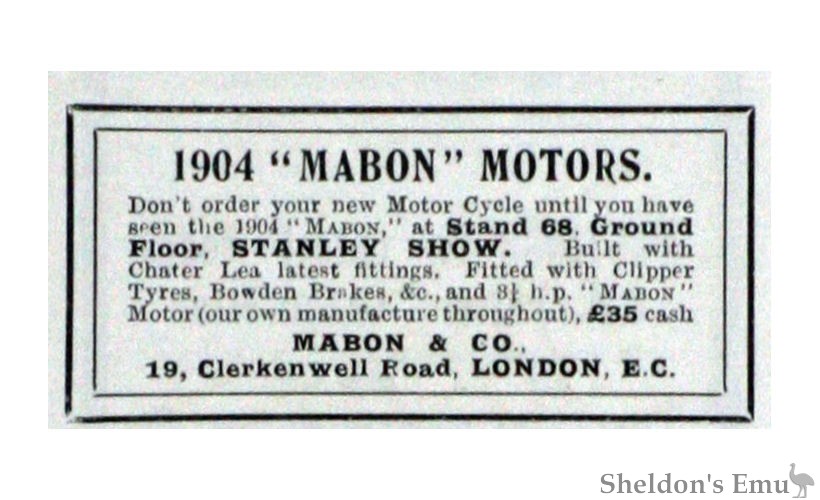
Don't order your new Motor Cycle until you have seen the 1904 "MABON," at Stand 68. Ground Floor, STANLEY SHOW. Built with Chater Lea latest fittings. Fitted with Clipper Tyres, Bowden Brakes, &c., and 31/4 h.p. " MABON " Motor (our own manufacture throughout), £35 cash
MABON & CO
Clerkenwell Road, LONDON, E.C.
... It may also, perhaps, be inferred that the motor cycling public is now content with much more moderate speeds than those which have recently been so prevalent. A cycle with a 3 horse-power engine may now be had, weighing altogether less than 1 cwt. The power in almost every case is derived from the petrol motor, and on the whole the workmanship displayed leaves little to be desired. It would seem, however, that the perfect internal combustion engine for this class of work should have better provision for cooling the cylinder than merely radiating gills. If water cooling is inconvenient on the bicycle, the provision of a fan should be a comparatively simple matter, without adding materially to the weight. It has been found in practice that, although the front side of the engine is kept cool enough when the bicycle is in motion, the hindmost surface of the cylinder shows a much higher temperature. Overheating of the cylinder walls tends to vaporize the lubricating oil, causing leakage of gas past and undue wear of the piston.
Experiments carried out some time ago by Professor H. L. Callendar showed very conclusively the gain in power which can be obtained from a small bicycle motor fitted with a fan. It was found that by running the engine on the stand at 2,000 revolutions without fan the temperature of the exhaust side rose to 570 deg. Cent. - a dull red heat - while the inlet side remained comparatively cool. After the provision of a fan the temperature on the exhaust side rarely exceeded 400 deg. Cent., even with the throttle full open, the spark retarded, and the engine running continuously. The fan was secured to the fly-wheel, and a suitable case conducted the air blast on to the engine. As the bicycle was not in motion it was decided, in order more nearly to approach the actual conditions on the road, to fit a second fan to blow on to the front of the engine, and it was then shown that with both fans at work the exhaust seldom exceeded 300 deg. Cent. or the inlet valve 70 deg. Cent.
It might be objected that the gain is purchased at the expense of the engine power, but it was found that not more than 1/25th horse-power was required to drive a fan which gave a blast of 25 miles per hour. With such figures before them motor cycle makers will do well to give this method of cooling close attention.
A new system of water cooling for motor cycles is shown by the N.S.U. Cycle and Motor Company, of Hatton-wall, London. The engine is of the vertical type, 4.5 horse-power, and the radiator is rectangular in section, and composed of a large number of tubes on the honeycomb principle. It is hung on the top tube of the cycle, and is provided at its rear with two fans, which are driven by a round strap from the engine crank shaft. The radiator carries about a quarter gallon of water.
One of the greatest novelties in the show is Howard's patent motor bicycle, the frame of which is practically the same as used on a standard safety machine. The motive power is supplied by a single-cylinder petrol engine of the horizontal type, and fairly large fly-wheel bolted to the tube in which the saddle pillar fits, and a bolt from the fly-wheel communicates motion to a pulley on the rear road wheel. Perhaps the most remarkable feature of this engine is the complete absence of a carburettor, the spirit being sprayed direct on to the stern of the inlet valve and being drawn into the cylinder with the air. The weight of the machine complete with a 3 h.p. engine is 90 lb. The engine is air cooled. A wide flange cast round the cylinder is drilled out with horizontal holes, through which the air is allowed to pass. The machine is built by Messrs. Mason and Brown, of Leicester.
Amongst variable speed gears a working exhibit is shown of Low's variable gear, which, although rather crude in construction, is simple, and has features which are desirable for motor car purposes. The gear consists essentially of a pulley, having two parallel grooves in which two separate belts can work, which is mounted on a countershaft between the engine and road wheel. The motor drives the twin pulley by means of a V belt running in one of the grooves of the latter, and the motion is transmitted to the road wheel by a second V belt running in the other groove. The twin pulley consists of a barrel mounted on ball bearings, and carrying at each end a fixed flange. Upon the barrel there slides a sleeve, which carries fixed upon it a third flange, whose outer faces form, with the inner faces of the two former flanges, the two V-shaped belt grooves mentioned above. This central flange is capable of movement in a direction parallel to the axis of the pulley, and it will be seen that, as it moves along, it recedes from one of the outer flanges and approaches the other one. The effect of this movement is to reduce the diameter of one belt-path and to correspondingly increase the diameter of the other one. The twin pulley is so mounted upon the machine as to be capable of a forward or backward movement, either by sliding along guides or by swinging in a frame or carrier. This movement is controlled by a lever, having a trigger and quadrant by means of which it may be retained in any desired position. The pulley being mounted, and with belts in position, the action is as follows: - Supposing the machine to be running, say, on any intermediate gear, the centre flange - being quite free to move sideways in either direction - will be in such a position that both belts are running at even tension. Now, if the lever be moved so as to move the pulley forward, the increased tension of the rear belt will at once cause the centre flange to move over towards the other belt, which, owing to its reduced tension, will allow the centre flange so to move over, until equilibrium is once more restored and the belts are running evenly as before; but the gear will have been lowered. If the pulley be moved backward the gear will be raised, always in exact proportion to the distance through which the lever has been moved.
Spring wheels for motor cars and cycles still have attractions for the inventive genius. Either from lack of knowledge or excess of enthusiasm, or a combination of the two, the inventors of these devices frequently state that by interposing springs somewhere in the wheel between the rim and the axle, all the good qualities of the pneumatic tire can he obtained without the attendant disadvantages. Of course, this is not the ease, since the solid tire cannot ride over uneven surfaces without lifting the wheel, if not the axle. The pneumatic tire, on the contrary, interposes an elastic cushion between the irregular surface of the road and the wheel itself, and this is effected by a continuous spring of compressed air extending round the periphery of the wheel. Thus no work is done in compressing springs. That the pneumatic is unreliable for motor car work is only too well appreciated, but many of the spring wheels which have been introduced only replace one source of trouble by another almost equally bad.
Perhaps one of the best attempts to produce a satisfactory elastic wheel has been made by the inventor of the Halle spring wheel. The principle on which this wheel is constructed may be explained by taking two parallel rulers and connecting them together, so that there are three rods joined by parallel links. If the two side members are held forcibly apart a considerable pressure may be sustained by the middle member. The result is that, as the pressure increases, the links form an angle and draw the side rulers towards each other against the outer pressure, which pressure, when the strain is released, tends to bring the three rulers into the original position again.
The main principle of the Halle wheel is as above described, but the side rulers are replaced by discs, and the centre ruler by a ring hub, while the links are provided with universal joints at either end. The side discs slide on tubes on the axle, and are forced apart by very powerful spiral springs. The universal joints allow the ring hub, to which the spokes are attached, to become eccentric to the axle in any direction, but as the side discs must always remain at right angles to the axle, the ring hub, which must remain parallel to the side discs, must always remain at right angles to the axle also; no matter what position of eccentricity it may assume. When weight or shocks are received by the wheel the side discs are drawn together by the links, forming an angle as the ring hub becomes eccentric to the axle. Besides the main horizontal springs, the Halle wheels are fitted with auxiliary resilient springs, either elliptical or volute. The function of these springs is to provide increased comfort of travelling. These wheels are made by the Halle Spring Wheel Syndicate, Limited, Tunnel-avenue, East Greenwich.
Although there is an extensive display of motor cars, there is not much which calls for notice, most of the exhibits being already familiar to those of our readers who are interested in automobilism.
Source: The MotorCycle Magazine, 1904