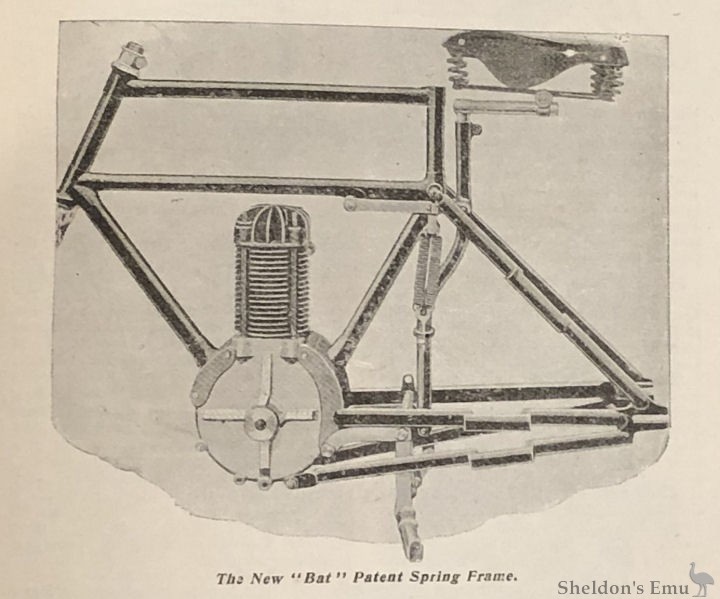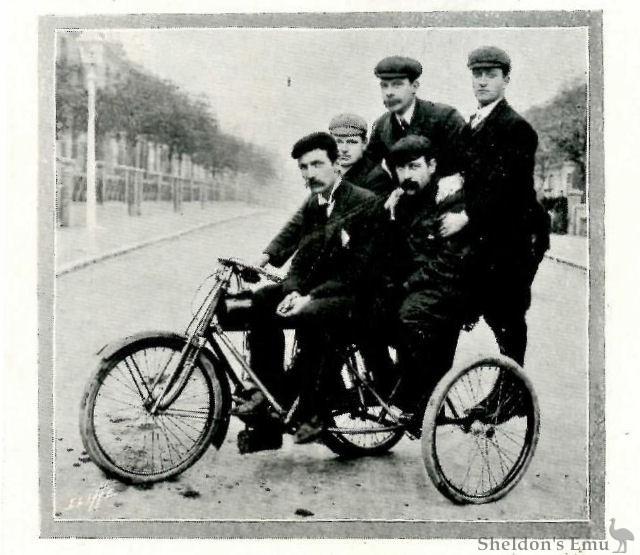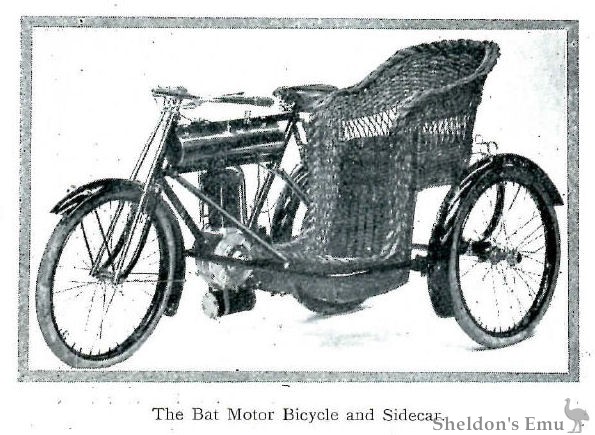

Bat Motor Manufacturing Co. of Penge, S.E. The Bat motor-bicycle has only been on the market for a few months, but it has already made an excellent name for itself, for two reasons. The first is that the machine is designed from first to last with the one idea of making a thoroughly reliable, strong, and powerful motor-bicycle, and the second reason is that the machine has developed a wonderful turn of speed, and this is solely due to the complete harmony of the system. The machine has a close, compact frame, firmly stayed for the work. In the No. 1 pattern a 2¾ h.p. De Dion air-cooled motor is employed, and in the No. 2 the power is 2½. The motor is placed vertically in the frame, and a stay runs from the bottom of the motor casing to the rear axle. The power is transmitted through the Bat patent pulley, and a Chicago raw hide belt to the rear wheel. The belt fastener is extremely neat and effective, and the patent switch, operated from the Bowden brake lever, renders the breaking of the current instantaneous. At an extra charge the new patent spring frame can be given, whereby the rider is carried on an insulated portion, and all vibration is avoided by an excellent method. A spray carburetter is used, and a petrol tank of the capacity of gallons is provided. The machine has neither pedals nor chain gearing, because the rider's power is dispensed with at starting and on the road, as the machine will climb any hill. F. W. Chase has recently done some marvellous performances on the Bat, proving almost without a doubt that it is on of the fastest motor-bicycles (of a reasonable horsepower) in the world. We illustrate the spring frame, and on another page will be found a photo of a group taken on a recent historic occasion.
1902 Stanley Show in Motor Cycling, November 26th, 1902. Page 275
The Bat Motor Manufacturing Co., Ltd.
Special features of the 1904 Bat will be: Large size exhaust lever, kept in position when machine is running free by a clip, which can be instantly released. A wire fixed on an arm, raising the exhaust by a clip. (This allows easy adjustment, and facilitates replacement when necessary.) An extra oil tank fitted at the rear of the saddle. Special new foot band brake.
A wipe contact, the contact-breaker cover being held by one screw. A new side-carriage specially made for the Bat; the trailing wheel can be set nearer the bicycle, so as to allow the machine to go through narrow doorways. We show the frame under test. The new Bat forecarriage is very rigid; it has patent steering, and special brakes on the front wheels, which are very-powerful. Both front and rear brakes are operated by levers placed near the footrests. Transparent mica wind deflectors are fitted to cool the engine.The car bodies are to be of wood or wicker, with space for tools under the seat. The engines will be the 2¾ h.p. M.M.C. and an M.M.C. specially made for the Bat, with mechanically-operated valves; also one with new 3½ h.p. M.O.V. Minerva. A novelty will be a patent stand fixed on the crank case, which allows the back or front wheel to be raised off the ground at will. A new large toolbag is fitted as an extra, clamped on rear mudguard. It consists of two large drawers, with a space underneath.
The Motor Cycle November 18th 1903 Page 802
A DESCRIPTION OF THE MOTOR CYCLES.
Bat Motor Manufacturing Co.
This exhibit consists of numerous specimens of the well-known pedalless Bat motor bicycle, in addition to which the company are also showing several well-designed examples of the Bat fore and-side cars. We were particularly struck with the workmanlike look of their touring machine, which is fitted with mechanically-operated valves, Longuemare carburetter, trembler coil, make-and-break contact; reservoir of special design, and the usual Bat patent switch, by means of which current is broken and brake applied at once, or at will. Attached to this bicycle is the very clever little invention which the Bat people have recently brought out - the Bat stand. This is in the shape of two short legs fixed to the lower part of the crank chamber. When in use these can be dropped to the ground, and then form a fulcrum by means of which either the front or rear wheel can be raised from the ground for examination. When not in use they pack away in a very neat and compact manner underneath the rear fork stays.
We also noticed on the stand several examples of Bat motor cycles fitted with their patent spring frame, which will be well known to most of our readers. The Bat forecar, which is also on exhibition, has a frame combining the excellent points of rigidity and simplicity; but the most striking novelty in its construction is the highly ingenious manner in which the band brakes on the two front wheels are put into operation by a mechanism of a quite novel description. This alone is well worth a visit to the stand. One of these machines is shown fitted with transparent wind scoops for the purpose of cooling the engine, while another is fitted with a small fan for the same purpose. Last, but not least, we must call attention to the Bat motor bicycle on which Mr. T. Tessier, the well-known motor cycle racing champion, made the flying kilometre record at the rate of 62 miles per hour, as well as other records too numerous to mention; and we may add from personal observation that both Mr. Tessier and the bicycle still appear quite capable of adding to this list. (Stand 130)
The Motor Cycle November 25th, 1903. Page 844
The Bat Motor Mfg. Co. Penge, S.E.
(Stand 169).–
The unique feature of this exhibit is perhaps its comprehensiveness, for there are to be seen here machines which should appeal to every class of motorcyclist. The ordinary Bat motor bicycle is already well known, and one of its features has always been the exclusion of pedals. Now, however, to meet a certain demand, a simple arrangement has been effected whereby a pedal crank bracket can readily be attached by means of two bolts, and provision is made on the hub for replacing the present band brake with a chain wheel and clutch.
In this case, a back-pedaling brake is provided to take the place of the band removed by the conversion of the machine. The machines are made in three powers– 2¾ h.p., 3¼ h.p., and 3½ h.p. A very fine forecar is shown fitted with the Bat spring frame. The engine is 4 h.p., water-cooled, with pump circulation. The drive is by means of a belt through the agency of a two-speed gear. The lubrication is effected, by means of air pressure, from the oil supply reservoir. This pressure is raised by means of an ordinary inflator, and when it is desired to charge the pump the tap is turned on and the oil is allowed to flow into the pump; this is a feature of the Bat machines. In the forecar and one or two other models of the Bat machine, the accumulators are curried in a neat tin case on the right hand of the rear stays. The e machine is shown fitted with the Simms-Bosch high-tension magneto. A standard feature of the Bat machine is the pedal-applied band brake operated by the right foot. (in the tricars, band brakes (also pedal-applied) are fitted to the front wheels. The arrangement of the control on all the machines is particularly good, having in view the easiest possible manipulation on the part of the rider.
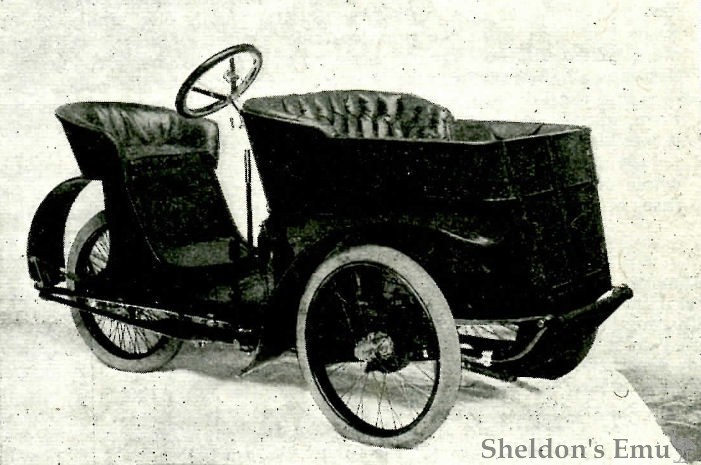
We must say we were very much impressed by the 4 h.p. forecar exhibited. The Bat-Kar is a modele de luxe of the forecar, and contains several new features. It is fitted with a 6 h.p. two-cylinder engine, this being placed transversely in the frame, and driving through an ordinary friction clutch on to the charge-speed gear, giving three speeds forward. The chains employed, it may he mentioned, are particularly well adapted to their work, having a very large margin of safety. The body of the car is entirely coach-built, and attached to a tubular frame, which in its turn is carried on the axles of the front and the back wheels through semi elliptical springs, having long shackles for their easier carriage. The method of springing the back axle is somewhat unique, for the back wheel is carried in forks which are binged on to a cross member of the frame, this giving the back wheel the up and down motion required to absorb vibration without in any way affecting the frame of the car proper. The front seat is of somewhat peculiar construction, inasmuch as it is entirely enclosed, access I being gained through a door opening in front. It is hardly necessary to point out that this is an ideal form of seat, for the passenger is entirely protected as to the lower part of the body from the elements.
The steering of the car is effected through wheel and steering column, two of the control levers being mounted upon the steering wheel. These operate the accelerator, which checks the operation of the governor, and the throttle control, while the levers regulating the supply of air to the carburetter and the sparking advance are conveniently arranged on the back of tile front seat. A side lever on the right of the driver applies the band brakes to the front wheels, while a pedal actuates the band brake on the back wheel, and the change-speed lever is to the right of the driver.
Report on the 1904 Stanley Show, The Motor Cycle, November 28th.