This page lists brands for which limited information is available. For a more complete listing visit the Italian Index.
See also Obscure Italian Marques.
Rebus
According to Mauro Colombo, the Rebus motorcycle was produced in Milan during the period 1908 to 1910.
Restelli was incorporated in Milan in 1909 to build aero engines (under the Rebus brand), and during the Great War also designed an economy four cylinder automobile. They later built a 1½ litre car which had some sporting successes, driven by its designer and builder, Enrico Restelli.
Sources: aisastoryauto.it, Mauro Colombo
Reggioli
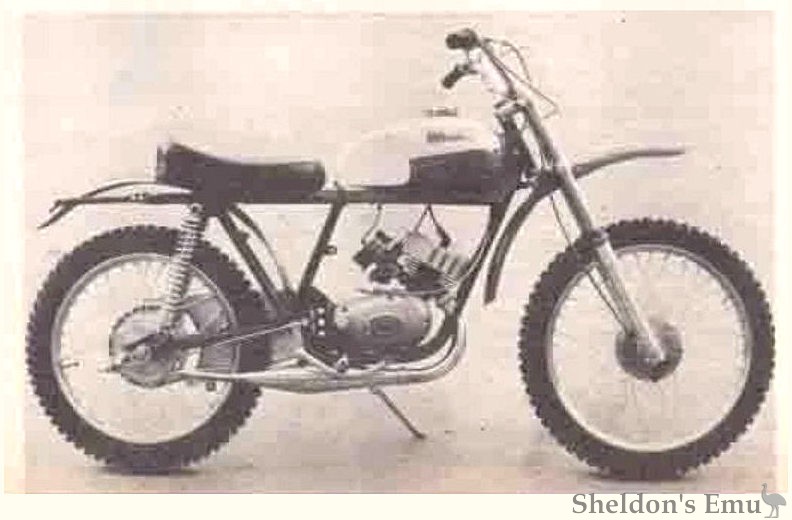
Walter Reggioli and Alfredo Pieroni of Florence constructed a limited number of 60cc MX machines using a two-stroke Minarelli engine housed in a Verlicchi frame.
They also built a machine named Motodelta powered by a twin-cylinder engine developed from two 60cc Minarelli engines.
Ristabilitosi finalmente da una lunga malattia che lo ha costretto per due anni a disertare le competizioni motociclistiche, l'ex campione italiano della regolarita Walter Reggioli ha ripreso gli allenamenti e quanto prima ritorne ra a gareggiare in sella ad una moto di sua costruzione Nella sua ben attrezzata officina fiorentina, con la collaborazione dell'amico e socio Alfredo Pieroni, ha infatti realizzato una bella 60 co da cross, preliggendosi con ciò di raggiungere due scopi: primo, realizzare una moto robusta, funzionale, competitiva; secondo, costruirne una ventina di esemplari e pori in vendita ad un prezzo particotarmente accessibile (225.000 lire).
Il telaio adottato è il classico e robusto Verlicchi da cross la sospensioni so- no idrotelescopiche (quelle posteriori regolabili su tre posizioni di carico!, le ruote da 17 pollici posteriormente e da 19 anteriormente, dotate di pneumatiri Continental - CS 6 -
Il serbatoio contiene circa à litri ed è realizzato in fibra di vetro: pure in fibra sono i parafanghi
Il motore adottato è il Minarelli Cross 2 tempi, 4 marce che sviluppa CV 8,5 a 9.000 giri.
Having finally recovered from a long illness that kept him away from motorcycle competitions for two years, former Italian enduro champion Walter Reggioli has resumed training; he intends to return to racing as soon as possible, riding a motorcycle of his own design and construction. In his well-equipped workshop in Florence–with the help of his friend and business partner, Alfredo Pieroni–he has built an impressive 60cc motocross bike. His goal is twofold: first, to create a robust, functional, and competitive machine; and second, to produce about twenty units to be offered for sale at a particularly accessible price (225,000 lire).
The frame used is the classic, robust Verlicchi motocross-style chassis; the suspension is of the hydraulic telescopic type (with the rear units adjustable to three different load settings!), and the wheels–17 inches at the rear and 19 inches at the front–are fitted with Continental CS 6 tires.
The tank contains approximately 5 litres and is made of fiberglass: pure in fiber are the fenders
The engine adopted is the Minarelli Cross 2-stroke, 4-speed which develops 8.5 CV @ 9,000 rpm.
Sources: Italian magazine article, boxerart.it, et al.
Ricordi 1898-1902
Ribetti
Recorded as being the first motorcycle with an engine which exceeded 10,000 rpm, only one example of the 1925 125cc machine survives and is displayed at the Bassella Museum in Spain.
Rocca
Manufactured by Amedeo Rocca in Bologna.
From 1956 to 1960 Rocca supplied two-stroke engines to the Boselli Brothers of Mondial of up to 175 cc. Rocca entered bankruptcy for the fourth and last time in 1960, adding to the serious woes Mondial was experiencing.
Source: Nunzia Manicardi.
Rondine Motor 2000-2026, (Rome)
Royal Prince
Built by Prati, the Italian importer of Royal Enfield, in the years 1933-1934, the Royal Prince was powered by New Imperial engines of 175cc and 250cc OHV engines inclined at 20°. The 175 was built specifically for the Italian market and was fitted with a Lucas ignition system and a 3-speed gearbox.
Source: Museo Nicolas
Rarer Italian Marques