Moto Rumi
An Italian Masterpiece
Moto Rumi
Cavalier Alberto Beggio founded the Aprilia company immediately after the Second World War, the company began producing bicycles in the small town of Noale, Vicenza (Venice). Cavalier's son Ivano joined the company in 1968 and the focus quickly turned from bicycles to motorcycles.
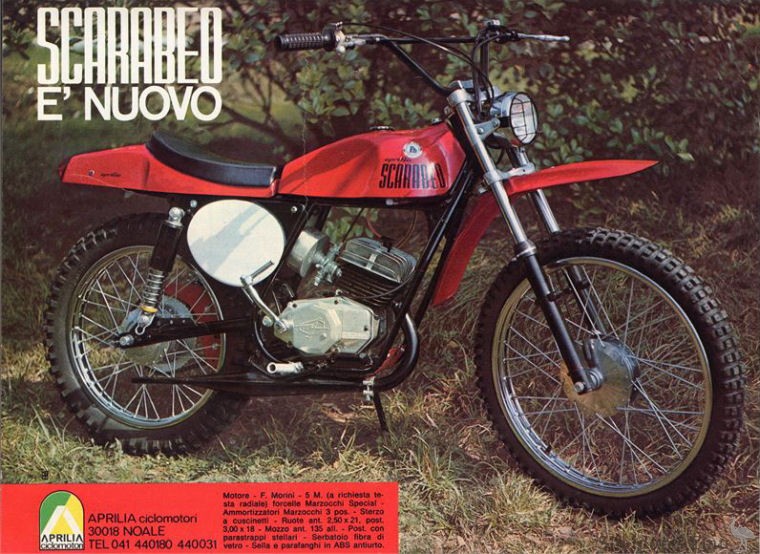
The first Aprilia motorcycle was built by Ivano and 12 assistants from the factory in 1968. It had a blue and gold colour scheme and was powered by a 50cc engine. That same year the company began production of two mopeds. the Colibrì and Daniela. Both mopeds were well received by the public, however it was the 1970 Scarabeo 50 which brought great success to the brand. The Scarabeo was produced in 50cc and 125cc capacities, and all models featured a very catching design. It remained in production until the mid 1970's.
The first true motocross bike arrived in 1974, and was tested by Maurizio Sgarzani with encouraging results. The firm also began developing the RC125.
Father and son understood that in order to further promote their product in a world that was without the marketing campaigns of today, they enter competition - and win. In 1975 Aprilia began racing the RC125 nationally with Ivan Alborghetti who obtained successful results in the first year. Their first Italian Championship was achieved in 1977 in both the 125cc and 250cc classes and Aprilia’s success was widely lauded. So began Italy's love affair with Aprilia motorcycles.
Aprilia saw the opportunity to begin exporting their motorcycles, and the largest export market was America. The decade ended with a constant growth in production, which was divided between mopeds and motocrossers. Aprilia’s moped production grew from 150 units to 12,000 units annually from 1969 to 1979, whilst their motorcycle production increased to 2,000 units per year in just a four year period.
The beginning of the 1980s saw a financial crisis impact the world, and during this time Aprilia decided to further develop their range to include enduro motorcycles, trials bikes and road machines with engine sizes ranging from 50cc to 600cc.
The fruits of Aprilia’s labour over those tough years was seen when they released their first road motorcycle, the ST 125, in 1983. The ST 125 became an overnight success with considerable praise from the trade press. The following year Aprilia produced the STX, an improved and more sporting version of the ST. Aprilia first enduro motorcycle appeared around the same time with a 50cc engine which had been developed from Aprilia;s motocross racing efforts. In 1985 Aprilia launched the ETX in both 125cc and 350cc capacities; these motorcycles were aimed at the motocross market, but over the next few years the motocross market’s popularity began to decrease and as a result it became extremely specialized. Aprilia decided at that point to focus on growing their road and endurance market.
In 1986 Aprilia developed the road going AF1 whilst in the endurance range the ETX was joined by the Tuareg. Tuareg had been inspired by the motorcycles used in the African rallies which were hugely popular in the mid-eighties - the motorcycle incorporated a large tank and a range of accessories.
Aprilia fashioned the EXT using a two-tone colour scheme, and then in the late 1980s they designed a colour scheme for the AF1 in pastel tones - highly unusual in the sportsbike category.
After Aprilia’s first experience in observed trials in 1981, they decided to enter the Trials World Championship in 1985 – the result was a 5th place overall for rider Philippe Berlatier. That same year Aprilia decided to also compete in the 250cc class of the World Road Racing Championship, with Loris Reggiani. It was a challenge considered rash by many observers, that a small Italian factory without any road racing experience, would go onto the track and take on the powerful Japanese; however, at the end of the first season the Aprilia GP 250 finished 6th in the World Championship standings. The Noale company’s first victory arrived two years later when at the Grand Prix of San Marino, with Loris Reggiani riding the Aprilia AF1.
With the success of the road racing efforts, Aprilia’s overall strategy changed and they began developing motorcycles of competition quality.
In 1992 Aprilia received its 1st World Championship in the 125cc class with a motorcycle which was still in development; the Championship was won by Alessandro Gramigni, and this was followed by Tommy Ahvala claiming the Trials World Championship the same year.
Aprilia Racing proved to be a source of talent, and many champions of recent years began their road to success riding an Aprilia; these include Max Biaggi, Loris Capirossi, Alessandro Gramigni, Roberto Locatelli, Kazuto Sakata and Valentino Rossi. Along with the sporting success, production, size, knowledge and technology grew for Aprilia and they had achieved international recognition.
The Nineties saw Aprilia make an entrance into the expanding scooter market, and in 1990 Aprilia launched their first scooter, the Amico, the bodywork of which was made entirely of plastic. In 1992 the company launched both a scooter and a twostroke motorcycle with catalytic converter, the Amico LK and the Pegaso 125. Aprilia then launched their four-stroke, four-valve scooters in 1993.
In 2000 Aprilia released their "clean" engines: the Ditech (Direct Injection Technology) which offered good performance, fuel consumption and very low emissions. In 1993, Aprilia launched the Scarabeo scooter which incorporated a combination of retro styling and modern lines. It became one of Aprilia’s most successful models.
In 1995 the RS 250 was born, one of the most successful racing bikes of all time. This paved the way for their entry into the larger superbike category with the launch of the RSV Mille in 1998. The design of the RSV Mille along with the technology it incorporated had been derived from Aprilia's success and expertise on the race track. The RSV Mille proved to be a great success both commercially and in competition. Aprilia then continued developing and producing larger capacity motorcycles with the SL 1000 Falco, RST Futura, ETV Caponord and the Tuono.
2003 saw the launch of the new RSV 1000R which was developed from the RSV Mille.
2004 saw Aprilia re-enter the off road market with the development of a Supermotard motorcycle, and an enduro version. In 2004 Aprilia entered the SXV into its first season of the Supermoto S2 World Championship, which they won first time out.
In 2000 Ivano Beggio bought Italian motorcycle brands Moto Guzzi and Laverda. With the declining state of the global motorcycle market things did not go well and as a result Beggio sold the family company to the Piaggio Group on the 31st December 2004.
The acquisition of Aprilia, Moto Guzzi and Laverda made The Piaggio Group the most important European motorcycle manufacturer and the fourth most important motorcycle manufacturer in the world, with a turnover of about 1.5 billion Euro and a production capacity of over 610,000 motorcycles and scooters per annum.
The Piaggio Group placed Leo Francesco Mercanti in charge of the Aprilia brand.
Aprilia headquarters has remained in Noale with offices of nearly 70,000 square metres. Production moved, in 1997, to a new factory in Scorze, a few kilometres away. Offices for customer service are based in Santa Maria Di Sarla, also nearby.
The Aprilia sales network in Italy has 192 official dealers and 1480 authorized sales outlets. Aprilia also owns subsidiaries in Croatia, Greece, USA and Japan, along with sales agencies in the UK, France, Spain and Germany). Aprilia machines are marketed in a further 24 countries via a network of importers who supply some 1,800 dealerships.
In 2007 (or perhaps earlier) Aprilia began producing scooters in China and Vietnam.
Source: Based on a 2007 article by Aprilia Australia
If you have a query or information about Aprilia motorcycles please contact us