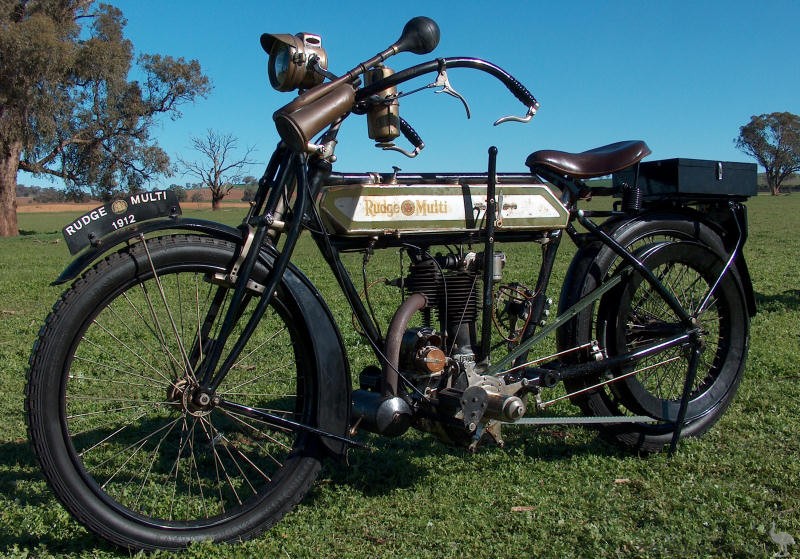
The 1912 model is the first year of the Rudge Multi, which uses a multi-speed axle and gear system with a laminated rubber drive belt and was a great improvement over the previous single speed configuration.
Rudge had its beginnings in 1868 making velocipedes (forerunners of bicycles). In 1894, the company was acquired by bicycle manufacturer Whitworth Cycles. They started manufacturing motorcycles in 1910, which included several early innovations, including a spring-loaded stand, a front-and-back linked braking system, a spray-action carburetor and, in their early 1912 model, the 500cc Rudge Multi, a belt-gearing system that offered no less than 21 gear ratios! The Multi became a highly sought after machine and gave the company their first racing win in 1914.
Rudge made a 998cc V-twin in 1914, but war halted production of it until 1919. In the 1920s, Rudge built four-valve cylinder heads for their 500cc single, a version of which won the 1928 Ulster Grand Prix - "The World's Fastest Road Race" - with a speed of 80.078 mph. As a result, their next model was named the Ulster and offered a top speed of 90 mph. Financial trouble and World War II brought production to an end in 1939.
Here are the 1912 specifications for this machine:
Engine: Single cylinder, 85mm x 88 mm, 499cc. Overhead inlet valve, side exhaust
Lubrication: Oil tank on seat tube, pump operated by right foot
Ignition: Ruthardt magneto, gear driven with vernier adjustment
Carburetor: Senspray
Transmission: Direct laminated rubber belt with Multi gear with engine-shaft clutch
Frame: Simple diamond, Rudge enclosed-spring fork
Wheels: Rudge, with 650x65mm beaded edge tyres
Brakes: Single shoe acting on rear belt rim, stirrup on front rim
Tanks: Separate fuel and oil
Builder: Rudge Whitworth
Original Finish: Frame black enamel. Tanks silver with thick green stripes lined in black. Black celluloid on handlebars, levers, pedal arms and hubs. Small parts nickel plated.
New Rudge Variable Gear Model
We were recently privileged to inspect the new model Rudge machines which are nearing completion and have formed the opinion that these machines which have made such leaps and bounds in their comparatively short active life will be even more to the front in 1912, not that there are any striking departures in design to chronicle, but there are many minor improvements which cannot fail to commend themselves to the practical rider. First and foremost the machines have been carefully redesigned with a view to reducing the weight in every possible part consistent with strength. For instance, the spring forks are neater and lighter, the lugs of the frame are lighter, the stand and carrier fittings have been redesigned, likewise the variable gear. This last mentioned model possesses the most notable departure, and the gear now possesses the undoubted advantage of a free engine, no matter what ratio of gear is employed. It will be remembered that formerly the gear had to be at its lowest point before the free engine came into operation, but by a clever adaptation of the Rudge plate clutch in conjunction with the gear mechanism on the engine-shaft a free engine is possible with all speeds. Though carried in a compact casing the free engine and variable gear mechanism are entirely separate. The width from the centre of the engine pulley groove is 5in. An inherent advantage of the Rudge gear is the fact that the belt always runs in line. The inner flange of the engine pulley is the movable one, and any variation results in a corresponding movement of the outer flange of the rear belt pulley. We tried this gear on the road in the rough, and it worked admirably. The quadrant will enable twenty different gear ratios, which should appeal to the sidecar user.
Detail Improvements.
Two other models which will be marketed are the 3 ½ h.p. clutch machine and the T.T. model. We detail a number of minor improvements which are common to all R.W. motor cycles.
A new rear brake has been adopted which gives a much greater gripping surface than formerly, and is as powerful a brake as we have ever tried.
Next year an Eisemann magneto will be fitted, which is a very compact instrument, with sloping pole pieces, which enables a hot spark to be generated at slow speeds. A neat arrangement is provided for the finest possible adjustment of the magneto timing, known as the Vernier micrometer adjustment, which amounts to 1/34th of a revolution. A cam with fourteen teeth is fitted on to the armature-shaft. On the periphery of this cam thirty-one teeth are cut which fit into corresponding serrations in the exhaust cam wheel. It will thus be seen that the adjustment is less than one degree. The exhaust valve lifter is a great improvement, and, being carried to the left-hand side of the machine, leaves the timing side very clean and easily get-at-able. The valve lifter has a very easy motion due to the long leverage. The new Rudge lifter is a reversal of the usual order of things, for the action of raising the inverted handle-bar lever pushes down the lifter, so causing the other end to act upon the bottom of the tappet. The lifter lever is fulcrummed in a boss cast on the crank case.
The engine has undergone minor alterations only, nor will this cause any consternation when its wonderful achievements on the track are considered. The exhaust valve guides are now cast solid with the cylinder, which means that they can be bored, absolutely true with the seatings. A new cotter and cup arrangement is shown in the sketch. It was found with the old cotters that there was a tendency for them to break, but by the new arrangement of a cone-shaped cup, a cotter is practically unbreakable. The special design of the cup enables a spring of the longest possible dimensions to be used.
1911 Olympia Show - The Motor Cycle October 19th, 1911. Page 1100
RUDGE-WHITWORTH, No. 115.

The 3½ h.p. multi-speed Rudge in its latest form.
Rudge-Whitworth, Ltd., Crow Lane, Coventry. – Six models are shown on this Stand, two as above, two T.T. machines, and two tourist models with Rudge clutch on the engine-shaft. Among the improvements which have been carried out on all the machines are shorter pedal cranks on the starting gear axle, giving a comfortable alternative footrest position; a larger belt rim brake which is self-aligning and bears uniformly on the rim over the whole surface of the shoe. Two methods of adjustment are provided, so that an almost unlimited amount of wear can be taken up. The appearance of the machine has been considerably improved by the substitution of a plain curved chain stay in place of the usual type, which is cranked round the belt rim. An inverted lever operates a new type of exhaust valve lifter, which is extremely neatly arranged, a rather noticeable feature being that the outer covering of the Bowden cable is used to push instead of the inner cable being used to pull. Both the valve springs are fitted with an ingenious and novel cotter, the great advantage of which is that, owing to the pin itself being only in compression, there is practically no chance for it to break. The dished spring washer used with this device also allows a slightly longer spring. The silencer has been improved, and is furnished with a large foot-operated cut-out. The holes in the silencer are arranged so that the exhaust does not disturb the dust.
1911 Olympia Show - The Motor Cycle November 23rd, 1911. Page 1256