
See also Canadian Marques
California Sidecars
Four models were listed, including:
Side Kick - a small sidecar designed for motor scooters and larger step-throughs.
Commuter - for middle weight machines of 250 to 500cc.
Source: Hal Kendall
Diamonado Sidecars
Arbor Vitae, WI 54568
https://www.diamonado.com/
"Thanks to the Diamonado hybrid, the 3-wheel rider is no longer expected to accept the compromises found in other 3-wheel offerings. This uncompromising hybrid combines the positive attributes of an articulating sidecar with the positive attributes of a rigid 3-wheel vehicle while the negative qualities of each are eliminated. When the Diamonado hybrid is attached to a motorcycle, a dignified and intriguing 3-wheel package is created that combines performance, utility, and security never before realized."
Dauntless Sidecars
Dauntless Motors Corporation, 17022 SE Wax Road, Covington, WA 98042-9122 USA
www.dauntlessmotors.com
Models include the Flying Tiger, with a body built in China, and the somewhat similar Arrow.
Source: Hal Kendall
38. The Duryea Co., Coventry, show five of their cars, including a three-wheeler. These range from a small phaetonette to a waggonette to carry eight passengers. The special mechanical features of these cars are the three-cylinder balanced motor, dynamo ignition, throttle control, giving from 3 up to 32 miles per hour. Direct drive from engine to rear axle, one piece nickel steel live axle, silent self-lubricating chain drive, extra powerful brakes, large diameter wheels, and tyres, the prices for these cars range from £375 down to £250 for the three-wheeled phaeton. The control of these cars is a unique feature, and is effected by a single lever, by which also the steering is effected, so that the driver controls the car easily with one hand. The large diameter wheels and tyres ensure very smooth running, and vibration is entirely eliminated. All the cars are handsomely finished off in black. The booklet describing the details of the cars is a very instructive one, and well worth perusal. The Duryea car will be further described and illustrated in our next issue.
1902 Stanley Show in Motor Cycling, November 26th, 1902. Page 275
Equalean Sidecar
Manufactured by Wally Wallick from 1975 to 1984. Some 270 tilting sidecar combinations were produced, one of which featured in an episode of Chips.
Source: 3-wheelers.com
Flxible
Manufactured from 1913 to c.1925 by the Flxible Sidecar Company established by Hugo Young of Loudonville, Ohio. The "e" was dropped from the name in order to trademark it. These machine were built until the mid 1920s when the firm switched focus to ambulances and buses.
Source: Gespann-Lexikon
Geer
Harry R. Geer of 856 McLaren Ave, St Louis, Missouri sold motorcycle components and built the Blue Bird, based on a Mitchell motorcycle from the Wisconsin Wheel Works.
Source: Graham Clayton
More information: Geer Bluebird at Mecum
N.B. The name "Bluebird" was used by several manufacturers - see Disambiguation
Good One
Sidecars made to order using a heavy steel chassis, they had a 21" wide seat which will accommodate two small children or one large adult.
Source: Hal Kendall
Hitchhiker
Sidecars designed and built by Bob Loberg of Minnesota. Production was later taken over by by Pat Sheehy of Ohio.
Source: Hal Kendall
Liberty
Sidecars manufactured by Peter Larson which had a GRP body and leaf spring specially designed for Harley-Davidson motorcycles, built in limited numbers from 1991. Imported to Germany by Reh until 2021.
Source: Gespann-Lexikon
M.M.
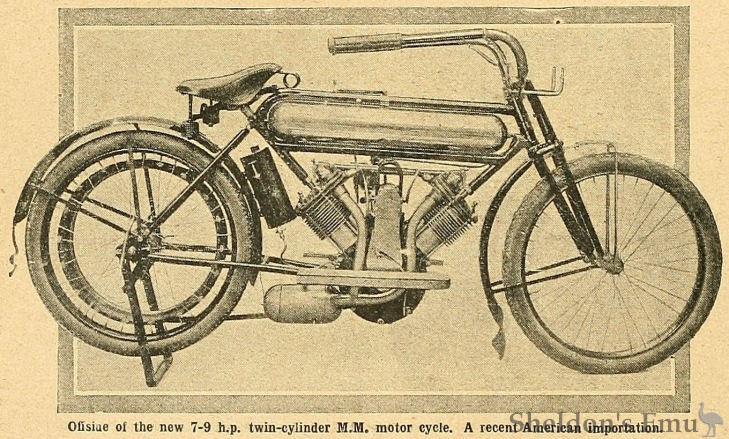
Built by American Motor Works, Brockton MA. The Marsh brothers built a motor bicycle in 1899, followed in 1903 by a 6hp single-cylinder high performance machine. In 1905 Charles Metz joined the firm, and they began advertising the M.M. marque, adding a 90-degree V-twin to the range. The company was disolved in 1913.
The Latest M.M.
The latest type M.M. motor bicycle sold by Messrs. J. C. Lyell and Co.. 113, Great Portland Street. W., is a 4 h.p., 82 by 91.5mm. The engine has the exhaust valve in front and an automatic inlet valve. The ignition is by Bosch magneto, driven by a train of gear wheels. The gas is supplied to the engine by a Schebler carburetter, which is quite an interesting device.
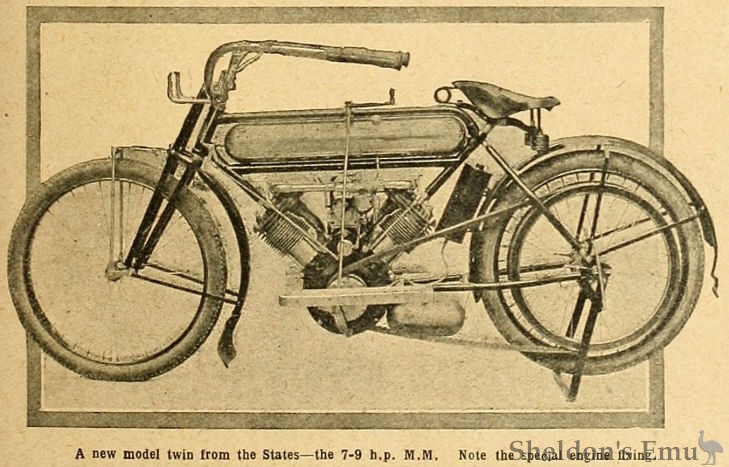
The 7-9 h.p. V twin is similar in every respect to the above, except that it has two cylinders of the same dimensions as one single, and, of course, has a more strongly constructed frame.
1911 Olympia Show - The Motor Cycle October 5th, 1911.
The M.M.
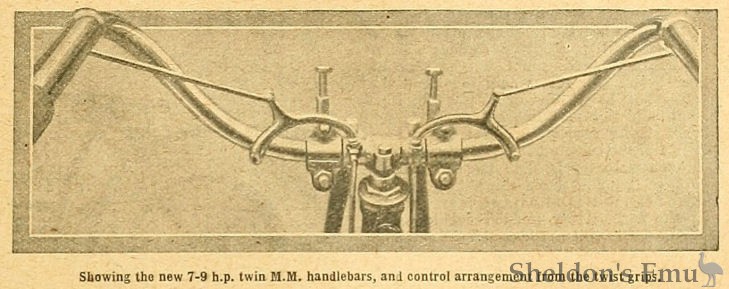
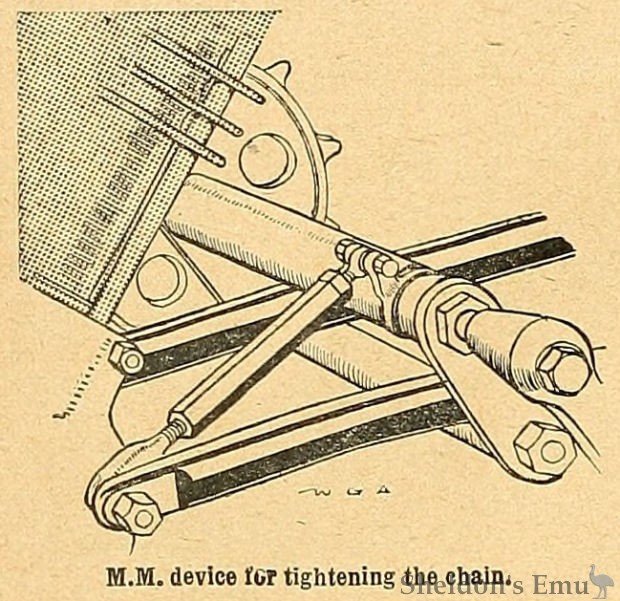
We illustrate below the new 7-9 h.p. twin M.M., the bore and stroke of which are 82 x 91.5 mm. The magneto is a Bosch and the carburetter a Schebler. The attachment of the engine to the frame by the cylinder heads is interesting. The 4 h.p. single-cylinder model is of the same dimensions. It is illustrated on page 1082. The engine is attached to the frame at three points: at the cylinder head, to the lower of the two top rails, and fore and aft at the crank case. The carburetter and magneto control are carried out in the usual American manner by long rubber twist handles and rods. The back wheel is very easily detachable, and is provided with a chain adjuster which serves to adjust the tension of the belt. The bottom bracket is carried above the forward end of the chain stays, and is able to be rocked backwards and forwards, the amount of movement being controlled by means of an adjuster which enables the pedalling chain to be very easily tightened. The stand is substantial, and when the machine is taken off it automatically flies quickly up into position. The front wheel is suspended on a flat laminated spring fork. It is interesting to note that the engine-shaft revolves on roller bearings. The tank is of brass, and provided with spun steel ends.
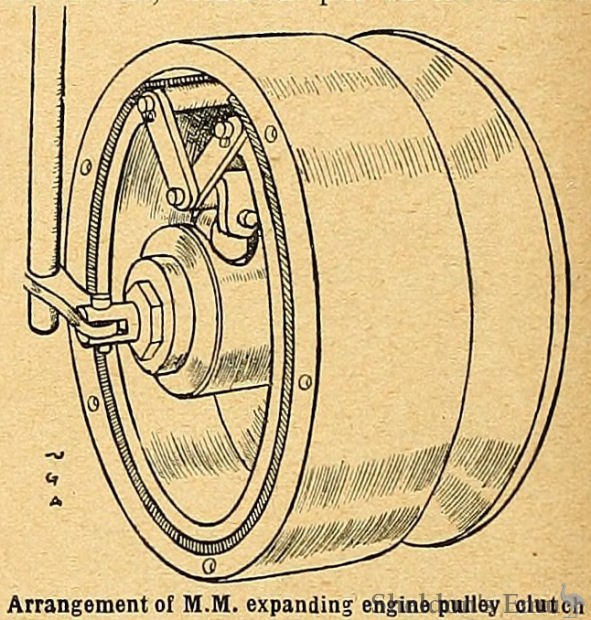
Both models will be fitted with a free engine clutch, which is of quite a simple nature, consisting, as it does, merely of an expanding brake which takes up the drive quite sweetly, so we are informed. It is worked by a long lever adjacent to the top tube.
1911 Olympia Show - The Motor Cycle October 5th, 1911. Page 1068
Motorvation
Sidecars manufactured by Motorvation Engineering Sidecars and Trailers
941 Fourth Ave. Sibley IA 51249
Models include Spyder T-1 and Coupe Royale.
Source: Hal Kendall
Pearson
Pearson Sidecars are hand-built from steel tubing and sheet metal. The have a bucket seat, automotive wheel and tyre, and both the wheel and the sidecar are suspended.
Source: Hal Kendall
Side Strider
Manufactured by Doug Bingham, 1969-2016
sidestrider.com ✝
"In 1969 Doug Bingham formed The Side Strider Inc. company. What began was street sidecar outfits!
Aside from Harley Davidson who have been mfg. sidecars almost from day one, The Bingham MK-I was the first sidecar in several decades to be available to the general public.
The distinguishing mark in History was the article in the Dec. 1969 issue of Popular Science Magazine.
Several years later, Doug Bingham took that BMW R60 with a production sidecar and raced it at the AMA National Sidecar Road Race at the famous Laguna Seca circuit in California, Circa 1974.
With passenger Pam Stone riding quite comfortably, they finished in a creditable 10th place position. Note: This is a stock BMW cycle with a street sidecar - racing against a full field of real road racing sidecars...
Interestingly enough, past British sidecar champion Eric Oliver competed in the 1958 Isle of Man Sidecar T.T. race riding a Norton Dominator 88 and a standard Watsonian Monaco. Oliver with his passenger Pat Wise, nice and comfortable finished in the top ten for a bronze replica!
Doug's knowledge of road racing sidecars and off road outfits made him a natural in this business.
In 1972, because of Doug's expertise and first hand knowledge he was approached by Watsonian (the) Worlds oldest and best known sidecar manufacturer to be their exclusive representative."
Watsonian & Side Strider
Watsonian began manufacturing sidecars in 1912 in the Watson family home. From there the company moved to Branwood, then on to a bona fide factory in Albion Road Greet, Birmingham, England. In 1983, the business moved to Northwick Park in Gloucestershire. The world's oldest sidecar company and the leading manufacturer of sidecars, Watsonians were world racing sidecar champions in the 1950s.
Directors Ron Watson (son of the founder) and Cliff Bennett (who joined the firm in 1926 as a 14 year-old lad) have sold the company and its assets to Doug Bingham, who has been Watsonian's American distributor since the early 1970s. Cliff and Ron are retiring. Doug's partner, along with Cliff's son-in-law, Peter Machin, who started as company secretary in 1973, and has been involved with day-to-day administration. A third partner is Cyril Heath, with the company since 1949, who is also vice president of the British Sidecar Federation.
In 1988 there was a merger of the Watsonian and Squire sidecar companies to facilitate competition in the Common Market.
Bingham sidecars all had a fibreglass body.
Bingham also imported Squire and Velorex sidecars.
Sources: Hal Kendall; sidestrider.com ✝
Smitty's
Sidecars manufactured in Ames, Iowa.
Models included Hawk I for middleweight motorcycles and Hawk II for larger machines.
Source: Hal Kendall
Vintage
Sidecars manufactured by Ron Russell, Vintage Cycle Works, Campbell, California.
These are replicas of the 1918 Harley-Davidson sidecar, which he fitted to the customers' modern HD. They were also available as a kit.
Source: Hal Kendall