
Singer Improvements.
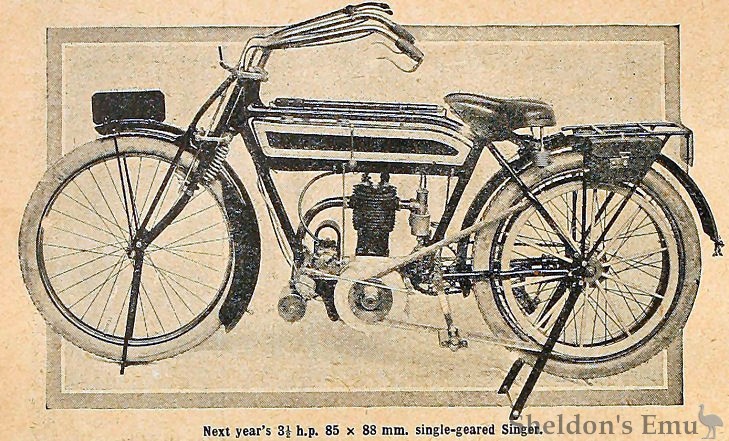
The Singer Company have made it their endeavour to produce as light as possible a 3½ h.p. machine to give lasting satisfaction, and to be fitted with all necessary refinements. From an inspection of one of their 1912 mounts we may say that we consider that they have succeeded admirably.
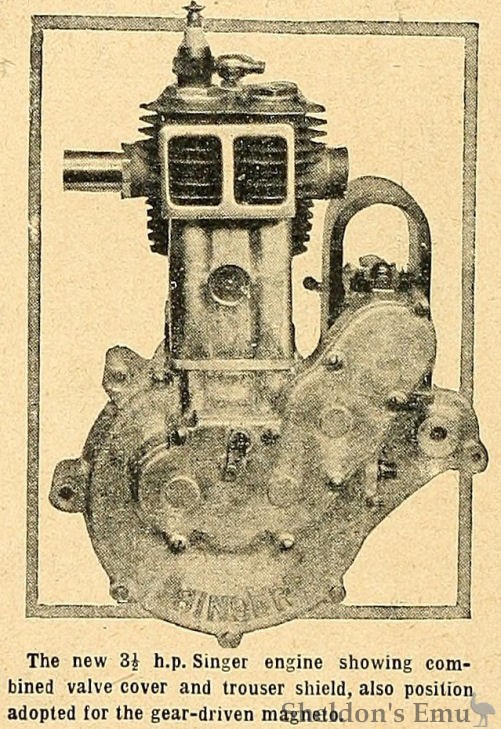
The engine retains all this year's features, but, as will be seen from the illustration, it has been altered in the timing gear.
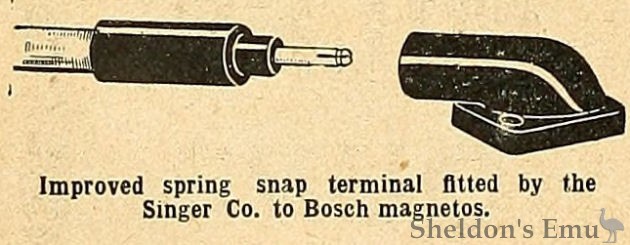
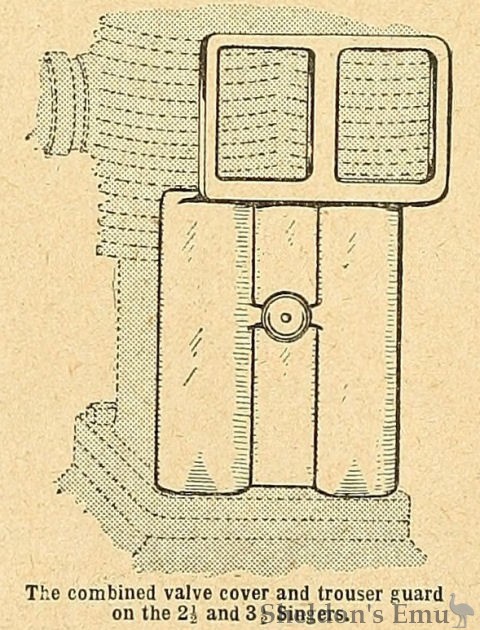
Only one intermediate wheel is now placed between the exhaust cam wheel and the magneto, and the gear case cover is held on by counter-sunk screws instead of nuts. This gives a considerably neater appearance to the engine, and should reduce gear noise. The combined valve cover and trouser guard is now shaped to the top of the crank case, while large windows are cut opposite the valve chambers so as to allow more air to pass for cooling purposes. All control levers now have rounded metal ends formed on the lever, and so prevent the loss of screwed-on knobs and the consequent discomfort to the fingers. A neat front wheel stand is fitted to the front forks. The model we inspected was fitted with a plate clutch in the rear hub operated by pedals conveniently placed and coming under the right foot, the foot brake being on the left side. A very simple terminal is fitted to the high-tension lead from the Bosch magneto, and consists of a long vulcanite collar fitted with a split brass "push-in" end (illustrated herewith). The frame design and engine generally have undergone no important alterations, but the tank has an improved finish, and the, oil pump is set at a greater angle so as to be more conveniently operated.
1911 Olympia Show - The Motor Cycle November 9th, 1911.
SINGER, No 110
Singer Cycle Co., Ltd., Coventry. – The standard single geared machine has undergone very few important alterations, those which have been made, however, being excellent detail improvements in every way. The magneto is in front of the engine, and is gear driven, the timing gear case being very neatly arranged and containing quite the minimum number of pinions. The exhaust lifter is also enclosed in this case. The frame is slightly dropped, and the tank is somewhat altered in design, a special feature of this being the fact that clips on the top tube are absent, the base of the tank being secured to platforms brazed on to the second tube. Another excellent feature which applies to all models is the handlebar control, which is furnished with an arrangement which entirely prevents the levers altering their position through vibration. These levers are entirely of metal, and are unusually long. This model is made with single gear, either ?with a Villiers clutch hub or as a T.T. machine with dropped handle-bars and rigid forks in place of the usual Druids. In the free engine model the operation of the clutch is carried out very neatly, while an excellent point is the fact that the belt rim spokes are reinforced with plates where they join the rim itself, thus making an extremely strong and rigid job. The silencer is fitted with a foot-operated cut-out.
The 4 h.p. model is intended more especially for sidecar work, and as a full description of it has recently appeared in The Motor Cycle, it is unnecessary here to do more than touch upon its salient features. The general specification is the same as that of the 3½ h.p. model, except, of course, that the casting of the crank chamber is extended to enclose the counter-shaft gear box in which the gears are thrown into operation by dog clutches, the pinion teeth being always in mesh. The belt is taken from a large pulley on the right-hand side of the box. A. 2½ h.p. model is made with the gear arranged in a similar way. This machine has a bore and stroke of 69 x 80 mm., and is practically a reduced facsimile of the 3½ h.p., except that in the attachment of the tank the platforms are not brazed in position but are clipped. The 2½ h.p. machine is made either single-geared with a Villiers free engine hub only or with the Singer two-speed gear. A late arrival on this stand was the new lady's model, which was fitted with a 2½ h.p. engine placed vertically in the frame, the magneto being in front of the cylinder as in usual Singer practice. The machine is of very neat design, and has a very efficient guard over the belt to protect the rider's dress. A Villiers clutch is fitted in the rear hub. The Singer range is very enticing.
1911 Olympia Show in The Motor Cycle November 23rd, 1911. Page 1270
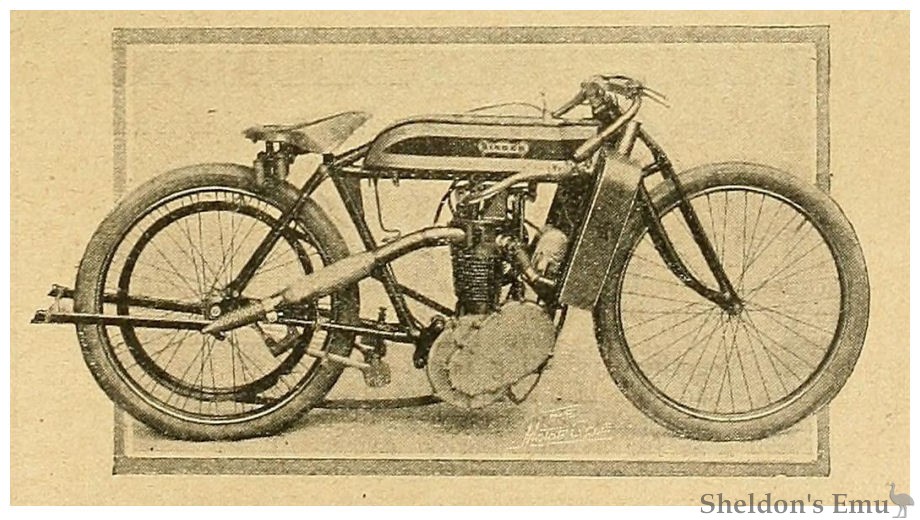
Singer OHV Watercooled 4 Valve Racer, 1912
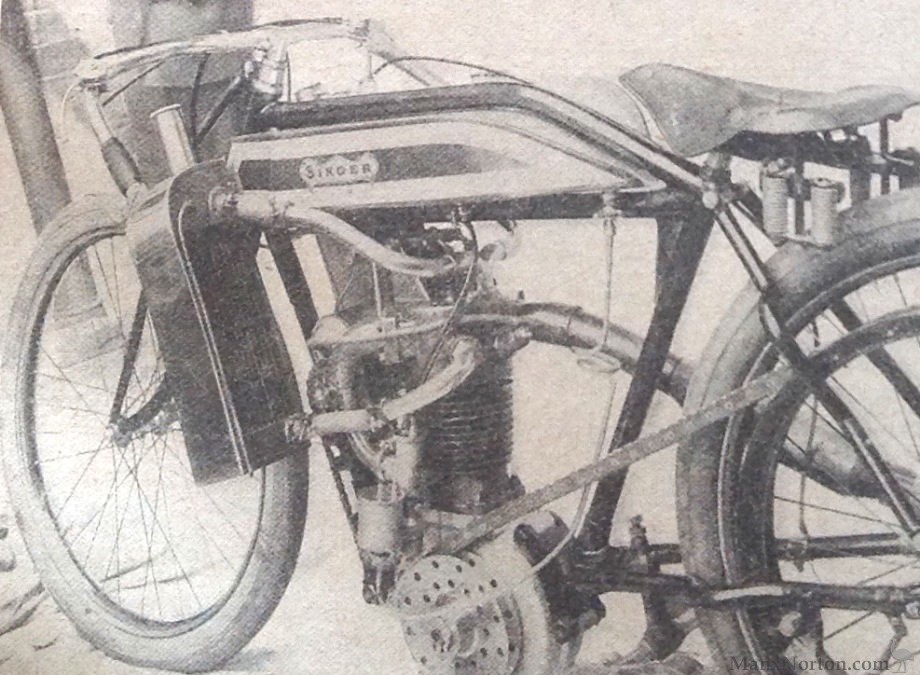
The new Singer racer with four overhead valves and water-cooled head.
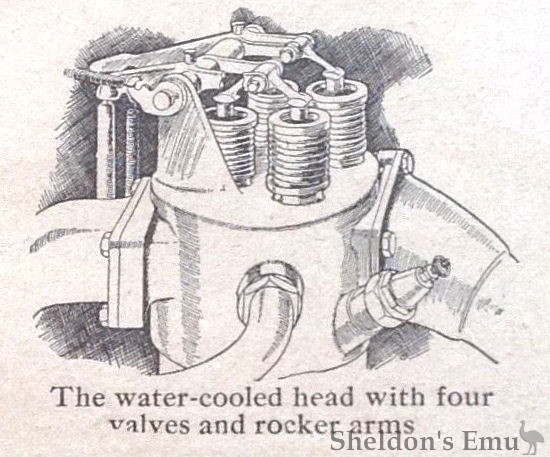
Design of water-cooled head and valve actuating mechanism.
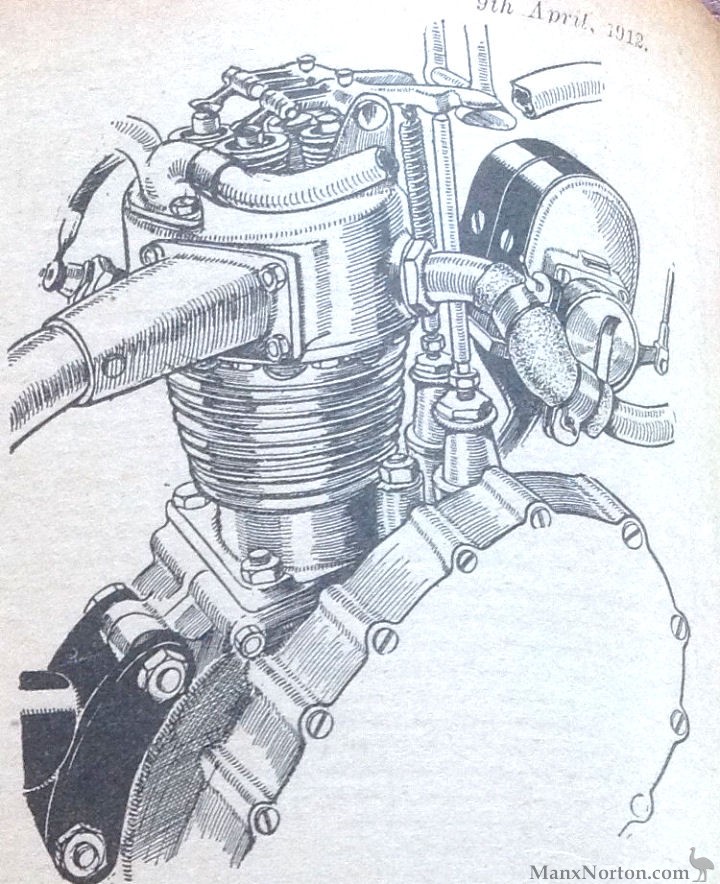
Singer 1912 4 Valve Watercooled Engine
En abril de 1912 las principales revistas de motociclismo de Gran Bretaña: “The Motor Cycle” y “Motor Cycling” describían un nuevo modelo para competencias presentado por Singer y con grandes expectativas puestas en las carreras del Senior TT y en Brooklands.
Diseñado por Louis Coatalen, de la Sumbeam Co. el motor era un 500 cc de 85 x 88 mm. de alta compresión con cuatro válvulas a la cabeza y tapa de cilindro refrigerada por agua. El árbol de levas inusualmente estaba ubicado en la parte delantera del motor y era comandado por cadena, mientras que el magneto Bosch también era comandado por otra cadena expuesta ubicada en el otro extremo del árbol de levas. La tapa de cilindros estaba abulonada al cilindro (que era refrigerado por aire) mediante unas bridas estrechas y contenía cuatro válvulas, siendo cada par (de admisión y de escape) comandados por una única varilla.
Dos pequeños radiadores, que contenían 11 litros de agua y estaban colocados tipo alforjas en el frente del tanque, refrigeraban la tapa de cilindros actuando por el sistema de termosifón. Otras innovaciones fuera de lo común era el control de la bomba de aceite mediante un pedal montado en el apoyapié derecho que se accionaba con el taco. El tanque de combustible era de gran capacidad y el silenciador algo inusual.
Los ingenieros de Singer esperaban lograr velocidades de 130 a 145 Km/h, pero problemas en las válvulas y sopladuras de la junta de tapa de cilindro hicieron que en las pruebas iniciales el prototipo no superara los 100 Km/h. A pesar de rastrear publicaciones posteriores no pude encontrar ninguna noticia de este modelo, por lo que supongo que terminó siendo archivado en el olvido, como tantos otros diseños demasiado arriesgados para la época.
The Singer Co. have evolved a very novel engine for racing purposes with which they expect to do great things at Brooklands. The power unit was designed by Mr. Louis Coatalen,. of the Sunbeam Co. The bore and stroke remain 85 x 88 mm. respectively, so that the machine is eligible to compete in the 500 c.c. class. The head is water- cooled, and in it are placed four large valves, two being for the exhaust gases and two for the inlet.
The ports are cast in the head. A roller chain-driven camshaft in front of the engine operates stout push rods, opening the valves by a neat overhead rocker system, which can be clearly
seen in the accompanying illustrations. The exhaust valves can be depressed by the usual hand lever through a neat cam gear bolted on to the lower top tube. Two small water radiators are carried pannier fashion, attached to the down tube, circulation being carried out on the thermo-syphon system. The magneto (an enclosed Bosch) is driven by a separate exposed chain off the end of the camshaft. The water-cooled head is bolted down to an air-cooled cylinder with tapering flanges.
Other Departures from Standard.
Besides the engine there are several unusual points on the machine, noticeably the webbed lug to take the rear ends of the top tubes, also the neat method of controlling the oil pump by a pedal mounted on the foot-rest. All that is necessary to inject a charge of oil is to depress by the heel a pedal fitted on the right footrest. This raises the pump handle by means of a Bowden wire, the plunger being afterwards depressed by means of an, internal spring. It is quite reliable, having received a prolonged testing at Brooklands.
The tank comes to the level of the top of the frame on one side, so as to give a greater capacity. The silencer also is unusual, but as its construction will be clear from the photograph a description is unnecessary. It is hoped that the machine will accomplish the speed of eighty to ninety miles per hour, and its performances will be watched with interest by followers of the racing game.
Sources:
Sergio Scalerandi & Howard Burrows, and Boston City Library.
Reproduced with acknowledgement to Mortons Motorcycle Media, holders of the copyright for "The MotorCycle" and "Motorcycling".