
 |
Riders |
 |
If the question arises and interests anyone, who is the best rider of all time?
If we rely on the results alone, the answer is obvious and unequivocal, the ranking gives:
1st Giacomo Agostini - 15 titles and 122 victories
2nd Ángel Nieto - 13 titles and 90 victories
3rd Mike Hailwood- 9 titles and 76 victories
Although it's likely that the best of all is in this trio, many will disagree on the ranking. Hailwood will probably come up most often.
Because, they say, he won many titles without much adversity. But we mustn't forget that, at the beginning and end of his career, this wasn't always the case. We must also remember that he beat Hailwood fairly in the World Championship.
Because some think that Nieto's victories are less valuable because they were achieved on small-displacement bikes. But is it easier to ride a 500 (with 80 horsepower, at the time) or a 50cc reaching 210 km/h at Spa, with tyres that a cyclist wouldn't want today?
I don't have the answer to that. And I won't try to give one, because we can't talk about the value of riders solely in terms of results. Of course, the latter are important, but some left too early. Others weren't lucky enough to have the right bike at the right time.
And then, if victory is everyone's goal, it's not necessarily this aspect alone that draws the crowds. The proof? Mamola (no title) and Schwantz (one title) are remembered by everyone for the spectacle they put on on the track. And then, who can dispute that, today, McCoy is the rider who draws the most spectators to the circuits. Even Kenny Roberts Jr. recently stated that he was ready to secure a place behind him to be able to enjoy the spectacle! Obviously, this will no longer be the case when McCoy is ahead of him in the Championship...
That's why I'm not just talking about the riders who won titles, or those who scored the most, but rather those who made the biggest impression on me, for one reason or another.
Since it was still necessary to find a presentation criterion, I classified them according to the number of titles they obtained.
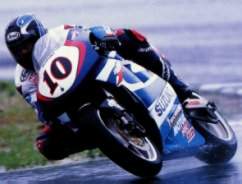
Giacomo Agostini Titles: 15 GP wins: 122 |
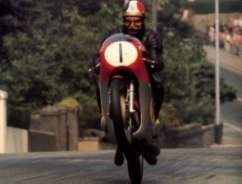 |
Agostini, despite having won a colossal number of victories and titles, was one of the most controversial riders of his time: it was often said about him that he had won so many titles and Grand Prix because he had no competition.
Let's admit the principle... but note that we don't entrust the best machine in the world to the worst rider.
Born on June 16th 1942 in Brescia, Italy, Agostini had three periods in his career.
He won his first titles when the competition was strong: In 1966 and 1967, he won two World Championships in 500 cm3 on equal terms against Mike Hailwood. Giacomo was on MV and Mike on Honda. The latter was, at that time, indisputably the best rider in the world.
Then the Japanese factories withdrew from the competition, partly due to the limitation on the number of cylinders. The task then actually became easier, apparently, for Agostini. Was it, in fact, easier to win on circuits like the Tourist Trophy, Brno, La Charte or Imatra ("the fastest motocross course in the world", according to Mike Hailwood) with an MV than with a Norton Manx or an AJS 7-R? I'm still not convinced.
After a few years of absence, the Japanese factories developed "customer competition" such as the TD2, TR2 (Yamaha) and H1R (Kawasaki) which, improved by good preparers, began to become more and more competitive and reliable. Meanwhile, Aermacchi was developing its 2-stroke twin cylinder, technically quite close to the Yamaha.
Agostini's supremacy was beginning to be seriously challenged, especially since, to face this growing adversity, MV had hired a certain Phil Read to assist him.
It was then that, like many others tired of seeing Agostini always in the top positions, I attended the 1973 French Grand Prix on the Paul Ricard circuit where the 500 Yamaha 4-cylinder ridden by Jarno Saarinen had just appeared. That day, attempting to keep up with his competitors with his MV which was beginning to be clearly outclassed, Agostini fell. For a moment, there was a heavy silence among the spectators, struck with amazement. When Ago got up and saluted, the crowd applauded.
Agostini had the opportunity to provide further proof of his fighting spirit. When he decided to change teams and opted, logically, for Yamaha, everyone predicted that he would never get used to riding a 2-stroke. After a rather difficult period he won several titles on these bikes, both in 350 and 500.
In 1976, after the Yamaha factory had withdrawn from GP competition, he raced again on MV, probably out of patriotism. This did not prevent him from winning what remains to this day the last race of a four-stroke in Grand Prix. It was on the Nurburgring, the real one, the one where the size of the rider can compensate for the handicap of a completely outdated bike.
Ángel Nieto Titles: 13 GP wins: 90 |
|
It is worth mentioning that during his attempts in 250, Nieto was less brilliant than in the lower categories. But he was not ridiculous there: he did not necessarily have the best machine and the 250 category was certainly the one where the competition was the fiercest.
But above all, Nieto had a size problem... which must have peaked at 155 cm.
Some people think that riding a 50cc is easier than riding a 500.
Less rewarding, perhaps, easier, certainly not: ask Alan Cathcart, who just tried one for "Moto-Légende," what he thinks.
You should know that these machines reached 210 km/h on the fastest descent at Spa, fitted with tyres as wide as those of a common moped. Then think about braking with drums no bigger than a box of Camembert cheese.... In the favorite expression of modern Formula 1 commentators, "it was hot." Except that this one really was!
Furthermore, be aware that this engine size is necessarily the one that requires the greatest finesse in piloting, not only because of the narrowness of the tyres, but also because of the motorcycle (the fact that a simple foot protruding from the fairing makes you lose a whopping 10 km/h) and the extremely sharp character of the engine. The latter, to reach 15 horsepower - which is nothing outrageous these days - had a range of use often less than 1,000 rpm. When you went outside this range, the engine stalled. Also, for greater ease of use (?) some have counted up to 18 speeds. You will think that it is enough, after all, to go up and down them! Not so simple: A Kreidler model, for example, had 5 foot-operated gears and a 3-speed demultiplier on the handlebars. This gives us a total of 15 speeds. Many of the "greats" of the time admitted that they were able to use them correctly when they were doing a lap of the track alone, but that it was impossible for them to maintain their concentration with such machines when they found themselves in a fight with other riders.
Angel NIETO has certainly broken a longevity record: 16 years passed between his first and last title.
Mike Hailwood Titles: 9 GP wins: 76 |
|
Among the greatest, Hailwood is certainly the one whose value has never been disputed. Whether he was the greatest of all time is something I still don't know, any more than I did about the previous ones.
In any case, he beat the greatest such as Jim Redman, Gary Hocking, Phil Read or Giacomo Agostini.
If he has never been questioned, it is probably because he has only ever proven his superiority on the track. So much so that, when Agostini arrived at MV, he claimed that Hailwood, then the owner, helped him win a title.
It is strange that Hailwood is remembered as a typical Honda or Ducati rider for his recent exploits in the Tourist Trophy.
Yet, like many British riders, he started out on Norton Manx and... Ducati, some of which were built specifically for his father.
He was then noticed by MV, with whom he won four titles in 500cc, before moving to Honda, for whom he raced in the 250, 350 and 500cc capacities... without ever winning a title in the latter capacity against Giacomo Agostini's MV.
Beyond his titles, he made a name for himself with some extraordinary feats, winning three times in the same week at the Tourist Trophy in 1961 (125, 250 and 500) and in 1967 (250, 350 and 500).
Stubborn, he was able to win the Tourist Trophy after falling in the wet and picking up his bike. The fact that it was "bent" didn't seem to bother him much.
In 1967, following the withdrawal of the Japanese factories, he converted to automobiles, with some success: he was European Formula 2 champion in 1972, on ... SURTEES (It's a small world). He ended his career in this discipline in 1974 following a serious accident, while he was a Formula 1 driver at McLaren.
In the meantime, he had time to save Clay Reggazzoni by pulling him out of his burning car. To understand what this can mean, try getting within 10 meters of a forest fire! Even if you never experience this "experience" - which, in any case, I wouldn't wish on anyone - his colleagues at the time recognized that only an ex-biker was capable of such a feat! Probably, but not just any old biker...
But the most improbable thing happened about ten years later, in 1979, when he got back behind the handlebars of a Ducati in the Tourist Trophy, which he won to everyone's astonishment.
Hailwood had just written the last lines of his legend.
Having won his greatest victories on the most dangerous circuit in the world, he was killed in a banal car accident in the middle of London.
Carlo Ubbiali Titles: 9 GP wins: 39 |
|
If we compare Ubbiali's career to that of one of his contemporaries, he has two more titles than Surtees, for example.
Yet his name is rarely mentioned when discussing the greatest champions.
Because of the engine sizes in which he competed?
Not necessarily: the reason should rather be sought in the character of Carlo UBBIALI, who was discreet, affable and not very talkative, that is to say the antithesis of the idea that one has of Italians in general, like Agostini, Rossi or Biaggi. (For which I do not blame them).
His rivals, however, were not the first to arrive: Cecyl Sandford, Tarquinio Provini, Mike Hailwood...
Let's just say that he certainly spent more time preparing for his races than promoting himself. While the others were busy, he watched. Then he took the handlebars and... he won.
PS: You can see in the photo above the safety conditions in which the riders of the time raced:
Phil Read Titles: 7 GP wins: 52 |
|
Like many other riders of his time, Phil Read started out by learning the ropes on Norton Manxes on the English short circuits, and didn't really have a preferred engine size.
A character who loved to be noticed, he often traveled to the circuits in his pink Rolls-Royce. A Pink Rolls, in a way.
He lived through the end of the first great period of Japanese factories and was a factory rider for Yamaha, during the brand's debut in GP.
This made him controversial since, in 1968, when, as teammate of Bill IVY, it had been agreed that the latter should win the 250 title and Read the 125.
But Read, seeing the 250 championship within his reach, did not keep his word and dispossessed IVY of the title that was due to him and that he fully deserved.
IVY being at the time as popular as Read, many did not forgive him, especially since IVY was to lose his life shortly after during the tests at the Sachsenring, on a Jawa, the famous 4 cylinder / 2 stroke, however unreliable.
When Yamaha stopped competing, Read continued to race on the same brand, but with "customer competition" twins. This earned him several redeeming moments, notably when, at the French Grand Prix, which was held on the Charade circuit, he entered the 500 class with a 250 twin and held his own against Agostini on his 500 MV for several laps.
Legend has it that he did not retire, as the official version has it, due to mechanical failure but voluntarily to avoid the indignity of being demoted. Just think!!! As we know him, Phil would have been happy to see his bike dismantled to prove that he had been able to beat Agostini with a bike with half the engine capacity!
As a privateer, he also won a title in 1971 on a Yamaha, then moved to MV, in the same team as Agostini. As the two men did not get along, Agostini soon left MV and Read won his last two titles for MV, in 500cc.
Which proves that Read knew how to adapt to all situations. But in fact, we already knew that:
He is to date one of the only riders to have won a title in both the 125 and 500 class, along with... Alex Criville.
John Surtees Titles: 7 GP wins: 38 |
|
Born in Tatsfield, Surrey on February 11th, 1934 he was the son of a south London motorcycle dealer. In 1950 at the age of 16 he began an apprenticeship at the Vincent works. He began riding for Norton in 1955.
As with Agostini, many, even today, claim that Surtees achieved so many titles largely due to the lack of competition.
A counterexample: At the 1959 Tourist Trophy, the M.V. Agusta
were the only factory bikes entered in the 500cc class, and Surtees was
riding one of them. It's no surprise, then, that he
set the lap record there at an average speed of 162.8 km/h, especially if we compare this average to those achieved
today.
Not so obvious, in fact, when you consider that the M.V. wasn't
actually that powerful compared to single-cylinder cars such as the contemporary Manx
and, above all, that it had rather poor handling, according to all those who were able to test it afterwards.
Small detail: This record was set in the rain... The one the following year, on dry ground, was only about 6 km/h better.
These 162.8 km/h in the wet with tyres that held the road about as well in these circumstances as a bar of soap at the bottom of a bathtub, therefore certainly required great finesse of driving.
In any case, Surtees is, and will probably remain
for a long time to come, the only racer to have won the supreme titles
in both motorcycles and automobiles.
Didn't he have an extraordinary end to his career in this field?
His choice of team wasn't the best, and the idea of becoming a manufacturer wasn't necessarily the most brilliant he's had... although the cars bearing his name still won a Formula 2 European Championship: Not so bad. But he had already proven enough things elsewhere.
Let's not forget that if he was nicknamed "Big" John, it wasn't because he was fat, far from it, but because he was "immense," almost a "giant."
He actually won three successive double titles in 1958, 1959, and 1960, a record that was only beaten by Giacomo Agostino!
Valentino Rossi Titles : 7 G.P. Victories : 83 |
|
Does Valentino have a special recipe for becoming a great champion?
Perhaps:
A clue: his nickname, "Rossifumi," is due to the admiration he has for the rider Norifumi ABE,
who has never received a title, who must have won two Grand Prix in his career, but who has
extremely spectacular driving skills and a kindness that allows him to make many mistakes,
forgiven by all, including Max Biaggi, which would earn him the wrath of all his peers in other
circumstances.
Mischievous as can be, he often disturbs with his antics which we can readily forgive given
his very young age.
He is nonetheless extremely hardworking: barely over his
season and having won a title in the 250cc class, he is already
testing his 500cc Honda, with whom he had just signed.
It was perhaps this blend of laid-back attitude and a sense of work and seriousness that gave him the balance that allowed him to have a dazzling career:
Born on 16 February 1979 in Urbino, Italy, he was the youngest world champion of all time, having won his first 125cc title at the age of 17.
The following year, he moved up to the 250cc class, where he had to compete against Loris Capirossi and Tetsuya Harada, both of whom were in the same team as him. This didn't stop him from having an extraordinary end to the season.
The 1999 season wasn't a walk in the park, however, especially since his Aprilia was no longer as dominant as the previous year. He also experienced
some bad luck, such as at the French Grand Prix where he broke his chain on the last lap, while well
in the lead.
All this didn't stop him from easily winning his first 250cc title... and his second title in his three-year Grand Prix career.
Valentino had already achieved a unique feat by winning a 125cc, 250cc, and 500cc title in just six years of racing! Only Read had achieved the same feat. However, it took him a little longer.
But the most important thing is how Valentino achieved his feat: One year to get used to the bike, one year to win. Unstoppable!
Not only will this record never be equaled again, since, since 2002, there has been no 500cc class, but it has been broken by the only person who could have done so: Valentino Rossi himself, who won the MotoGP title in the class's first year.
You can say what you want: that Valentino had the best bike, that there was no competition...
In 2004, "Vale" provided a definitive answer to these questions: Following a disagreement with Honda, Rossi signed with the second-largest Japanese manufacturer, Yamaha, which had not won a title in the top class for 12 years.
The challenge is huge, enormous: The previous year, this bike hadn't
won a single Grand Prix and was even dominated by the rookie Ducati.
Honda, for its part, continues to claim that its bike is the best,
and not its rider.
Yet, in the first Grand Prix of the season, in South Africa, Valentino
won, to everyone's surprise, and perhaps even his own. We tell ourselves that
it's a matter of chance, beginner's luck, that the competition isn't
ready yet. Regardless, he is still the first rider in 55 years of Grand Prix racing to win two consecutive races in the same category
with two different brands.
The rest of the season wasn't easy, with 4th-place finishes (it's rare for "Vale" to miss the podium), crashes (even rarer), and even pettiness from the competition, which earned him a start at the back of the grid at the Qatar GP.
No matter: With nine wins this season, Rossi claimed another title, which he secured before the final round of the season, and in style: in Australia, he would have only needed to finish second to secure the world crown. That wasn't enough for him: Gibernau was in front of him, and despite all the risks, he overtook him several times on the final lap to climb to the top step, thus making his Spanish rival swallow his shame from the Qatar Grand Prix.
Along with Lawson, Rossi is the only rider to have won two consecutive titles in the top class with two different manufacturers.
We may have our best rider in the world. In any case, since Hailwood, I haven't seen one display such panache.
Geoff Duke Titles : 6 G.P. Victories : 33 |
|
Geoff Duke won two titles in the 350 class (1951-1952) and one in the 500 class (1951) on the Norton Manx.
Although the Manx remained one of the favorite weapons of private riders until the end of the 1960s, Duke had a tough time against the Guzzis in the 350 class and especially against the 4-cylinder Gileras in the 500 class.
Duke won three World Championships for Norton and then won three consecutive 500cc World Championships for Gilera.
Geoff Duke was the last rider to win a world title for Norton.
Timeline: Born 29 March 1923, St Helens.
Riding for Norton in the 1950 TT, he finished second in the Junior TT and then broke both lap and race records in the Senior TT.
On September 9, 1951 he won the 350cc Nations Grand Prix at Monza on a Norton.
In 1953 Duke was awarded the Order of the British Empire.
September 12th, 1954 - won the Italian Grand Prix at Monza riding a 500cc Gilera. He won the 500cc World Championship for Gilera in 1953, '54 and '55.
On June 26th, 1955 he won the German Grand Prix.
On August 18th, 1956 The Glasgow Bulletin wrote, 'Geoff Duke Must Finish Six Months Suspension'. Having won three World Championships for Norton, Geoff Duke moved to Gilera in 1953, with whom he had a string of three consecutive 500cc World Championships. His support for a riders' strike demanding more start money led to Duke being suspended for six months, dashing any hopes for a fourth consecutive title.
Geoff Duke died on 1st May 2015, Isle of Man.
Jim Redman Titles : 6 G.P. Victories : 45 |
|
Born in London on November 8, 1931, Jim Redman was a student there when he emigrated to Rhodesia (now Zimbabwe), then in the midst of a revolution, to save his brothers and sister from an orphanage. He later returned to the European continent to participate in the "Continental Circus," under a Rhodesian license.
When interviewed by a journalist, he never mentioned this tragic episode in his life, which was probably more heroic than any World Championship title.
However, he certainly maintained a certain perspective on these events, a certain approach that would lead to a certain incomprehension on the part of his contemporaries, whether journalists, riders, or spectators. Particularly when he stated that
his motto was to "Win by going as slowly
as possible."
Taken out of context, such a statement may seem
strange and suggest a lack of what we now call
"panache."
Let's not forget that at that time, the circuits (Tourist Trophy,
Imatra, Spa) were extremely dangerous, and a 60 or 70 horsepower motorcycle was virtually unrideable due to its
brutality and its unpredictable, if not hypothetical, handling.
What Redman meant was that, depending on the
circumstances, it's better to wait for your opponents to make a mistake rather than trying to overtake at all costs, and
that it's pointless to continue attacking when you're
well ahead of a racing.
It's an attitude we still encounter today, but no one dares admit it anymore.
Which didn't stop Redman from regularly beating riders like Hailwood and Surtees.
Mick Doohan Titles : 5 G.P. Victories : 54 |
|
Born on June 4th 1965, things weren't always rosy for Doohan - he experienced a number of falls and injuries.
After a serious accident, he returned to the fray, all fired up. The machine then kicked into gear, and for five years, he left his rivals with nothing but crumbs, winning five titles in a row.
One might think his machine was superior, yet Criville and Okada had the same machine and only challenged him very occasionally. Biaggi may have been able to create an illusion in 1998, but Doohan was able to resist both psychologically and sportingly, on the track, like a great champion, without causing unnecessary controversy.
It must be remembered, as one journalist pointed out, that following his first serious accident in 1992, he would have been 90% disabled in civilian life: He could no longer use his right foot to brake and used a lever specially designed to be operated by hand. Hardly any of us would have dared ride on the road in such conditions. Besides, the motorcycle probably would not have been approved for use there.
Following his second serious accident in early 1999, he can retire with his head held high. He has little left to prove, nor, above all, lessons to learn from anyone in terms of courage.
Anton Mang Titles : 5 G.P. Victories : 43 |
|
Born on the 29th September 1949, between 1980 and 1982, Anton Mang won four World Championships in the 250 and 350 class on a Kawasaki.
One would be tempted to believe that his machine alone allowed him
to demonstrate such dominance.
However, there was no shortage of competition, but it remained
powerless, including his teammates, even though they were riding the same
machine.
Following his four combined titles, Kawasaki withdrew from these
classes and, with the top places awarded, nothing
was heard of Mang for five years.
However, he won his last title in 1987, on a 250cc Honda, at
nearly 40 years old, the year he decided to retire.
This title was won on a machine he had developed himself
and against fierce competition.
Notably, that of a certain John Kocinski, fresh
off the U.S.A., who had loudly proclaimed that he would
show European riders how to ride a motorcycle. We
know what happened: the old fox left the young wolf in the dust.
Who never fully recovered, by the way.
We suddenly realize that Mang is an
excellent tuner, endowed with a rare understanding of racing.
While his latest title is probably the finest he has won, it certainly wasn't necessary to wait
so long to realize it.
Hugh Anderson
Titles : 4 |
|
While he wasn't the first rider to win a Championship for Suzuki, he was the one who won the most during the brand's early days in competition, in the smaller displacement categories, 50 and 125cc.
If we look closely at the results of the 1960s, particularly in the 50cc category, we realize that, strangely, the much less powerful Hondas tended to dominate the displacement category.
The reasons for this are relatively simple:
Two-strokes, at that time, were relatively reliable: Riders constantly rode with two fingers
on the clutch lever to prevent, when they had the
time, the engines from seizing up or outright blowing up.
It took a certain amount of courage, and perhaps a dose of recklessness, to venture onto circuits lined with straw bales, sidewalks, or telegraph poles with such machines.
Furthermore, you should know that a 1960 Suzuki 50cc is equipped with a 14-speed gearbox, to cover a usable rev range of... 800 rpm.
So, indeed, anyone can ride a motorcycle with barely 15 or 18 horsepower. But those capable of battling in a pack with such a range can be counted on the fingers of one hand.
Max Biaggi
|
|
Born in Rome on 26th June 1971, Biaggi was nicknamed "Mad Max". This was probably given to him due in large part to the immense popularity of the 1979 film of that name in which Mel Gibson stars as a police officer turned vigilante in a dystopian near-future Australia in the midst of societal collapse. Sadly, Gibson has reputedly joined those who would bring this about, given his alleged support for the far right. .
Biaggi's not my favorite, far from it: There's no one more pretentious and egocentric than him.
Still, he won four 250 titles in a row. That when Aprilia declared that its bikes could win without Biaggi, but not vice versa, he switched to Honda... and won again.
It's also notable that he was the only rider to date to have won his first Grand Prix in a 500cc class and that in 1998, he fought until the very end for the title against Doohan, even though it was his first season in the class.
He failed in 1999 when everyone expected it? Everyone knows, unless they're blind, that the Yamaha 500 was a real trap at the start of the season, a 200-horsepower Macintosh capable of blowing up in your face without warning on any corner.
So far, in both the 500 and MotoGP, Biaggi has found himself on the ground far more often than not. Which reminds me of what someone used to say to cheer me up a long time ago, when I found myself on the ground: "Until you cross the line, you don't know where it is." So, in 2002, Max went looking for the line again and is the only one to have mastered it with a Yamaha and reaped the rewards.
In any case, there are things like this that are irreversible: When Jagger stops going on stage, he'll stop breathing. When Biaggi stops riding a motorcycle, he'll also stop breathing. And Max never gets on a motorcycle to end up anywhere but on the top step.
Eddie Lawson Titles : 4 |
|
What struck me most about Lawson was that I long believed he only won because he had the best bike. Indeed, when his rivals (Spencer, Gardner, Rainey, Schwantz... not exactly unknowns...) went sideways and left monumental tyre marks on the asphalt, he himself looked like he was just strolling along.
Yet he won his titles with several brands. And he didn't necessarily choose his bike because it was the best at the time. Even worse, I recently learned that he won one of his titles on a Honda which, according to Alan Cathcart, a famous tester who has ridden on just about anything with two wheels - from the best to the worst "horses," was a real "trap."
Yet, Lawson never complained.
A truly great man, but very discreet. Too much so, perhaps?
Kork Ballington Titles : 4 |
|
Strangely, if you ask any motorcyclist for a
ranking of the best Grand Prix riders, it's rare for
Kork Ballington to make the list.
Yet he has as many titles as Eddie Lawson or Max Biaggi and
many more than Kevin Schwantz!
Did he arrive at the wrong time? Not necessarily, however,
when he signed with Kawasaki, the brand, contrary to
the extremely sporty image it had established, had only
won one World Championship title.
When it returned in the late 1970s, it was to make a big splash, and its bike was equipped with an engine which, aside from
its pure power, had the particularity of having two longitudinal cylinders (one behind the other)
rather than transverse ones (facing the road). This already gives it a definite aerodynamic advantage, enough to make the bike superior to the competition.
It's a bit of a hasty mistake to forget that it was indeed Kork Ballington who developed this bike.
It's a failure to remember, especially in a unique and never-to-be-repeated feat, Ballington won his four 250 and 350 titles in just two years: 1978 and 1979.
Walter Villa Titles : 4 |
|
Most people first heard of
Walter Villa (b. 13 August 1943 – ✝ 18 June 2002) in tragic circumstances, with the
disappearance of Jarno Saarinen and Renzo Pasolini on May 20, 1973 at Monza.
It is true that, until that day, Walter Villa had not
achieved any notable performances on an international level.
It is also true that the Benelli 350 he was riding that day
lost oil and was the cause of the tragedy that occurred
in the following race.
Between holding Walter Villa responsible for this tragedy, there is a
step that unfortunately, frankly, some
did not hesitate to take. Without any basis or evidence,
since all evidence tending to implicate the organizers' responsibility was carefully concealed.
And the rumor spread that Walter Villa, aware that his motorcycle was losing oil, had not stopped soon enough.
The accusation is far too serious for anyone not to try to reestablish the truth, or at least part of it:
Few witnesses spoke out following this accident, and one might wonder what the reason was. Since then, many riders and journalists
have retired, and tongues have loosened.
Drivers who had seen the Benelli leak oil
tried to warn the organizers. But the organizers
threatened to revoke their licenses if they
tried to delay the start of the race. These
same riders therefore warned some of their
colleagues of the danger, but Saarinen and Pasolini were
already on the starting grid.
Journalists, who also witnessed this oil
leak, also contacted race management,
who threatened to suspend their accreditation if they
intervened.
Finally, how can we believe that Aermacchi could have subsequently entrusted its motorcycles to a rider who could have been involved in the disappearance of its favorite rider?
In truth, when he was hired by Aermacchi, Walter Villa
had distinguished himself several times in the national
championship. But since news of the incident was difficult to get across
border borders, no one outside Italy had heard of it.
This commitment was driven, in addition to his qualities as a rider,
by his skills as a developer, which he had demonstrated by developing, with his brother Francesco, a motorcycle
that proved itself in the Italian championship and subsequently allowed
many riders to shine at the world level
without, however, being able to win a title due to lack of
funds.
In any case, Villa amply confirmed his talents by winning four titles against stiff competition, including a 250-350 double in 1976.
Loris Capirossi Titles : 3 |
|
Born in Castel San Pietro Terme, Italy on April 4th 1973, Capirossi won two successive titles in the 125cc class, in 1990 and 1991.
When he "moved up" to the 250cc class, he did so to smash everything -
like all riders in this situation, by the way.
For six years, he would find stronger competitors,
mainly Max Biaggi, virtually unbeatable in the
class class.
In 1998, when Biaggi moved up to the 500cc class, Capirossi found himself
at Aprilia, with the best bike on the grid... but with
Rossi, fresh from the 125cc class, and, above all,
the experienced Harada.
At the last Grand Prix of the season, Capirossi had a few
points lead over his rival HARADA. On the final lap,
Harada leads the race... and the championship. Regularly speaking, the fox is impregnable. What can be done to reclaim the title that's slipping away? Hit him!
Capirossi will be dropped from the race and fired from Aprilia. But he retains the title... "His" title?
Since then, Loris has largely made up for it, among other things by riding his Ducati Desmosedici to victory in his first year in the MotoGP class and by constantly improving the bike, regularly outperforming his teammates. With the possible exception of Troy Bayliss, who came On vacation, after winning another Superbike title, he took a stint during the final GP of the season, which he won masterfully while discovering his bike.
Wayne Rainey Titles : 3 G.P. Victories : 24 |
|
Arriving in the World Championship at the same time, almost everything pits Wayne Rainey and Kevin Schwantz against each other.
Where Schwantz is spectacular and a constant attacker,
Rainey is exceptionally fine-tuned and very calculating.
A few figures are enough to sum up this situation: Shwantz has 25 victories and one title, and Rainey has won 24 races and three titles.
Unfortunately, while Schwantz has lost count of his crashes in competition, Rainey has only fallen four times. But the last one almost proved fatal: It left him paralyzed in his lower limbs, even though his career could have been still long.
He didn't admit defeat, however, and later retrained as a "Team Manager" before recently taking a well-deserved retirement.
Kenny Roberts Titles : 3 G.P. Victories : 24 |
|
When Kenny Roberts arrived in Europe, initially on a 250cc bike as a trial, a capacity in which he didn't particularly distinguish himself, no one distrusted him.
Americans were then considered capable of turning in only one direction on the Daytona track or of sliding on the cinders, which brought them closer to the "crossers," who were then hardly considered. Even his two "Number One" titles hardly impressed the Europeans.
A fatal mistake, the science of sliding acquired precisely on the cinders allowed him to master the pitfalls of the increasingly powerful 500s.
In his first year in the 500, he won the title against Barry Sheene and went on to win two more as a rider.
In his final year, in 1983, he battled against a certain Freddie Spencer, who won the title by two points. He retired with his head held high, making way for the new generation. He will probably forever remain "The King."
As Team Manager, he would win three more 500cc titles with Wayne Rainey and one in the 250cc class with John Kocinski.
The idea of developing his own bike, the KR3, was probably not the best one he'd ever had.
Freddie Spencer Titles : 3 |
|
In 1985, the riders were already highly specialized and only raced in a single engine size: 125, 250, or 500, because the riding style in each category was already very specific.
Yet, that year, Freddie Spencer successfully completed a crazy bet: winning a 250/500 double.
The last double was 4 years ago (Anton Mang) and the previous one 9 years ago (Walter Villa).
But no one, to date, had achieved a double in engine sizes as different as the 250 and 500.
All had been won in similar engine sizes: 125/250, 250/350, or 350/500!
More importantly, they were won with incredible domination over the competition and almost never training. This earned him the nickname "E.T.".
Three titles in all may seem low for someone so memorable, but let's not forget that Spencer missed out on many opportunities while trying to develop the (in)famous oval-piston Honda N.R. 500.
After his double, he suffered setbacks, most notably an injury that kept him off the track and prevented him from returning to the highest level.
Ten years later, he attempted another comeback, unsuccessfully. His comeback attempts were never considered pathetic but rather a testament to immense courage and fighting spirit.
Luigi Taveri Titles : 3 |
|
When Luigi Taveri (b. 19.Sep.1929, Zürich) arrived on the Grand Prix scene, the era domination by of Italian riders and Italian factories, with the exception of Giacomo Agostini and M.V., was almost over.
Japanese factories predominated and chose riders of English origin, or at least English speakers (Australians, New Zealanders), probably for practical reasons.
How did Luigi Tavieri end up hired
by Honda?
Likely due to his tuning skills. His keen sense of mechanics can be summed up with this simple
anecdote:
At a time when the slightest mechanical failure was synonymous
with, at the very least, a serious and unpredictable crash, Luigi Tavieri,
during practice for a Grand Prix, coasted to a halt in pit lane, to the general astonishment of his mechanics.
He announced stoically: "The engine is breaking down."
The engine was then disassembled: A broken valve was resting
on the top of the piston, with no other damage!
But the man is modest. He recently admitted that the best memory of his career was the day Soichiro Honda invited him to dinner and told him he had been very happy to work with him.
As proof: Honda left him several of the machines he had raced on, including a 125cc 5-cylinder. He is probably the only one able to use it without direct assistance from the factory. He doesn't hold back on this, during retrospectives, to the great delight of spectators.
Tarquinio Provini Titles : 2 |
|
Another mechanical specialist, Provini was mainly noted for beating the much more noble M.V.s with his modest "Mondial," before moving to M.V. (for whom he would win a 250cc title) and suffering a serious accident that prevented him from returning to competition.
However, he was particularly adept at navigating his career change, as he later founded the model-making brand Protar, dedicated to competition motorcycles. Protar stands for PROvini TARquinio, so it seems only fitting that one of the brand's first models was a 125cc Mondial?
Barry Sheene Titles : 2 |
|
Barry Sheene has experienced almost everything:
The best thing is that he went through it all with the same
good humor. This, probably, was the most important factor in his
immense popularity.
No matter what happened, he never took himself too seriously.
Could this have cost him victories or titles?
Probably not: Not taking himself seriously doesn't
mean he wasn't serious: let's just say
that he didn't have and never did have a "big head":
many current riders should take inspiration from him.
What is certain is that none of his titles are cheap titles, since they were won in a hard-fought battle against people like Roberts, Spencer, or Agostini. So many riders representing several decades of motorcycle racing.
All of whom today miss this great rider, since on March 10, 2003, the claws of that big, dirty crab closed. Number 7 slammed the door in our faces. Why does it always have to be the best who start first?
Dieter Braun Titles : 2 |
|
If we were to hold a competition for atypical riders, Dieter Braun would certainly deserve a prize: a West German, he wasn't one of the riders, still numerous at his time, who needed to race to earn a decent living, since he came from an extremely wealthy family.
You might think that it wouldn't be very difficult, then, to win races under these conditions: You just need to buy the best bikes and hire the best mechanics. And by sleeping in comfortable hotels, you arrive fresh on race day, which is an additional advantage over the competition.
This isn't how Dieter Braun envisioned things. Racing primarily for the pleasure of mechanics, he bought an ex-factory Suzuki 125 that many would have bought only to put in a museum. He rebuilt many engine parts to improve performance and modified the gearbox to comply with FIM regulations, winning his first title in 1970 with this bike. Eager to change classes, he acquired a 250 Yamaha "customer competition" bike, identical to one anyone could have bought, even though he had been approached by factories for his mechanical skills. He also modified the engine according to his own ideas and won a second title in 1973.
After Braun won the East German Grand Prix in 1971 season the West German national anthem was played during the winner's ceremony. The East German crowd began singing the words to the anthem. The Soviet controlled DDR government reacted by making the following year's East German Grand Prix an invitation only race, and in 1973, the race was removed from the Grand Prix calendar.
Braun's career ended after a serious accident at the 1977 350cc Austrian Grand Prix at the Salzburgring, held on the 1st of May. Others involved in the crash were Hans Stadelmann, Alan North, Johnny Cecotto, Franco Uncini, and Patrick Fernandez. Stadelmann died from his injuries.
Emilio Alzamora Titles : 1 |
|
When Alzamora entered the 125cc World Championship in 1999, he already had considerable experience, which would certainly give him a significant advantage over his competitors, most of whom were very young.
That year, the Championship was extremely competitive, with various riders vying for victories in successive Grand Prix races. But the battle is so fierce that a rider who wins one weekend finds himself distanced in the next race, or worse, suffers a crash.
Meanwhile, Alzamora regularly scores points for second or third place in almost every Grand Prix.
So much so that he won the Championship by a single point over his second-place finisher.
And he is probably the only rider to have won a Championship without winning a single race during the season.
Yet, in the eyes of many, he is one of the best riders on the grid: Few are capable of such great consistency and falling so few times.
Johnny Ceccoto Titles : 1 |
|
A bit like Saarinen, Ceccoto arrived almost out of nowhere to embark on a meteoric career.
His entry into the World Championship depended on the Yamaha importer in his home country: Venezuela, where motorcycling is not particularly well-developed.
He immediately performed well, challenging many established values, even beating Giacomo Agostin fairly.
He would win Grand Prix races in the 250, 350, and 500cc classes, but shortly after winning his World Championship title, he switched to racing.
But he wasn't as successful as he had been in motorcycling, despite winning a title in the touring class.
Wayne Gardner Titles : 1 |
|
Until the mid-1960s, it was common for riders from the antipodes to try their luck in the world championship, both in cars (Jack Brabham, Bruce McLaren) and motorcycles.
Then, probably because these sports had developed in their hemisphere, they disappeared from our continent.
But that's not the only reason his title was so well received: After so many years of domination by the "Yankee" school in the 500cc class, he proved that the Americans were not unbeatable.
In fact, this domination resumed immediately after him, only to be interrupted for five years by Mick Doohan, also Australian.
Bill Ivy Titles : 1 G.P. Victories : 21 |
|
With only one world championship title, Bill Ivy (27 August 1942 – 12 July 1969) nonetheless remains, in the minds of spectators who knew his era, a true hero.
At just over 1.60 m tall, it seems fitting that he won his only title in the 125 cc class. He nevertheless began his career, like so many other British riders, on a 500 Norton Manx.
Ivy was one of those combative and generous riders who were willing to make many sacrifices to continue racing. This is why, following his disagreement with Phil Read, he rode a 350cc for the Czech manufacturer JAWA, with which he increasingly competed seriously with Giacomo Agostini.
But the reliability of his machine was questionable. It was unfortunately fatal for him.
Takazumi Katayama Titles : 1 |
|
The first Japanese to win a Championship, Katayama was not considered a rider in the same way as his European colleagues, since he had an employee contract.
He was hired, like his predecessors of the same nationality, primarily for his skills as a developer, to test various developments in races, and eventually support his team boss.
This would lead him to win Grand Prix races in the 250, 350, and 500 series.
When circumstances required it, he was called back to the factory for the development of future bikes, without any challenge being allowed.
All this only adds value to his title, won, for the record, on a 350 3-cylinder Yamaha developed by Yamaha Holland.
John Kocinsky Titles : 1 |
|
When he arrived in 1987, very young (around 18 years old) in the 250 Grand Prix, after a few remarkable performances in the U.S.A., everyone was eager to see this young prodigy in action.
Blown with pride, he declared during the off-season that he would show the riders of the old continent how to properly ride a competition motorcycle.
In fact, they didn't see much. In a final humiliation, Kocinski was beaten that year by the old Anton Mang, 20 years his senior, who retired at the end of the season! This in no way detracted from Kocinski's immense and genuine talent, who nevertheless became the 250cc World Champion in 1990, largely thanks to the guidance of Kenny Roberts, whose team he had joined.
He then moved up to the 500cc class, in which he
won a few Grand Prix races. But tired of his rider's demands and other whims,
Kenny Roberts ended up firing him with a bang.
KOCINSKY then moved back down to the 250cc class, with Suzuki. His bike's performance seemed unconvincing, so he could think of nothing better
than to blow up the engine at the finish of a race.
He had just closed the doors to Grand Prix racing for a long time.
He then switched to Superbike, where he would win another title on a Ducati.
Since returning to 500cc as a "semi-privateer," he hasn't been able to prove much since, except that he wasted his immense talent by believing, too soon, that he was the best.
Jarno Saarinen Titles : 1 |
|
Jarno Saarinen, from Finland, is entering the 250cc championships thanks to Finnish importer Arwidson. From the outset, his results were respectable, since he already achieved several 3rd and 4th places.
In 1971, following these encouraging results, the experiment
was repeated this time in the 250 and 350 cc classes.
He did even better, winning races
ahead of Phil Read in the 250 and Giacomo Agostini in the 350.
Aside from these results, Saarinen made an impression
for several reasons:
- The speed with which he achieved his results, compared
to riders who had been racing for more than ten years.
- Because at the time, no one believed that anyone would
have the crazy idea of riding a two-wheeler in Finland,
due to the climatic conditions generally encountered there (I I'm serious).
- And especially by his riding position, with almost vertical clip-on handlebars, which resulted in an extremely reclined position on the bike.
Several tried this configuration and, after testing the strength of their suit, quickly backed out.
In 1972, Saarinen received official support from Yamaha. But the latter did not provide a mechanic.
This did not particularly bother Saarinen, who, on this point, was almost on par with his rivals. With a slight advantage, since he was a mechanical engineer.
He finished that season with a title in the 250cc class and a runner-up finish in the 350cc class, having won three victories in the latter class.
When Yamaha announced its return to the 500cc class in 1973 with a four-cylinder engine, everyone thought that Agostini would be beaten in that class for the first time in a long time.
The season did indeed start with a bang... at the Daytona 200, where he won with his 350cc ahead of all the other factory 750cc bikes.
Then he won two straight victories in the 500cc class, only losing the third due to a broken chain.
Then came the Italian Grand Prix, May 20, at Monza, a circuit on which no further motorcycle Grand Prix races were held.
Kevin Schwantz Titles : 1 |
|
Kevin Schwantz brought Suzuki a 500cc title
that it hadn't won for over ten years.
But in the minds of the public and his fans, this title is
of secondary importance.
Of course, it brought deserved recognition to a
career marked by courage and generosity.
Had he not won, Schwantz would still be remembered for the tyre marks more than twenty meters long when accelerating, right on the corner. Or for his legendary braking moves, with all wheels locked at 250 km/h, which were so spectacular that they disarmed his opponents.
No matter what, no matter his position in the championship, Schwantz always fought.
So much so that he probably won his title with a machine inferior to his rivals: Since Schwantz, Suzuki has not won a title.
Kelvin Carruthers Titles : 1 |
|
Kel Carruthers was one of the riders who arrived in England from his distant Australia to compete against European riders in Grand Prix races.
Like many others, he spent the winter months preparing his bikes and the rest of the time on the continent traveling from circuit to circuit in vehicles that were mostly worn to the bone, making the whole thing look like a circus caravan. Hence the name: "Continental Circus".
These riders entered as many engine sizes as possible since they earned their living from
entry bonuses but also from finish bonuses. This, implicitly, required a certain amount of skill
from mechanics, since the bikes, most often purchased second-hand, didn't return to a decent
garage for nine months.
The bikes were... pretty much whatever you could find, and the
brands were varied: Bultaco, Yamaha, Norton. When you got a (semi-)factory handlebar, as was the
case for Carruthers with Benelli, it was "Peru"... or almost, since the riders didn't pay for
their bikes, but most of the time, the maintenance was their responsibility. This was even the
case for Saarinen, at least in his early days.
In any case, Carruthers won a title for Benelli in 1969, the brand's first title in nearly 20 years (the previous one dates back to 1950, with Dario Ambrosini).
When he hung up his leathers, Carruthers didn't retire
from the world of motorcycling. He emigrated to the U.S.A., at the request
of Yamaha, to develop track racing there. There was
almost everything to do, since there was only one
important race: the Daytona 200.
There, he looked for talent and trained riders.
When he returned to Europe to compete through his own rider against the Grand Prix leaders, the man he had trained, "his" rider, was called... Kenny Roberts!
Kenny Roberts (Jr.) Titles : 1 |
|
One might think that with a father like his, Roberts Jr. had
everything he needed to make his way in the world of motorcycling.
Of course, it can't be said that he never received any support or advice, yet he took his first steps in the 250cc class with a private team, where he didn't particularly shine.
However, his skills as a tuning engineer were deemed sufficient by his father, who called on him to develop his KR3.
Then Roberts Jr. joined Suzuki. The competition was then
fierce in the 500cc class, and even when Doohan was forced to retire, he was still not among the favorites: the odds were on Biaggi or Alex Criville. However, from '99 onward, he would make a name for himself, if only for the fact that he managed to make the Suzuki work and win. That hadn't happened for a long time!
He won four Grand Prix races that season but didn't win the title, largely due to his bike's still-imperfect reliability.
In 2000, he won his first title, finishing indeed, a 6th place at the Brazilian Grand Prix. Many were quick to call him a "grocer." At the following Grand Prix, he secured the clearest victory of all those won in 500cc during the season, thus silencing his detractors.
This gives me the opportunity to have a rant about certain journalists (print and television): I still don't know why when Olivier Jacque secures a second place, people talk about a "racing genius" and when ROBERTS does the same, they talk about a "grocer," especially since they have the same number of wins and second places this season.
This is forgetting that ROBERTS had, during the year 2000, among his rivals riders who had accumulated 10 World Championship titles (Rossi, Biaggi, Capirossi, Criville: nothing but
bad ones) and Jacque, absolutely none!
Daijiro Katoh Titles : 1 |
|
Katoh made his Grand Prix debut in 1996, in Japan.
In his first race, he finished 3rd.
Even though he was "in his own backyard," his performance was still remarkable. Nothing was heard of him for a year. Until
the "Continental Circus" decided to return to his home country. In 1997, he was entered again in the Japanese Grand Prix... and won. Another year's absence, until his home Grand Prix, where he won again, in 1998.
In many countries, this would have been more than enough to open the doors to Grand Prix racing for him. But in Japan, whether you're a worker, a manager, or a motorcycle racer, you don't do what you want: you listen and do what your boss says. It doesn't have much to do with motorcycles, but I've always wondered: Who, in Japan, orders the boss? God, perhaps? Which shouldn't be a problem, since there are several of them. More than enough to form a sort of board of directors! That said, things don't always go smoothly: Imagine the door god ordering the window god to close it or get thrown out! So much so that, even in
the land of the rising sun, things are not always as
bright as one would have liked.
In any case, Katoh would spend another year in the national championship
before being allowed to compete in a full Grand Prix season in 2000. He would win no fewer than four victories, with the title only being decided at the last Grand Prix
between Olivier Jacque, Shinia Nakano, and Daijiro Katoh.
Alone on his Honda, battling against a pack of Aprilias, led
by his experienced compatriot, Harada. Despite the competition, he would crush the season in the same way as Rossi in the 500cc class, with no fewer than 11 victories.
Katoh isn't there because he's the smileiest of all Grand Prix riders! Which doesn't stop him from having other qualities. One, rather amusing, is his ability to fall asleep anywhere. The second, linked to the first, is his speed of action: Between two adjustments, he sleeps amidst the hustle and bustle of the pits. Once the adjustment is complete, he has to be woken up. He's then capable of setting a time on his first flying lap!
Daijiro sadly passed away, riding his MotoGP Honda, during the first GP of the 2003 season.
Santiago Herrero Titles : 0 |
|
Although he never won a Championship, Santiago Herrero remains for me one of the greatest riders of all time.
Not by his height (he must have stood at a maximum of 1.60 m), but by the finesse of his riding, his skills as a tuner, and his immense courage.
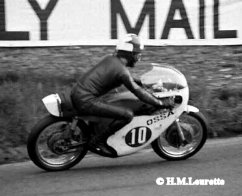
As a Spaniard, it was out of the question for Santiago Herrero to ride a motorcycle of a nationality other than his own. That's why we always saw him on his improbable OSSA with a single-cylinder engine, derived from the brand's motocross bikes, totally outclassed compared to Yamaha's twin-cylinders, each better tuned than the last. The Ossa brand compensated for 50% of this technical handicap with innovative chassis features: a monocoque frame and oleopneumatic suspension.
The rider made up for the other 50% that the machine lacked to compete with the Yamahas.
In 1969, at the Ulster GP (Ireland), Santiago crashed and broke two malleoli in his left hand. The next Grand Prix took place three weeks later, at Imola. The doctor refused to let him go, but Herrero insisted. The doctor then told him he would sign the authorization if he shook his hand. With "Santi's" agreement, he removed the cast and they shook hands. As he left the room, Herrero collapsed in pain in his mechanic's arms. But he
started and finished 5th, which allowed him to take the championship lead, which he unfortunately did not maintain.
1970 was supposed to be the year of revenge. Santiago Herrero found himself leading the World Championship ahead of such greats as Phil Read, Rodney Gould, and Kel Carruthers.
During the Tourist Trophy, he thought he would make a big splash.
The mountain circuit was supposed to allow him to compensate for his bike's weaknesses with his riding. But
"Santi" fell early in the race. Tenacious, he got back on his bike but never saw the finish. As
Henri-Michel Leurette says on his website (webzinemaker.com/pilotedelegende)
"the angels couldn't bear to live without him..."
Randy Mamola Titles : 0 |
|
Among the uncrowned riders, Randy Mamola is certainly the one who will be remembered most for his spectacular riding (even more so than Kevin Schwantz) and his unforgettable tricks, such as the one that involved going over 120 km/h from one side of his bike to the other to catch it after a spin, breaking its fairing, and then continuing his race.
Let's not forget that he was also a vice-world champion several times.
More than ten years after his retirement from competition, when he appeared to perform a demonstration, of course enhanced by a few tricks, he still received a standing ovation from the crowd.
Renzo PasoliniTitles : 0 |
|
After starting out at Aermacchi, Renzo Pasolini moved to Benelli, with whom he won the 350 class world vice-championship in 1968.
Following a highly publicized separation at the time,
Renzo Pasolini returned to Aermacchi.
His results for this brand could hardly have been
brilliant: It's indeed difficult to compete against
3- or 4-cylinder M.V.s with a single-cylinder engine, and even more so,
a rocker arm!
However, with an Ala d'Oro, he achieved
very respectable rankings in the Italian championship races, which
were, admittedly, held on circuits that, due to their layout
and track width, were more like hill climbs
than traditional circuits.
With Aermacchi's single-cylinder 350s being overtaken by both
the M.V.s and the Yamahas, whose reliability was improving
more and more, the company decided to develop two-stroke twins
for the 250 and 350 classes, thanks to subsidies
provided by Harley-Davidson, with whom ties had
become very close. narrow.
Renzo Pasolini was the ideal rider to lead the development of these new machines, since he had an engineering degree.
He was highly regarded by the public because he had shown himself capable of competing against the greatest, but also for his kindness and calmness.
Personally, what struck me most about this rider was his driving style, which was, to say the least, unorthodox:
He was often seen approaching a bend very quickly, then, suddenly, straighten up and spread his arms and legs, as if he had been in a panic.
Was it due to poor eyesight, a theory that could be supported by glasses with lenses at least 1 cm thick?
Certainly not, since he adopted this method in practically every bend.
And then, if it had been Ineffective, he certainly would not have won multiple Grand Prix races ahead of the best, such as
Agostini or Saarinen.
PASOLINI tragically passed away on May 20, 1973, at Monza, at the same time as Jarno Saarinen.
Both had many things in common, including being extremely well-liked by those around them and the public.
Gary McCoy Titles : 0 |
|
When Red-Bull's team manager called on
Gary McCoy during the '98 season to replace a rider
he deemed underperforming, most of his colleagues-and competitors nonetheless-wondered if he hadn't simply
fallen on his head.
Winning races was particularly important for a team since the bikes were entrusted to them by Japanese manufacturers, and Yamahas were becoming increasingly sought-after. Why then, rather than hiring
a "sure thing," possibly from
Superbike, bring in this Australian who has only won
two Grand Prix in 125cc, with inconsistent results, and who
has never ridden a more powerful bike?
Everyone is wondering.
McCoy's first appearances confirm for many
their initial feeling: Although his style is spectacular,
it can only be ineffective. Furthermore, he rides with a 16.5" wheel, which the "big shots" in power don't want to hear about.
He did win a race in early 2000, but it could only be anecdotal.
Until his results began to improve, then he won two Grand Prix in a row: He was the only one to have done so during the 2000 season. He then had as many wins as the championship leader.
Since then, almost everyone has switched to a 16.5" rear wheel.
This hardly matters. McCoy is one of those riders, like Schwantz or Mamola, whose spectators don't come to see him win or win a title (which, however, we wish for him). Seeing him ride is enough for them. What is certain is that he doesn't worry too much about finding sponsors. Whether he wins or not, he's one of the most filmed riders in the entire field!
For 2004, McCoy joined NCR Ducati in the Superbike World Championship,
In 2008, McCoy joined Triumph's new Supersport World Championship campaign on the Daytona 675 bike.
2009 was his last active season
Joey Dunlop Titles : Sans importance |
|
The only rider here who, unless I'm mistaken, has never set foot on a Grand Prix circuit, but who could have easily
shown his "illustrious" colleagues a lesson.
An average speed of 200 km/h on a circuit like the Tourist Trophy is already a certain calling card, isn't it? Especially since he won the "TT" 26 times. Plus the Ulster 23 times, among others. And in all categories.
Joey raced primarily for fun; otherwise, he would have retired well before the age of 48. It was a lifestyle choice: He
took as much pleasure in hosting his friends in his bar in his native Ireland.
The most impressive thing, certainly, was that he was able to take a van and go to Kosovo to bring food and clothing to starving children. He delivered them himself to make sure they reached their destination. These days, he would have been just as capable of going to Afghanistan.
The "others" fight on the track. He fought on another level: that of life. Not out of calculation, but because he was Joey. Unique, quite simply and in all simplicity.
This page is adapted from an archive of Histoire de la Moto, 1900-2000
Edited March, April, May 2026