
2¾ h.p. Enfield.
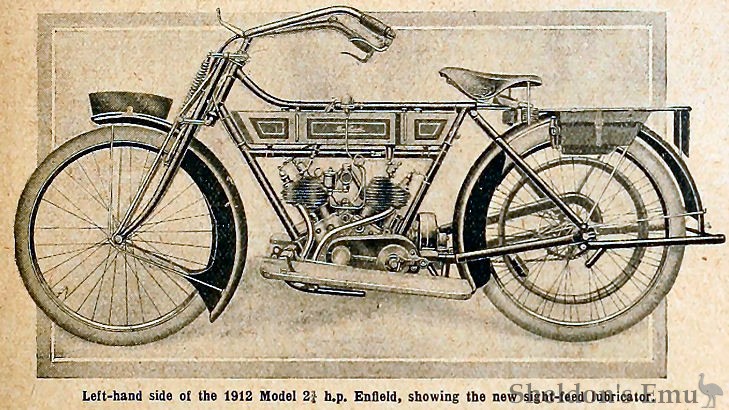
Left-hand side of the 1912 Model 2¾ h.p. Enfield, showing the new sight-feed lubricator.
Very few alterations have been found necessary in the 2¾ h.p. Enfield; in fact, refinements only are noticeable. Long footboards are fitted, and the two-speed gear will be operated by pedals. A new silencer with no cut-out is now used, and the crank case relief valve has been moved to the right hand side of the rear cylinder, and from it is led an overflow pipe, so that any surplus oil serves to lubricate the rear driving chain. An improved exhaust valve lifter is employed, having a very neat and simple action. The gear ratios have been raised to 5¾ to 1 and 7¾ to 1 instead of 6½ to 1 and 9 to 1. Lubrication is by a sight-feed drip, a hand pump being fitted for emergencies. Side flaps are fitted to both front and rear mudguards.
The 2½ h.p. open frame has two or three extra refinements. A lever is fitted on the handle-bar, by means of which, when the engine has been started, the gear can be withdrawn while the rider takes her seat. An auxiliary dressguard has been fitted over the engine, and a cushion drive is employed. This is also standard on the 6 h.p. sidecar machine, and can be fitted as an extra to the 2¾ mount. It consists of six rubber blocks divided by arms, through which the drive is taken. Three of these arms lie in the hub shell and three in the corresponding case on the driven sprocket. We rode a 2¾ fitted with this device, and though the machine was exceptionally highly geared (4¼ to 1), we noticed not the slightest jar even when running slowly.
We have already dealt with the new 6 h.p. Enfield-Jap sidecar combination which will be a feature of the exhibit.
1911 Olympia Show - The Motor Cycle November 16th. 1911. Page 1214
ROYAL ENFIELD, No. 39.
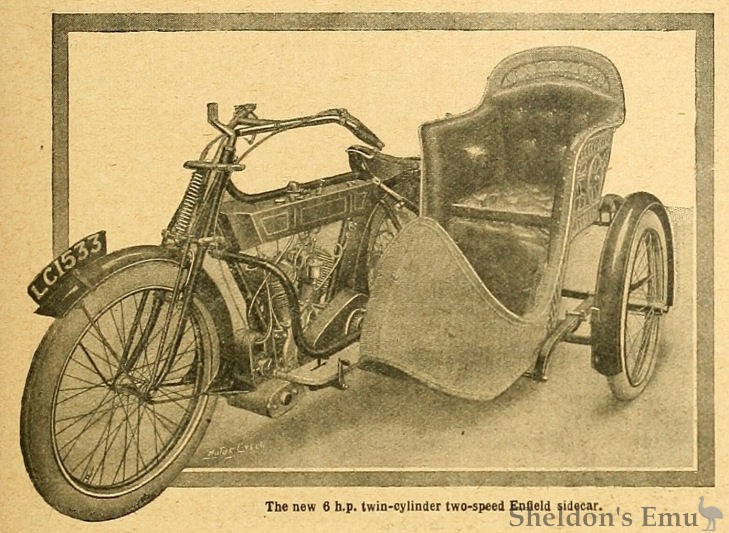
The Enfield Cycle Co., Ltd., Redditch. – The 6 h.p. Enfield is specially constructed for sidecar work. It is fitted with an enlarged and strengthened Enfield two-speed gear with rubber cushioning device for taking the shock of the drive. Improved handle starting has been fitted for 1912. A 650 x 65 mm. back tyre is adopted to take the strain transmitted to the rear wheel of a combination passenger machine. Drip-feed lubrication is employed to the engine. Neat rubber-covered footboards are fitted, and the gear control is operated from a handle fixed to the top tube. A new feature of this model is the easily detachable rear mudguard and carrier which facilitate tyre repairing. We described this model in detail on October 26th, since when no important alterations have been made.
This model was described in our issue of November 16th, and it is only necessary to remind our readers that it can be supplied with either single gear or the Enfield two-speed (in this case operated by pedals on the footboard). It is fitted with a new handle-starting device, and it will be remembered that on the 2¾ h.p. model the valves are disposed in pairs, behind the rear V cylinder and in front of the front cylinder.
The 2½ h.p. lady's model was also mentioned in the issue of November 16th. In this case also the gear is foot-operated, but a lever is fitted on the handle-bar to enable the gear to be put in the neutral position while the rider takes her seat. The rubber-cushioning device is fitted to this model as a standard. Mudguarding has been carefully studied in all models, and side flaps are fitted to both front and rear guards.
1911 Olympia Show - The Motor Cycle November 23rd, 1911. Page 1249
Autorette.
The Autorette, which is a new two-seated three-wheeled runabout manufactured by the Enfield Autocar Co., Ltd., of Birmingham, and illustrated on this page, will, we understand, be in view next week at Stand No. 38, Alldays and. Onions, Ltd., Birmingham.
This new runabout possesses several interesting features, particularly in connection with the springing. The frame and two-seated side by side body are supported on laminated springs which extend both sides of the single rear driving wheel, and are there coupled to a lever and rod system which enables the rear wheel to rise and fall and yet keep perfectly vertical. The engine, which is at present a water-cooled 7-8 h.p. twin m.o.v. J.A.P., is fitted between the body and the rear wheel mudguard, and drives through an epicyclic gear carried alongside the engine, providing two speeds forward and a reverse. The transmission from the gear box shaft to the rear wheel is by a roller chain running in an oil bath, metal-cased. Side radiators are placed between the body and the rear mudguard, one on each side of the engine, and the whole mechanism is enclosed by a metal case provided with a sliding top panel. The steering is by wheel with inclined steering column like a car, and there is also a cape hood and wind screen. The wheels are 650 x 65 mm., with plain tread to the front and steel studded to the rear; a butt-ended tube is fitted to the rear tyre. Two brakes are provided, one on the rear hub operated by a hand lever at the side, and one on the front wheel operated by pedal. The whole machine is finished in French grey, and the body is well upholstered, side doors being fitted exactly the same as on the larger four-wheeled vehicles made by the Enfield Autocar Co.
1911 Olympia Show - The Motor Cycle November 16th, 1911. Page 1216
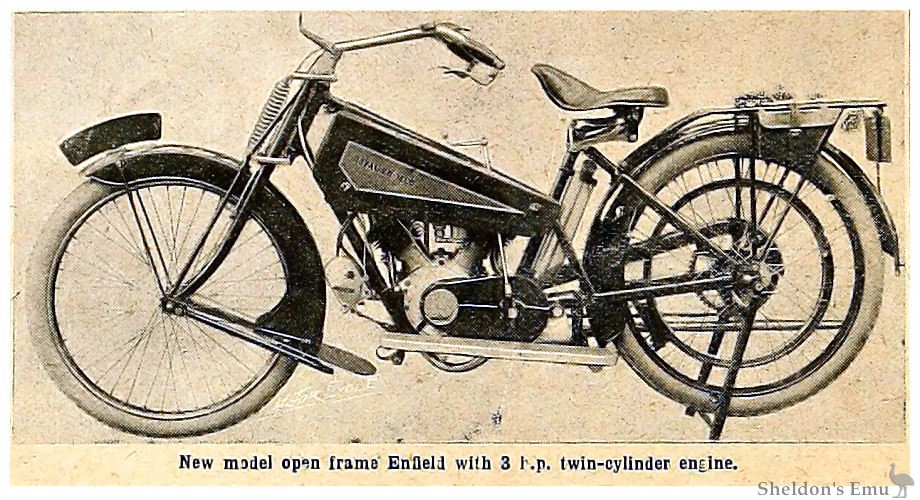
The 3 h.p. is a new model, and was described in a recent issue of this journal. The engine is a striking piece of work. The method of attaching the cylinders is unusual, and it is only necessary to undo three nuts, when both cylinders can be removed. This is effected by three small clamps, which grip a flange on the base of the cylinder. A neat kick-starter is attached to the 2 to 1 gear. A mechanical oil pump is fitted on the timing gear side. This forces oil through the crank pin and big ends, whence it is splashed to the pistons and remaining bearings. A large glass oil reservoir, through which the oil is pumped, is fitted behind the seat-pillar. As in the case of the 6 h.p. model, the front chains are entirely enclosed, and the rear chain is protected on the upper side. Footboards are fitted, and the Enfield V. handle-bars with controls braced on, which have become a feature of these machines.
This model is also shown constructed as a lady's machine, with a sloping front bar. The petrol tank is provided with a large glass topped filler cap, which acts also as a petrol gauge. Simple and neat dressguards are fitted round the tank, extending below it. These are hinged to the upper edge of the tank and held in position by simple clips. Thus the engine is readily accessible, although the shields afford ample protection for a lady's skirt.
2¾ h.p. Model (twin-cylinder) : 54x75mm.; side by side valves; Amac carburetter; chain: Enfield two-speed
The 2¾ h.p. Enfield is too well known to require lengthy description, and has undergone no important alterations with the exception of the fitting of a kick-starter. This is carried on the front down tube and connected to the crankshaft by means of a chain. The Enfield "cush" drive is fitted to all models; this consists of a drum divided into three compartments, in which lie six rubber blocks; between each pair of blocks is a flange attached to a plate on which is carried the driven sprocket. All the Enfields are beautifully finished.
1912 Olympia Show
The Motor Cycle November 28th, 1912 p1392
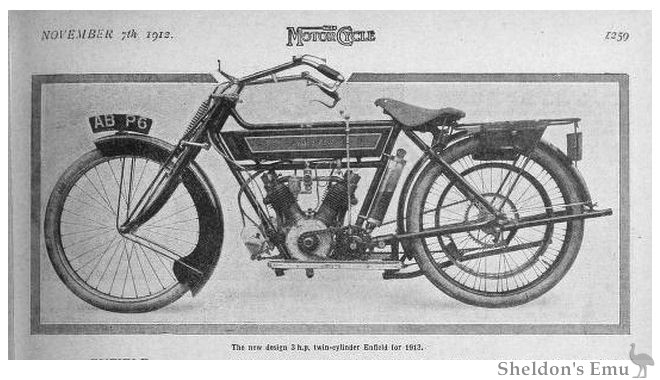
Royal Enfield 1912 3hp V-Twin 425cc
The cylinder bore has been increased from 54mm to 60mm. It has the same engine type as the prototype, being of Enfield's own manufacture, but housed in the early frame. When the bike entered the catalogued range for the 1913 season, it had a new frame and slightly heavier constructed forks.
Image and text courtesy Keith Hodgson of Yorkshire
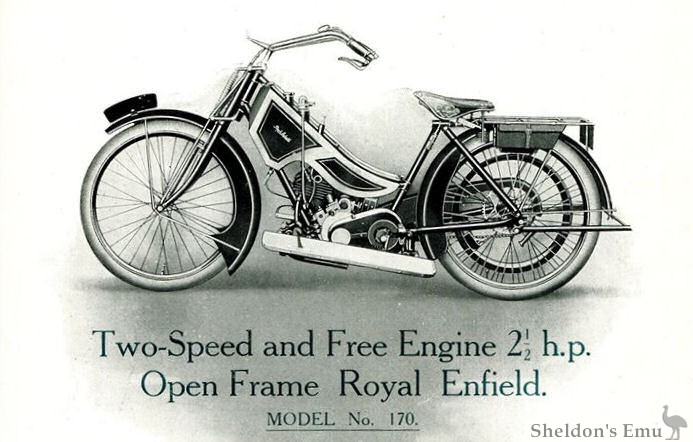
2½-h.p. Open Frame Motor Cycle
With Royal Enfield patent two speed and free engine gear,
The elegant design of this machine and the ease with which it is mounted and dismounted make an immediate appeal to ladles, business and professional men. The engine which with all other working parts is efficiently guarded by quickly detached covers, has a single cylinder bore and stroke 64 × 75 m/m, and develops remarkably high power. It is fitted with Amac carburettor, Bosch magneto. automatic drip feed lubrication. The drive is transmitted by Hans Renold chain to the rear wheel, where is fitted the Royal Enfield patent Cush Drive (an ingenious arrangement by which the drive is taken through rubber which absorbs ail shocks. ensures sweet running. and adds greatly to the life of the tyres).
The equipment includes the famous Royal Enfield patent two speed and free engine gear with foot pedal control, foot boards of ample width, Royal Enfield registered spring forks and clean handlebar. Dunlop tyres. etc.
Price Net Cash 50 Guineas.
If you have a query or information about the Royal Enfield please contact us