
1898 - The first automotive vehicles with the Royal Enfield name were produced - a quadricycle with a De Dion-Bouton 2.75 hp engine. This was followed by a tricycle.
1900 - By now the quadricycle and tricycle had been produced in some numbers.
1901 - Produced the Motor Bicycle with a 150cc 1.5hp engine above the front wheel. As an early Werner design, the engine sat in front of the headstock and drove the rear wheel by a crossed belt that must have worn badly.
1902 - The model continued for that year and was replaced by a similar contraption with an Enfield engine of 239cc 2.75hp.
Report from the 1902 Stanley Show
The third machine has a 2.25 h.p. water-cooled engine, bolted vertically in the frame; the timing shaft forms the driving shaft, but, instead of being at a two to one ratio, the reduction in speed is six to one, the necessary exhaust lifting and sparking cams being made in triplicate on the large tooth wheel; no other gears are used. The timing shaft issues from the crank case at the opposite side, and carries on its extremity a driving chain wheel containing a spring clutch, from which the drive is conveyed to the back hub by a special chain. The front compartment of the tank contains the cooling water, one and a half gallons being carried; 18ft. of 3/8 inch aluminium piping, formed into a radiator, is coiled in the space between the tank and down tube. The weight complete, with petrol and water, is 140lbs., price 75 guineas, and speed 30 miles per hour. This, however, can be easily altered by changing the rear sprocket wheel. In quads, the well-known Enfield type is retained, fitted with either 3.5 or 2.75 water-cooled De Dion engines, and Bozier two-speed gear, worked by lever at drives side; the quads sell at about 120 guineas, according to power.
Motor Cycling, 26th November 1902
1903 - Two of the new models had Enfield engines mounted vertically in a loop frame. One was of 239cc with belt-drive, and the other 2.25hp water-cooled with chain drive to the rear wheel, but this was too expensive. A third model, with a Minerva engine hung from the down-tube, appeared and was soon dropped.
1904 - The simple single remained - this with a 2.75hp or 3.5hp engine and belt drive - plus a cheaper air-cooled version.
1905 - The cheaper model now had two-speed gear. The company's attentions began to turn to cars.
1906 - Produced 16-20 and 24-30 h.p. automobiles with shaft-drive and four-cylinder engines.
1907 - The company merged with Alldays and Onions and produced cars called Enfield-Allday until 1925.
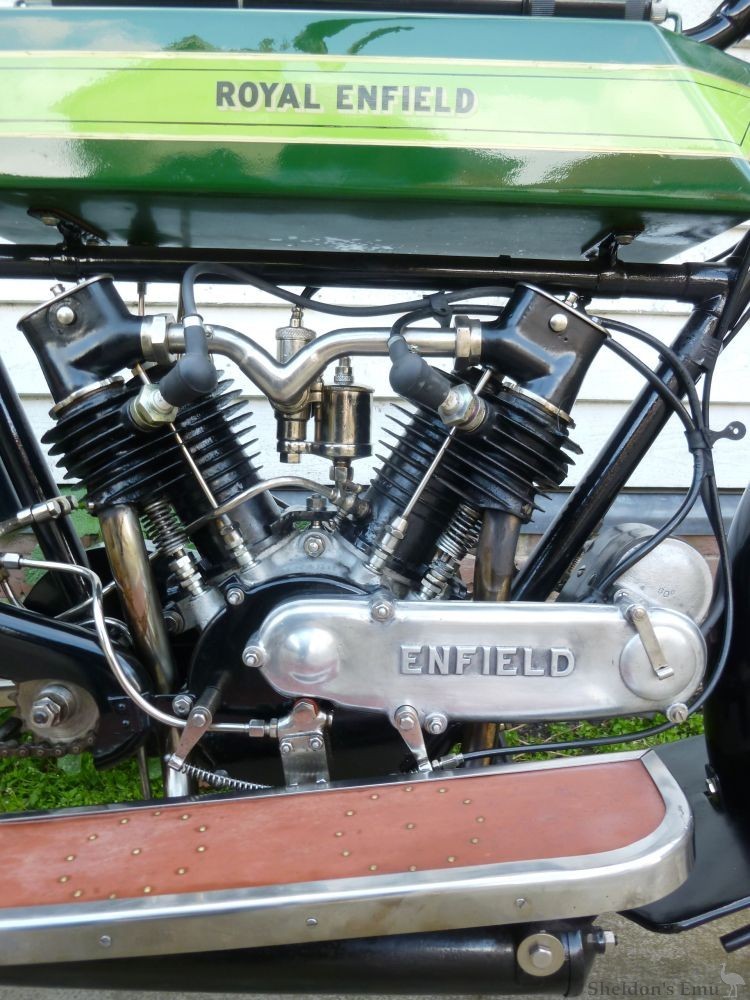
1909-1910 - They returned to powered two-wheelers late in 1909, and produced the first of the famous Enfield V-twins, first with Motosacoche 344cc 2.75hp engines, later with Enfield's own engine.
1911 - A 2.75hp, 343cc model appeared with a V-twin engine, chain drive and the option of two-speed gearing. One such machine came fifth in the Junior TT and others saw success at Brooklands.
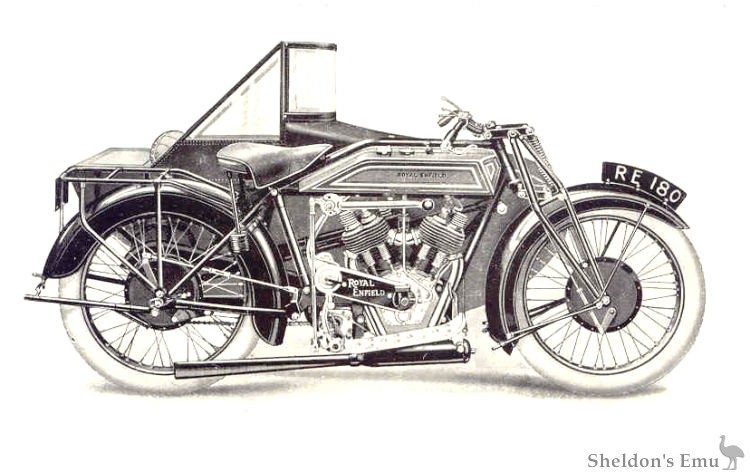
1912 - There were three models for that year: the 2.75hp V-twin, a 2.5hp ladies' single and a 6hp sidecar V-twin using a JAP engine. Chain drive, two speeds and Druid forks were common to all. The Enfield Cush drive made its first appearance.
1913 - The twins were joined by a 3hp model with a 424cc Royal Enfield engine with overhead inlet-valves and a dry-sump lubrication system. Until World War I, the big twins with 770cc, 6hp JAP engines and after WWI 976cc, 8hp Vickers-Wolseley engines.
1914 - Little changed, but a TT version of the 3hp twin was added. Again the firm entered the Junior TT but what success they had was soon wiped out by tragedy when F. J. Walker came third but crashed at the finish and later died from his injuries. During the year the firm added a 225cc two-stroke, two-speed to the range. Lightweight and simple in design, the model had a long and successful lifespan.
1915 - The first of the small two-stroke 225cc engines, starting with model 200, appeared.
World War I - Throughout the war years, the firm built the 6hp model for service sidecar use. Some were fitted out as an ambulance, others with a Maxim machine gun. They also experimented with 675cc three-cylinder in-line two-stroke with a bevel box to the two-speed gearbox and rear wheel by chain. Later came an 848cc in-line sv four built in-unit with a three-speed gearbox. Neither went into production.
1919 - Civilian models returned in 1919, with just two forms. The 6 hp JAP V-twin with an 8hp engine option for sidecar work, and the 225cc two-stroke as basic transport.
In 1921 the larger model changed to a 976cc V-twin Wolseley engine made by Vickers to an Enfield design.
1923 - Late in the year the range expanded by adding singles with 346cc sv and ohv JAP engines, still with two speeds.
1924 - Three-speeds appeared, firstly on the four-strokes. In came drum brakes and some machines had a 346cc sv Enfield engine in preference to the JAP.
1925 - A similar OHV model was produced.
1926 - A 488cc sidevalve model joined the range.
1928 - At last there was success in the TT, when Cecil Barrow came second in the Lightweight. The road range adopted saddle tanks and centre-spring forks and was joined by a 225cc sv model. Most now had three-speed and some had four. A speedway model was introduced.
1929 - A new model was brought out as a 488cc ohv with twin-ports.
1930s - The first J model appeared in 1930. Throughout the decade there was
a large variety of models from small two-strokes to large side valves,
from A-Z. A 225cc two stroke, B 225 cc sv, BO 250cc ohv Bullet, C 350cc
sv, CO 350cc ohv, G 350cc ohv Bullet, H 488cc sv, J 488cc ohv, J2
488cc two port ohv, K 976cc sv v-twin, L 570cc sv, T 148cc ohv, Z (Cycar)
148cc two-stroke and many more variants.
See J Series
1931 - All the singles had inclined engines, some of which had been modified.
1932 - The radical new model called the Cycar appeared.
1933 - The first Bullet 500cc single, with exposed four-valve rocker gear and inclined engine, was introduced.
1935 - They changed to three valves. These engines had their integral oil tank in front of the crankshaft, while post-war Bullet oil tanks were behind the crank. They were dry sump, the integral tank being separate from the crankshaft space. Royal Enfield entered a 500cc Four valve-Racing model for the Senior TT 1935. This was the last TT Royal Enfield entered. Despite having entered in the TT from 1911, the factory never managed a first place.
1936 - A new series of singles took over. These had vertical engines with oil sump in the crankcase. The range covered all the sizes described above.
1937 - British Industries Fair Advert for Royal Enfield Motor Lawn Mowers. Also for Motorcycles, Cycles and Motor Carriers. All made throughout in the famous Royal Enfield Works at Redditch, of all-British materials and components. (Engineering/Metals/Quarry, Roads and Mining/Transport Section - Stand No. B.427)
1938 - Royal Enfield 500cc single port J model ohv. During the 1920s a mid-range of Enfields left the Redditch factory: model 350 (350cc SV), 351 (350cc OHV) and 352 (350cc twinport sports). The two-valve J model rockers were enclosed, and the engine became upright. Model K side-valve V-twin had grown to 1140cc and was then called KX.
World War II - During the war production changed to motorcycles for the forces. The models produced for the military were the WD/C 350cc side-valve, WD/CO 350cc OHV, WD/D 250cc SV, WD/G 350cc OHV, WD/L 570cc SV and the "Flying Flea" - a 125cc lightweight motorcycle that was could be dropped (in a parachute fitted tube cage) from aeroplanes.
After the war the Enfield Cycle Company came back with the last G and J pre-war models, and the "Flea". The post-war J models had a rigid rear frame, and a four-speed Albion gearbox with an extra lever that the rider could press to find neutral. This was a simple, solid 499cc push-rod single with 84 mm bore x 90 mm stroke and a compression ratio of 5.5 to 1. It also used a fully floating white metal big end, similar to those found in radial aircraft engines, with the usual felt oil seals, Amal carburetter, and Lucas magneto ignition. The fully floating white metal big end could be replaced with an aftermarket caged roller bearing conversion.
1947 - The Royal Enfield 500cc Model J was back in production, but was now fitted with telescopic forks with two-way hydraulic damping instead of the old pre-war girder forks. The front axle mountings were offset forward of the fork legs.
1948 - The J2 model, with 'twin exhaust ports' and pipes, was released initially for export only. The J2 exhaust port split into two after the exhaust valve, so the difference was more for appearance.
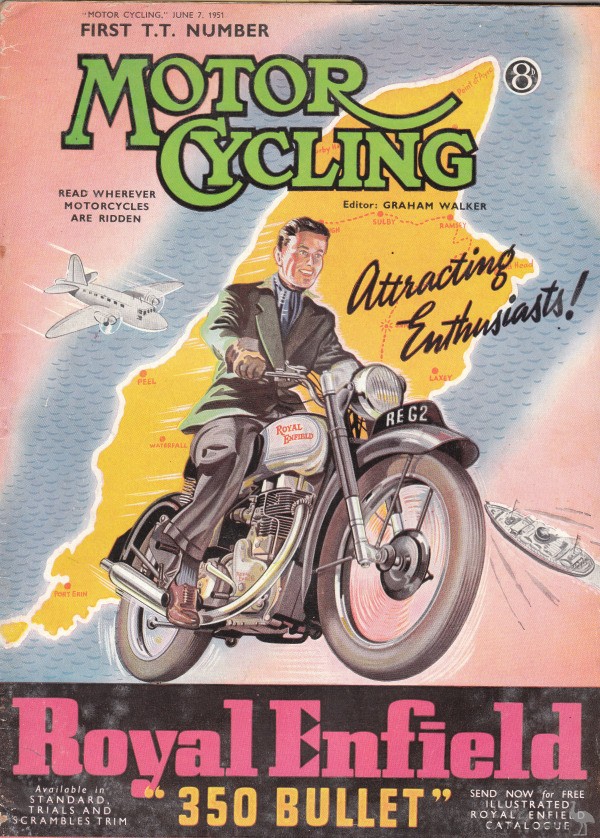
1949 - The Bullet name was revived for a 346cc sports model listed in road, trials and scrambles forms, all with pivoted-fork rear suspension and modified design.
1950 - The compression had been raised to 5.75 to 1, with a claimed power output of 21 bhp at 4,750rpm. These were essentially torquey sidecar machines.
1954 - The 350cc Bullet model was to be made in India until the present. In 1953 the 500cc model appeared, using the same bottom end.
1955 - The Indian government looked for a suitable motorcycle for its police and army, for use patrolling the country's border. The Bullet was chosen as the most suitable motorcycle for the job. The Indian government ordered 800 350cc model Bullets, an enormous order for the time.
1955 - The Redditch company partnered Madras Motors in India in forming Enfield India to assemble, under licence, the 350cc Royal Enfield Bullet motorcycle in Chennai.
In 1957 tooling equipment was sold to Enfield India so that they could manufacture components. The first machines were assembled entirely from components shipped from England, but by 1962 all components were made in India. The Indian Enfield uses the 1960 engine (with metric bearing sizes), in the pre-1956 design frame.
1955-1960 - Royal Enfields were painted red, and marketed in the USA as Indian Motorcycles by the Brockhouse Corporation, who had acquired the rights to the Indian name after it went under in 1953. Floyd Clymer, of manual fame, was involved, but Americans were not impressed by the badge engineering, and the venture was unsuccessful. It was rather ironic that Enfields' went 'Indian' in two different ways. The largest Enfield "Indian" was a 700cc. The marketing agreement expired in 1960 and from 1961 Royal Enfields were available in the US, still through Clymer, but under their own name, up until Clymer's death in 1970.
1956 - A new frame was introduced in the British-made version of the Bullet, making it different from the 1954 model still being produced in India. The British made version was manufactured until 1964. The Bullet 350 and 500 also used the fully floating big end design.
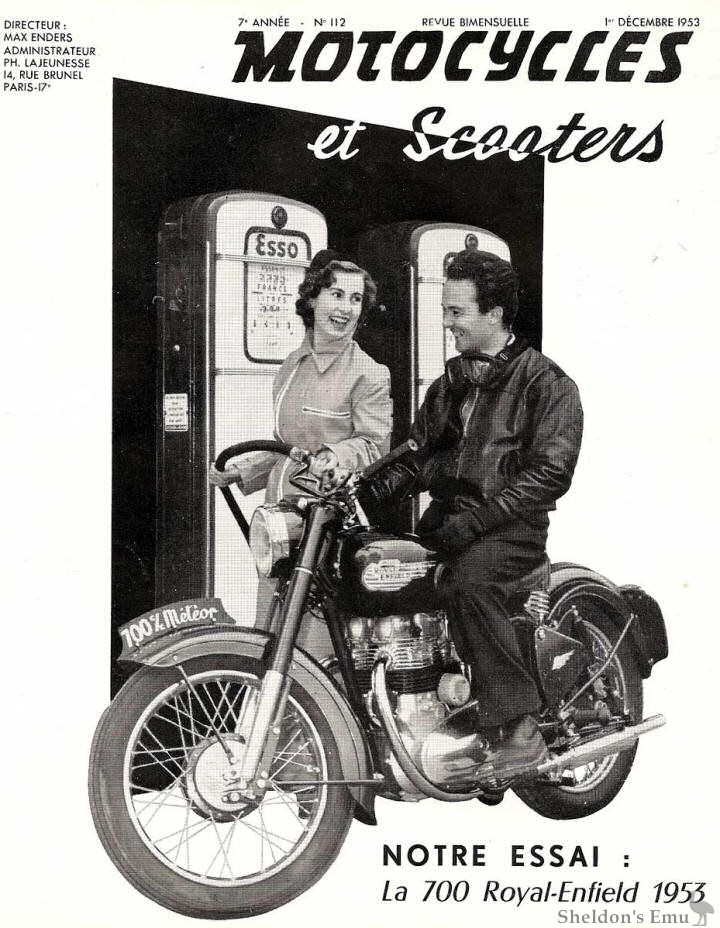
The new swing-arm frame 500cc twin of 1949 would eventually evolve into the Interceptor. The 500's big end had no bearing inserts, the machined con-rod running directly on the crank pin. In the 1956 700cc Super Meteor, a development of the 500, conventional babbit bearings were fitted, and were used on all subsequent vertical twins.
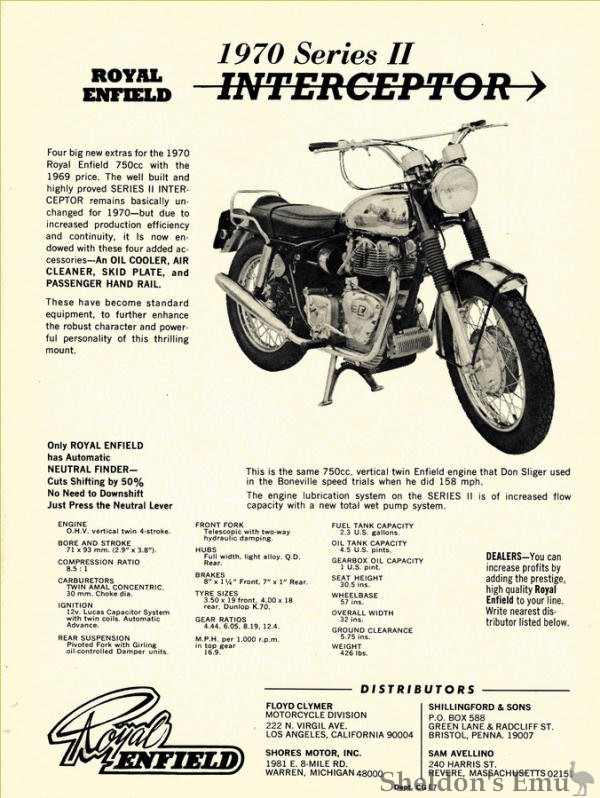
During the onslaught of the Japanese motorcycle manufacturers in the late sixties and early seventies, the English factories made a final attempt with the 1962 - 1968, series I and Series II. Made largely for the US market, it sported lots of chrome and an engine performance with less than 14 seconds to the quarter mile at speeds well above 105 mph. It became very popular in the US, but the classic mistake of not being able to supply this demand, added to the demise of this last English made Royal Enfield.
By 1962 the bikes were being manufactured by Enfield of India, which purchased the rights to the Royal Enfield name in 1995 and is now known as Royal Enfield of India.
1967 - The Redditch factory ceased production in 1967, and the Bradford-on-Avon factory closed in 1970, which meant the end of the British Royal Enfield.
After the factory closed, a little over 200 Series II Interceptor engines were stranded at the dock in 1970, originally on their way to Floyd Clymer in the US, but unfortunately he had just died, and his export agents, Mitchell's of Birmingham, were left to dispose of them. They approached the Rickman brothers for a frame, and the Rickman brothers' main problem had always been engine supplies, so a limited run of Rickman Interceptors were promptly built.
Royal Enfield is the only motorcycle brand to span three centuries, and still going, with continuous production. A few of the original Redditch factory buildings remain (2006) and are part of the Enfield Industrial Estate.
An independent manufacturer since the demise of Royal Enfield in England, Enfield India still makes an essentially similar bike in 350cc and 500cc forms today, along with several different models for different market segments.
1986 - UK civil servant Raja Narayan, returned to India and organised an export arm for the company to market the Bullet in England. Starting with a 350 in 1986, he was soon giving feedback that led to improvements. By 1989 the Enfield Bullet appeared in UK motorcycle shows.
1994 - Eicher Group bought into Enfield India.
1995 - Late in the year, the Enfield India firm acquired the rights to the name Royal Enfield. Royal Enfield of India now sells motorcycles in over twenty countries.
2006 - The latest top level export version of the Bullet is the Electra-X a 500cc machine with a 'lean burn' engine incorporating a new cylinder head and piston, alloy barrel, gear oil pump and roller big end bearing. There are also some styling and frame changes as well as a front disk brake. The recently designed left foot change 5-speed gearbox and electric start are also part of the package. Other improvements are a more modern Micarb VM 28 (CV) carburettor, 280 mm front disk brake, 150 mm rear single leading shoe drum brake, electronic ignition, and new, gas filled rear damper units. This is an export-only model, and in India the top Electra is a 350cc, though a basic right change four speed 500cc version is available.
First designed around 1947, but still including elements from earlier
machines such as the Model G, the Bullet claims to have the longest
continuous production run of any motorcycle. It is also significant that
the Indian factory has itself now celebrated its own 50th birthday.
Lately, the Royal Enfield motorcycles have enjoyed a resurgence in India after the release of some new models of these bikes with a constant vacuum (CV) carburettor and an alloy engine. These models are the Royal Enfield Thunderbird and Machismo. A model called Electra , which is a more refined version of the classic 350cc machine with electric-start kit is also popular. This model is not normally exported outside India, but is replaced by the 500cc Electra-X .
Source: Graces Guide
If you have a query or information about about this page, please contact us