
Rex Patterns.
The alterations from the 1911 Rex models are not drastic, but they are sufficiently important to warrant a fairly lengthy description. For example, over-head valves have been discarded in favour of those side by side; large diameter valve springs are employed, and the shape of the cylinders has been slightly altered. The cylinders are secured to the crank case by two swinging bolts, which are hinged on the crank chamber connecting bolts, and pass through holes in the head, thus the cylinder casting is in compression to some extent, and can really be made slightly lighter in the walls than if held down by studs and nuts at the base of the cylinder.
One of the most novel alterations is the eccentric rim to the flywheels, recently illustrated. This has been adopted to secure not only a better balance without bob-weights, but the makers also claim that they can obtain a higher engine speed owing to the lessened friction due to air resistance in the crank case when ordinary bob-weights are fitted with angular projections. The internal cams have been discarded in favour of the usual type of outside cam. In place of ball bearings to the crankshaft, Hoffmann roller bearings have been adopted, and it is claimed that there is no more friction with this type of bearing, and line instead of point contact is obtained, the former being considered an advantage by the makers.
The taper gudgeon pin in the piston is retained, but a set-screw is added which locks the pin in position and renders it absolutely secure. The magneto is chain driven, and is carried at the rear of the crank case, the timing gear cover plate and one-half of the magneto driving chain cover being cast in one as in the 1911 models. Arrangements have been made for re-timing the magneto by providing a special nut which screws on to the end of the armature-shaft. This nut is screwed externally in such a manner that when it is removed from the shaft and reversed endwise, the externally screwed part engages with a thread cut on the inside of the sprocket wheel. The nut is then screwed inside the recessed sprocket until it butts against the end of the armature-shaft, when the force exerted by the screw draws off the sprocket, which is fitted on the coned end of the shaft in the usual manner. Of course the sprocket need not be entirely removed; the moment it is loosened the magneto can be retimed and the nut reversed.
The Rex firm was one of the first to adopt the vapour pipe from the crank case to the combustion head, viâ the carburetter, and it has now been decided to fit this pipe direct from the crank case to the inlet port in the cylinder. The oily vapour which is forced up this pipe every time the piston descends assist in lubricating the top portion of the cylinder walls.
There are practically no alterations to the bicycle itself, except that the aluminium footboards have been replaced by neat wooden boards, which will be fitted on springs and covered with rubber matting. The arrangement of the exhaust pipes on the twin is neat. The end of the tube is merely flattened, and the result is not by any means noisy.
Singles and twins, air and water cooled, will be staged at the Show in racing and touring trim.
1911 Olympia Show - The Motor Cycle November 16th, 1911. Page 1211
REX, No. 73.
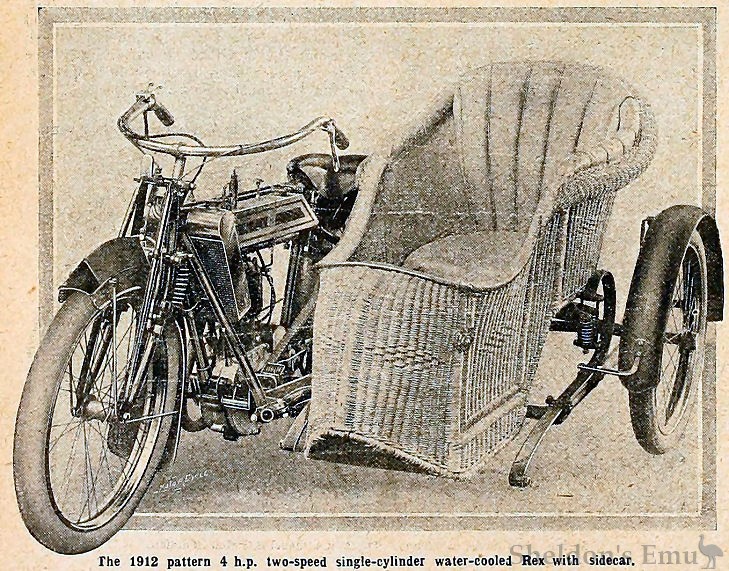
The 1912 pattern 4 h.p. two-speed single-cylinder water-cooled Rex with sidecar.
The Rex Motor Mfg. Co., Ltd., Earlsdon, Coventry. – The single -cylinder models have been re-designed for 1912, a detailed description having already been published in these pages. The well-known two-speed hub gear remains unaltered. The starting handle is carried in a leather holster strapped to the side of the carrier. All the machines are fitted with the Rex spring cantilever saddle pin and the T.T. type of exhaust pipe, consisting of a long pipe extending to beyond the rear axle, the end of which is flattened. A cut-out is provided worked. by the rider's heel. The magneto is handle-bar controlled in all types. The inflator clips are brazed to the front forks.

A new model for Olympia. The twin-cylinder two-speed Rex-Jap, which as its name implies, is a Jap-engined machine, built in the Rex works. It is sold by the Premier Motor Co.
The principal features of the Rex twin, such as the tank, saddle, and efficient mudguards on the front wheel, wide rubber-covered footboards, etc., are the same as in the single-cylinder models. All touring machines are provided with a special bracket bolted to the head for carrying a generator. The T.T. twin is of the same dimensions as the above, but is single-geared and has a flat handle-bar. One of the most interesting machines in the exhibition is the 4 h.p. water-cooled Rex. Except for the water cooling this machine is similar to the other single-cylinder model. The water-cooling system is particularly neatly carried out. Both outlet and inlet pipes are of ample dimensions, while the radiator is of the honeycomb type and should be particularly efficient. The circulation, of course, is on the thermo-syphon system. The water-cooled machine is fitted to a sidecar, the basket body of which calls for special comment. Its exterior lines are particularly graceful, and it is upholstered in Quaker grey-coloured leatherine. Pockets are provided on each side of the footboard, while a high side door is fitted. The padding at the back is supplemented by springs, while upholstered rolls run along the side arms. The Sidette is also shown, the motive power of which is a 6 h.p. Rex twin engine. This machine is one of the most practical sidecar combinations in the exhibition.
1911 Olympia Show - The Motor Cycle November 23rd, 1911. Page 1264