
Premier Motor Co of Aston Road, Birmingham
1906 Produced four and six cylinder cars made in Belgium and sold under the Premier name.
Premo was a motorcycle produced in 1909, by the Premier Motor Co. This was the name used by the company for the two-stroke Rex model they sold.
They used the Premo name until late in 1909, when an injunction was taken out against them by the Premier Cycle Co of Coventry. They then became PMC. There was never any connection between the Birmingham and Coventry firms.
1910 Cycle and Motorcycle Exhibition
Premier Motor Co.
Aston Road, Birmingham. Stand No. 77.
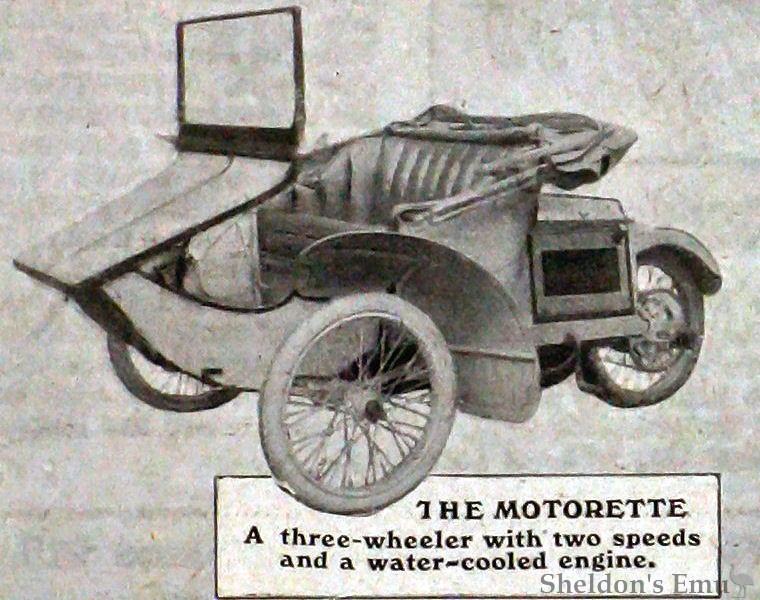
The Premier Motor Co. have a particularly attractive bill of fare to offer for 1911. The two-stroke 3½ H.P. single machine has not been greatly altered, as it was found quite satisfactory during the past season. An entirely new model will be introduced in the Motorette Sociability. This may be briefly described as a tri-car with the two seats side by side. This development of the body work is extended by covering in the back part of the machine, very much like the back of a beetle. At the front the passenger's comfort is increased by an ample sloping dashboard, and a hood can be raised for bad weather. The frame is carried on semi-elliptical springs in front, and by single arm springs at the back. Two types are provided, one, a two-stroke with fan cooling, and the other, a four-stroke with water-cooling. In both cases there are two exposed flywheels, one at each end of the crank shaft, and the spokes of the flywheels are formed as vanes, either for the cooling cylinders direct or by drawing air through the radiator, which is arranged in two parts on either side of the engine.
The steering is effected by an upright tiller, which carries the control levers of the Brown and Barlow carburetter. A Bosch magneto is employed for ignition purposes. The lubricating oil is fed by hand pressure to a well in the forward extension of the crank case. Thence it drops at a predetermined rate into the crank chamber, where it is kept at a fairly constant level by the crank throwing any surplus into a recess which is provided for the purpose. The change speed gearing is of the Roc type, and is mounted in the back hub, but a plate clutch is employed instead of usual band clutch for the high speed. The brake pedal is provided with a ratchet so that the foot is relieved in descending long hills.
In addition, the company have some of their well-known rigid side-cars.
P.M.C.
Three new models will be marketed by the Premier Motor Co., of Birmingham. In each case the frames are made by the Rex Manufacturing Co., while the engines fitted are the 4 h.p. single-cylinder and 6 and 8 h.p. twin-cylinder J.A.P.'s.
One of the twins was shown to us, and we were at once struck by the neat and workmanlike appearance of the machine. The Rex two-speed is fitted in the rear hub, and both wheels, belt rim and gear brakes are effectively mudguarded, while the magneto is placed behind the engine, thus being easy of access and protected from mud.
Special lugs are brazed to the frames for sidecar attachment. The mention of sidecars brings us to the fact that we saw in the process of construction a new model P.M.C. sidecar, the frame of which has a cranked rear cross-member to allow the wheel to be brought in line with the rear wheel of the motor cycle, while the front member is dropped to allow the body to come more to the rear without bumping the frame. We were also shown a neat coach-built torpedo sidecar body, with a side door.
1911 Olympia Show - The Motor Cycle October 26th, 1911. Page 1127
P.M.C., No. 108.

A new model for Olympia. The twin-cylinder two-speed Rex-Jap, which as its name implies, is a Jap-engined machine, built in the Rex works. It is sold by the Premier Motor Co.
The Premier Motor Co., Ltd., Aston Road, Birmingham. - Two models of the Rex-Jap machine, which may be described as being Rex motor cycles with the exception of the engine, are shown, one conforming with the specification above and the other being an 8 h.p. model with 85 x 85 mm. engine. The Bosch magneto is placed immediately behind the crank case. The two-speed gear is made under Roc licence, and enables the engine to be started by handle with the wheel on the ground. Automatic drip-feed lubrication is provided. The tank is of a sensible and large size and is painted in distinctive colour.
Shown on this stand, and intended for use with these models, is a very fine example of a coach-built sidecar, a great feature of which is the extraordinary lightness. The sidecar wheel is sprung on a pair of quarter elliptic springs furnished with radius rods, so that it is impossible for the wheel to get out of alignment. An excellent feature in this arrangement is that for an extra heavy passenger the springs can be slid along the clips so as to be greatly stiffened. The frame of the sidecar is extended backwards, and supports a large luggage grid and also a carrier for a spare cover. This sidecar is fitted with very quick detachable fittings, which allow the combination to be assembled or erected in less than one minute.

Offside of the new P.M.C. Motorette with water-cooled engine.
The Motorette three-wheeler is shown in two types, both for passenger work and commercial use. The engine is water-cooled, the radiators being placed on each side of the bonnet, which is immediately behind the side-by-side passenger seats. In front of each is a scuttle dashboard with hinged flap, carrying a wind screen. The engine case is surmounted by a large luggage carrier. Lubrication is of the semi-automatic type, a large supply of oil being carried in a separate tank, from which it is forced by a hand pump into the engine sump. The flywheels are cast with large fan blades, which induce a draught of air through the vertical tube radiators.
1911 Olympia Show - The Motor Cycle November 23rd, 1911. Page 1257
Source: Graces Guide