
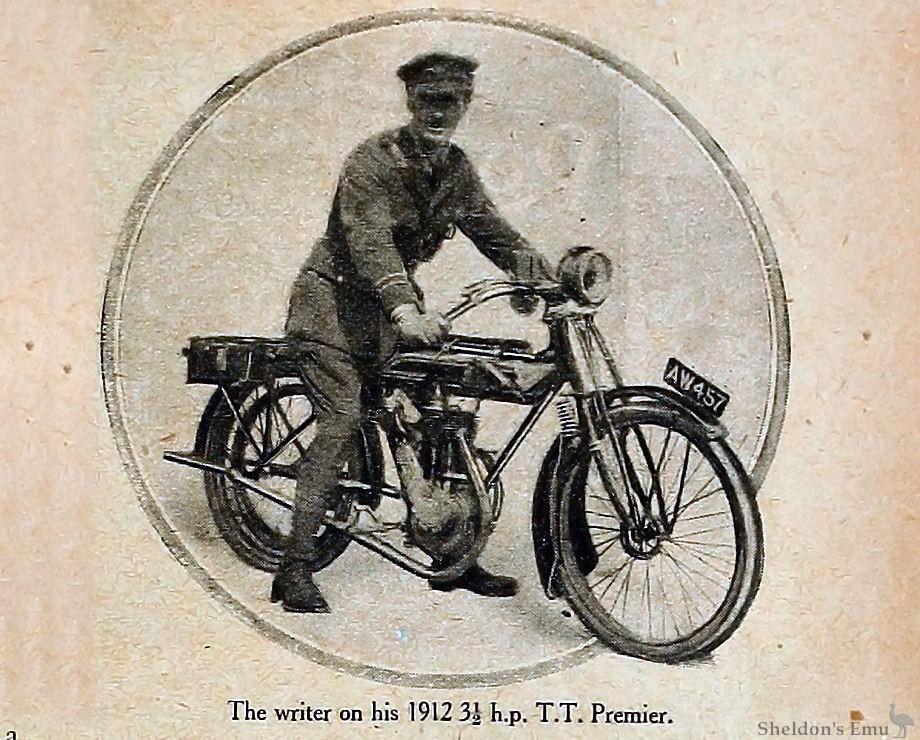
The writer on his 1912 3½ h.p. T.T. Premier.
A Word for the Simple Solo Single of the Type made a Decade Ago, and which weighed under 190 lb.
THE idea, now so prevalent, that a solo motor cycle to be effective must be equipped with a three-speed gear, chain drive, and other costly and heavy refinements, is to a great extent fallacious. The simplicity and briskness of a single-cylinder 500 c.c. machine will be found to compensate to a large degree for the lack of a kick-starter and gear box. Certainly an automatic pulley may be fitted to advantage, because it in no way deprives the T.T. motor cycle of its best characteristics, and it eases the engine just when necessary. Experience proved that with such a pulley there was no trouble from belt-slip or excessive wear on belts; in fact, it eases the belt from snatch when the engine is "plugging," and also when it is violently accelerated.
Achievements of a 1912 Model.
In the autumn of 1912, the writer purchased a 3½ h.p. T.T. Premier, fitted with a drilled pulley. Drilled engine pulleys are a constant source of belt-slip, and for serious motor cycling they can be classed with discs as being undesirable. This machine was improved by the substitution of a Philipson pulley, and at the United Services meeting, held on the Brooklands Track in September, 1915 (the machine then being three years old), and, in spite of at least 20,000 miles to its credit, as good as the day it left the Premier Works), it easily won a heat, and almost secured a place in the 600 c.c. Open Sprint, and, without any adjuslment to the pulley, tied equal first in the 600 c.c. Open Test Hill-climb. The weight, stripped, on this occasion was only 156 lb., and the machine as used for touring scaled under 190 lb., with lamps and spares. The carburetter used was a Senspray, which the writer considers to be well . adapted to this type of motor cycle. No mechanical trouble was experienced, although the Premier was not specially nursed; but always care was taken, first, not to race the engine until it had warmed up to its work, and secondly, to see thet the valves were down on their seatings when a ride was ended; both of which simple rules ensure even expansion or contraction, and make a great difference in preserving the tune of the engine.
Reliability and Liveliness.
For or comfort and reliabihty no less than for high average speed the writer can recommend such a machine, which, with lamps and horn, should not cost more than 70% of the heavy tourist or sidecar medium powered motor cycle.
A valve cap decompressor was found useful during a sojourn in the Metropolis, but for ordinary country this was discarded. The average consumption 80 m.p.g. with petrol, and the only time benzole was tried 120 m.p.g. was obtained on easy, but muddy. roads. Twice, through runniing out of petrol, neat paraffin was requisitioned, and the journey home was completed, but (in common with the writer's experience on other machines') the carburetter insisted on less, and not more, air. As to "speed wobble," a slight "dither" of the rear wheel was noticeable at high speeds, but this in no way affected the control of the machine, as there was never any tendency for the rear wheel to swing right out of track, and one soon became accustomed to it. The wide, low footrests, rigidly supported behind the crank case, helped to steady the cycle, especially on corners, which were taken by leaning the machine well inwards, with as much pressure as was possible on the outside footrest.
Previous to this the writer's last two machines were a 7-9 h.p. American twin and a 3½ h.p. machine of the same make as the T.T. cycle, but fitted with a Sturmey-Archer hub gear and weighing 230 lb. Neither of the latter was as fast nor as handy as the T.T. machine, and most active riders would have preferred the simpler type for anything except traffic dodging.
Faith in the Single Cylinder.
At present the writer has an I.O.M. pattern 3½ h.p. Rudge-Multi which seems to combine all the best qualities of the purely sporting mount with a capital variable gear and a clutch. The power unit, too, confirms one's belief that the sturdy single of first-class design will more than hold its own with twin or multi-cylindered engines of various patterns.
It must, of course, be understood that personal taste will create a market for almost every type of motor cycle that is known, and that the writer in no way intends to trumpet an overwhelming superiority on behalf of the single-cylinder machine or of the T.T. type. One's own machine may indeed be "another man's poison," but therein lies much of the interest to be had in the progress of the modern motor cycle. In any case, the present-day enthusiast need not fear to plunge for, say, a Norton, Rover, or similar T.T. machine - the Premier is no longer made - if he considers that the price of a more elaborately furnished machine with gears, clutch, and kick starter, is beyond him. His personal inclinations and needs can be reconciled with probably a number of the many excellent machines now being manufactured.
Velox.
The Motor Cycle October 21st. 1920. Page 403
Premier.
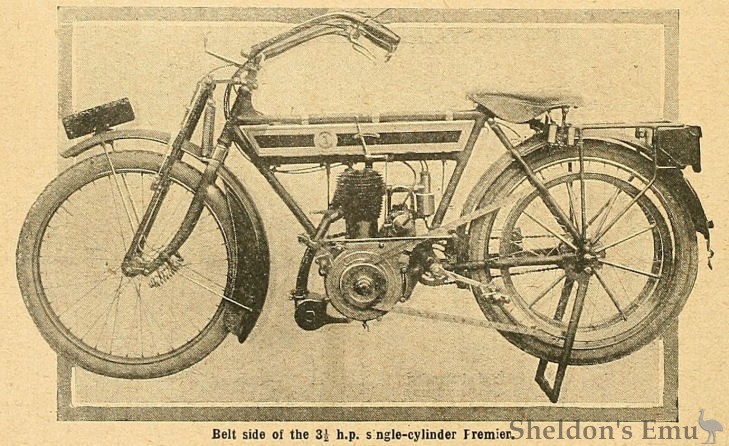
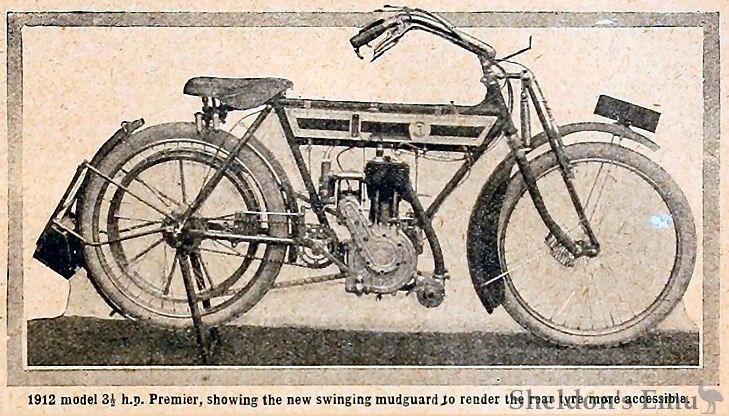
We have recently had the opportunity of examining the first of the 1912 Premier models. The frame has been considerably lowered, while the new pear-shaped cylinder casting adds greatly to the appearance of the 3 ½ power unit. The cylinder head has been redesigned to give a smoother flow to the incoming and outgoing gases, and the piston has been somewhat lightened. In other respects the engine will remain much the same. All the tank fittings are very large and substantial, and a pipe is led from the petrol tank to the compression cock for the purpose of priming the engine. Great attention has been paid to the mudguarding for the 1912 models. The front mudguard has been fitted with side wings, and the rear guard with an extension over the belt rim. while in the case of the two-speed model a 7 ½in. wide curved mudguard covers the belt rim, rear wheel, and brake rim. In both types the carrier – which is made to take a large tool-bag at the rear below the luggage platform – supports the mudguard which can be detached at the rear stays and swung down with the carrier so as to provide easy access to the back tyre.
The handle-bars have been slightly altered to give a more comfortable riding position, and incidentally the appearance has been improved by the alteration. The sidecar model is fitted with the twin 66 x 80 mm. engine which, with the exception of ball bearing big ends, has undergone no great alterations for the coming year. The Millennium two-speed gear is fitted to the rear hub, and the control is particularly neatly carried out.
A ladies' model with 3 ½ h.p. engine and Armstrong three-speed gear will shortly issue from the Premier Cycle Co.'s Works, and a twin two-speed sidecar combination is another introduction for 1912.
1911 Olympia Show - The Motor Cycle October 19th, 1911. Page 1100A.
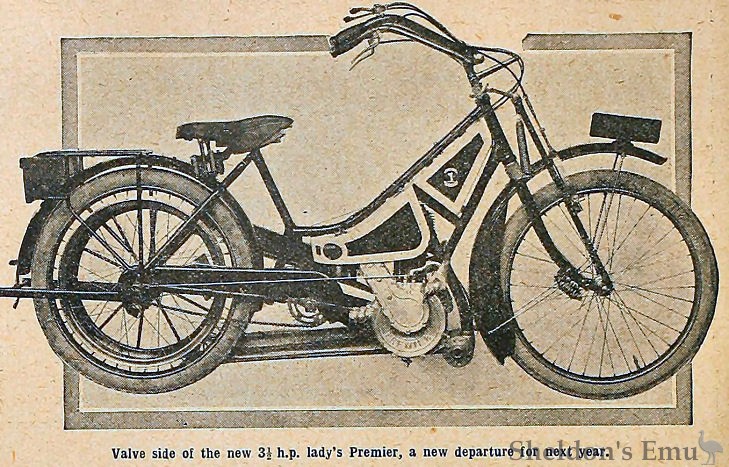
A New 3½ h.p. Ladies' Model Premier.
This is quite a new departure for the Premier Co., but the machine has a neat and pleasing appearance, and as the top tube is low and ample dressguarding is provided, it should prove a very serviceable mount.
A standard 3½ h.p. engine unit is placed vertically in the frame, and is held in position by a forked down tube in front (through which fork the auxiliary exhaust pipe passes) and two substantial engine plates at the rear.
The open frame gives a low riding position, and has a curved top tube, the lower end of which is only 19in. from the ground. This tube is stayed at the rear end to the chain stay bridge, and above the engine to the front down tube. The combined petrol and oil tank is situated behind the head, while the engine unit is surrounded by a neat metal cover in which a gauze covered window is formed directly behind the carburetter intake. The belt is protected both above and below the pulleys, and the top half of the pedalling chain and sprocket is enclosed. Footrests are fitted at a comfortable position, and the brake and clutch pedals are brought conveniently near to them, the brake pedal being on the left side, and the clutch pedal on the right. Clutch, spring forks, stand, and carrier are all fitted as to the standard 3½ h.p. model, the rear mudguard being detachable behind the back stays. A free engine hub clutch is fitted as standard, completing a very sound ladies' heavyweight machine.
1911 Olympia Show - The Motor Cycle November 2nd, 1911. Page 1153
PREMIER, No. 64.
The Premier Cycle Co., Ltd., Coventry. – The following are the chief Premier improvements for 1912. The diameter of the radiating fins decreases towards the lower portion of the cylinder, producing an appearance similar to the Gnome engine – consequently the largest fins surround the parts which most require cooling. There are springs underneath the tappets to keep them up to the valve stems, so as to avoid clatter. The piston head is dome shaped, having a minimum amount of obstruction. The fixing of the gudgeon has been improved by the addition of a locking bolt provided with a Fastnut washer. The oil pump is fitted with a non-return valve. Druid instead of the Premier forks may be fitted if desired. Both tank stoppers are fitted with vents specially designed to prevent splashing. The rear mudguard is divided and held by a neat sort of clip and bolt, allowing the tyre to be exposed. These mudguards are specially wide in the case of the Millennium two-speed machine, so as to prevent mud being thrown on to the rider from the belt rims. On the single-cylinder models the brake is operated by one rod having a direct pull from the pedal lever. The brake shoe is pivoted on a stud fixed halfway up the arm which carries it, so that when the pedal is depressed the shoe adapts itself to the rim. Side shields to the front mudguards are fitted in all cases. A similar model is also shown with a disc clutch in the rear hub.
This machine is fitted with Druid spring forks, and is in other respects similar to the model described above.
This engine was shown for the first time last year, with special connecting rod arrangements causing both cylinders to fire evenly. The radiating fins are cast horizontally with the ground. This and all other Premier models have the magneto set neatly behind the engine. The two-speed gear is controlled by a pedal mounted on the footrest. In the case of this machine both silencers are separate one from the other. The excellent finish of these machines calls for special comment.
1911 Olympia Show - The Motor Cycle November 23rd, 1911. Page 1265