
At the age of 12 Bruno Rossati began working eleven hour days.
"Now, approaching 91, I find myself reminiscing about my youth, still riding my motorcycle every day.
Letter re Ladetto

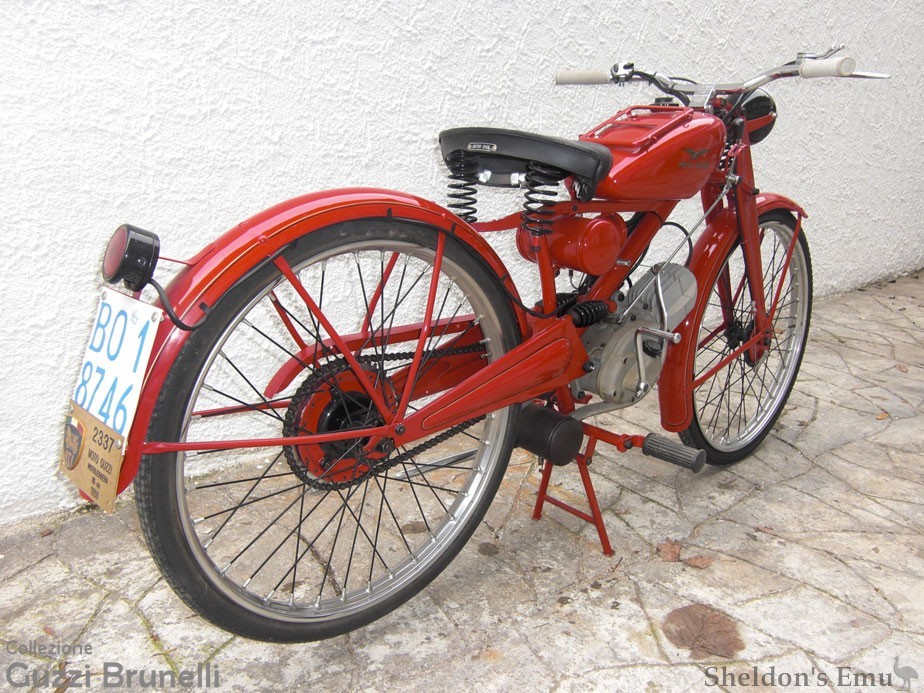
The Mandelo factory produced over 70,000 of the Motoleggera 65 lightweights between 1946 and 1954. In 1949 it was upgraded with a stronger swinging arm, reinforced front fork, and engine modifications. In 1953 the Cardellino was introduced using the same 64cc engine, and this superceded the Guzzino, as it had become widely known. Also in 1953 a larger version, the 98cc Zigolo, was displayed the Milan Show.
The Guzzino was also built under licence in Spain by Moto-Hispania. Very similar in most respects, the engine had an aluminium alloy cylinder with a cast iron liner, and was fitted with an IRZ carburettor and Femsa ignition. Listed as the ISA-Guzzi 65cc, it was available from 1948 to 1963
Road Tests of New Models
Moto-Guzzi 65
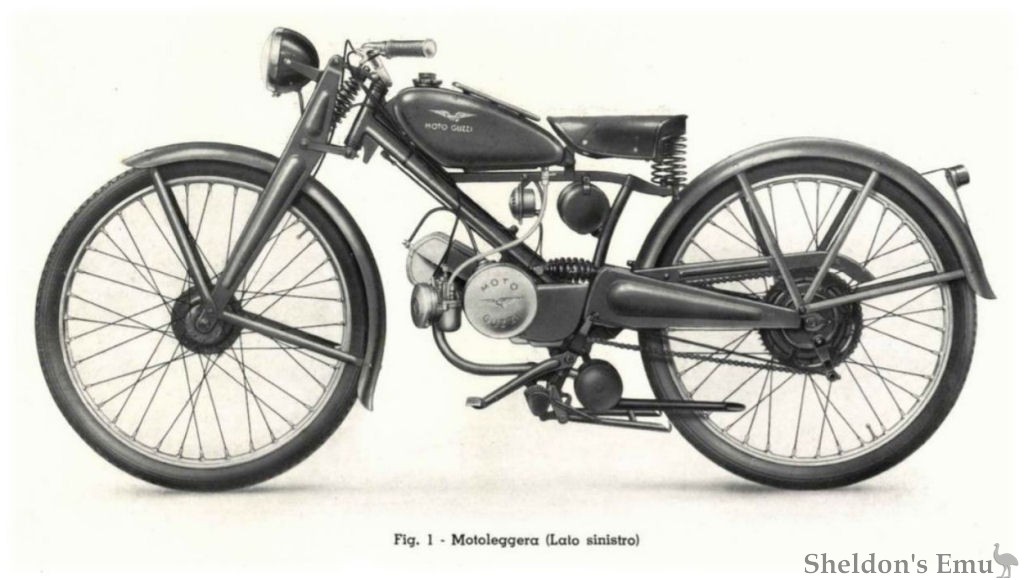
A Diminutive Italian Machine of Outstanding All-round Performance for Its Size
SMALLEST-capacity, fully-fledged, large-production motor cycle in the world, the Italian Moto-Guzzi 65 has a range of usefulness that belies its engine size. The combination of an efficient power unit, a three-speed gear box and light weight, make the machine a thoroughly practical little motor cycle, not only for runabout purposes, but also for-far more ambitious journeys.
Though of small overall dimensions, the Guzzi provides a commanding, man-size riding position that would do credit to many larger machines. This results from a combination of 30-inch saddle height, relatively low footrests, and a handlebar shape which gives a natural grip angle. The machine handles extraordinarily well, steers to a hair's breadth and, in virtue of its low weight, can be "thrown about" in complete safety.
The parallel-ruler type front fork has an adequate range of movement and the rear-springing is soft enough to absorb even minor road irregularities. On the machine under test proprietary friction dampers were fitted to the rear suspension, though these were loosened off to make them ineffective. The need for dampers was never felt and throughout the performance range on a variety of road surfaces the standard of road holding and comfort was of a very high order.
For cold-engine starting two or three digs on the starter pedal were required; a first-kick start was usual when the engine was hot. Mild piston slap ceased when the engine had been running for a few minutes to warm up, and it then idled reliably and with no undue four-stroking; the pick-up on opening the throttle was brisk and without hesitation. There is only slight noise increase at wide throttle openings over the pleasant, musical exhaust whisper heard at idling speeds.
Though the clutch gave all the indications of freeing readily and fully, it was difficult to avoid a slight "scrunch" when engaging bottom gear with the machine stationary and the engine ticking-over. Operation of the clutch by means of a full-size handlebar lever was finger light and the clutch took up the drive easily and smoothly. The gear-change lever is situated on the right-hand side and just in front of the fuel tank, where it is well clear of the rider's knee, yet readily to hand. Changes could be made quickly and with little chance of missing the gear ratio required. A very slight whine was audible in second gear at lowish speeds, but bottom gear (and, of course, the direct-drive top) and the helical primary drive from the engine to the gear box were noiseless. The brakes were outstandingly effective-light in operation, progressive in action, and capable of stopping the machine in almost unbelievably short distances; for example, in 22 feet from 25 m.p.h. In addition, when maximum braking was applied at high or low speeds the Guzzi remained completely stable.
The quiet liveliness of the engine, the good handling, the comfortable riding position, and the feeling of absolute command it engendered, combined to make the Guzzi a first-rate machine for traffic work. A speed of 25 m.p.h. from rest could be reached with a slickness comparable with average four-wheel vehicles, so that in built-up areas one could remain comfortably with the rest of the traffic.
On out-of-town roads an effortless cruising speed was between 25 and 30 m.p.h., with considerably higher speeds practicable in only slightly favourable conditions. For example, on two occasions with a barely perceptible tail wind on level roads speeds of over 35 m.p.h. were maintained for lengthy periods; although engine r.p.m. were well over 5,500, there was no trace of vibration nor any manifestation of over-driving.
As might be expected, adverse winds and hills took their toll of the performance. In such circumstances one had the option of making good use of the gear box or letting the engine slog in top gear (assuming the gradient was not too severe), which it would do very happily and comparatively powerfully in the manner of two-strokes. A gradient that would defeat the Guzzi in bottom gear would rarely be encountered in hilly country given a modicum of forethought in route selection.
For experiment, the 1 in 5½ gradient of Pebblecombe Hill, Surrey, was tackled and surmounted with 18 unhurried "foots" while the engine pulled steadily in bottom gear. This was a good test because the hill is lengthy and, because bottom gear had to be engaged before the steepest part was encountered there was no possibility of the performance being falsified by rushing tactics. In full wet-weather riding gear, including waders, the rider's weight was 13-stone.
Fuel consumption under fairly hard riding conditions worked out at about roo m.p.g. The fact is that the "big-machine" feel of the Guzzi, coupled with its many other attributes, tends to encourage full use of its performance hence the "hard riding."
Finish of the 65 is in the well-known Guzzi red enamel, with chromium plate for the handlebar and controls, exhaust pipe, wheel rims and lamp rims. There is a useful parcels grid on the tank-top and a sturdy carrier on the rear mudguard.
The Motor Cycle, 29th March 1951
Specifications
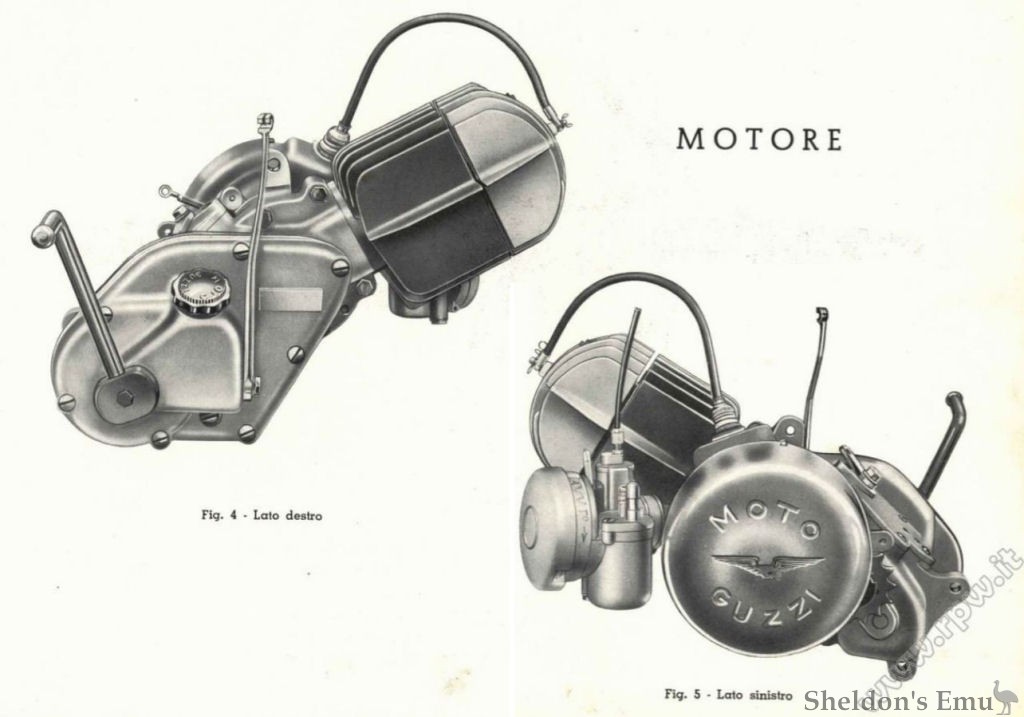
Engine
Single-cylinder two-stroke | BORE: 42 mm | STROKE: 46 mm | DISPLACEMENT: 65 cc
Cooling: air cooling | Cylinder Head: Detachable
Induction: Carburettor - Dell'Orto MU14 B2 |
Lubrication: Oil-fuel mixture
Ignition: Flywheel magneto-alternator
Starting: Kick-starter
Gearbox: Moto Guzzi 3-speed; Hand-operated gearshift
Clutch: Multi-plate
Transmission - PRIMARY (engine-gearbox): Gears | SECONDARY (gearbox-wheel): Chain | DIRECT (engine-wheel):
Chassis
Frame Section Profile: Tubular | TYPE: Single-beam | WHEELBASE: 1,200 mm
Suspension
front: stamped parallelogram with central spring
Rear: swinging fork with central springs
Brakes: drum brakes front and rear
Wheels: Spoked
Tyres: Type - clincher (beaded-edge). SIZE - front: 36 x 1 3/4 x 2in.; rear: 26 x 1 3/4 x 2in.
Lighting System: Electric. Headlight make: CEV
Seating: solo saddle, leather cover. Seat type: springs attached to the frame.
Colour Scheme: (codes, colour distribution, and pinstriping): Lechler Carmine Red #14 - Pinstriping: fuel tank - none; mudguards and swinging arm - gold on the inside, black on the outside