
Edwardian Era and WWI
Report from the 1902 Stanley Show
The James Cycle Co., Ltd., Birmingham, stage two motor-bicycles. The Model T has a 2 h.p. Minerva motor. An exceedingly strong fork crown and duplex forks are points that call for special notice.
The other model has a 2.5 h.p. Minerva motor fitted on to a special frame. This machine has a surface carburetter, extra powerful brake work, and the special spoking of the wheels call for attention. The finish of both machines is very handsome, the rims being nickelled, with green lacquered centres and edges.
Motor Cycling, 26th November 1902
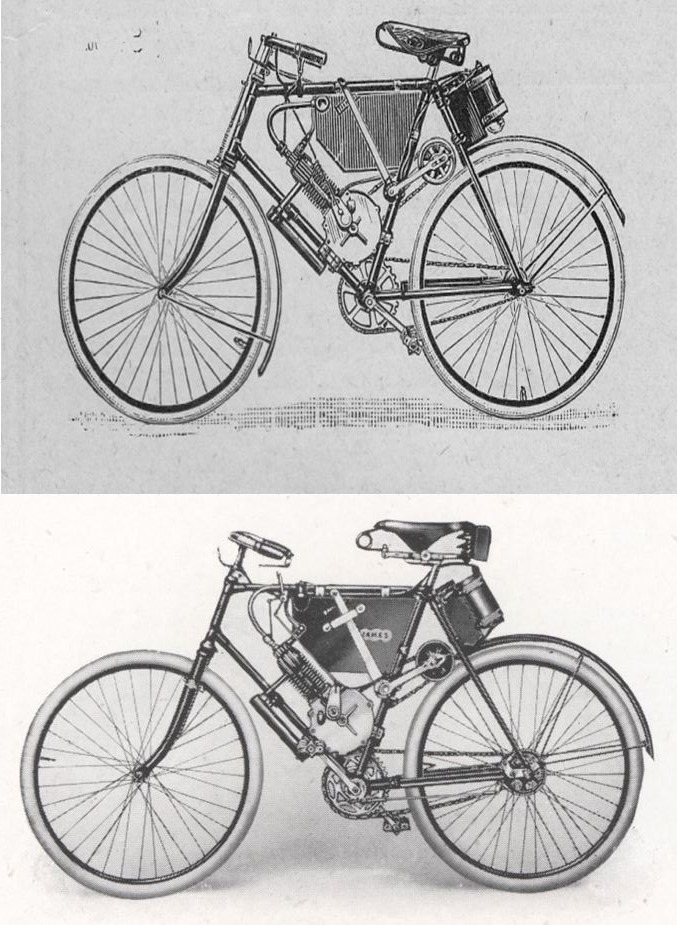
Delin and the James Derby
The James history written by A.E. Kimberly in 1950 says: "In 1902 James secured from Delin a supply of Derby engines which were fitted to his cycles and drove the machine through a friction pulley onto the rear tyre and so was the prototype of today's auxiliary engines."
https://www.erfgoedcelleuven.be/nl/delin
The bikes look very similar. ~ David Wells.
(It seems that Automoto absorbed Delin, and the James Derby model does not appear to have continued after 1902.)
1908 saw the introduction of a most unconventional machine, the James "Safety" Model with hub centre steering. Designed by P. L. Renouf it was built in the firm's new factory in Gough Road, Greet. It was very advanced for the day, with quickly detachable (QD) wheels and internal expanding drum brakes front and rear. Despite the innovative features - or perhaps because of them - the model did not prove popular with the public and was withdrawn after only three years
James Cycle Co.
Birmingham. Stand No. 49.
The James motor-cycle was one of the biggest novelties at the last Show, and it is safe to predict that few will attend this without inspecting the exhibit. The open frame, which permits access to and replacement of a tyre without disturbing the wheel, is one of its chief features, and the addition of springing throughout, together with a multiple disc clutch, will still further enhance its reputation. In addition, a machine of standard design, fitted with the same engine, is included, the outcome of representations made to the company by riders who recognised the speedy qualities of the James engine, but who desired a machine built on conventional lines.
The new model is a workmanlike mount, and at £48 should find a number of buyers. It is offered in both the Tourist and T.T. types.
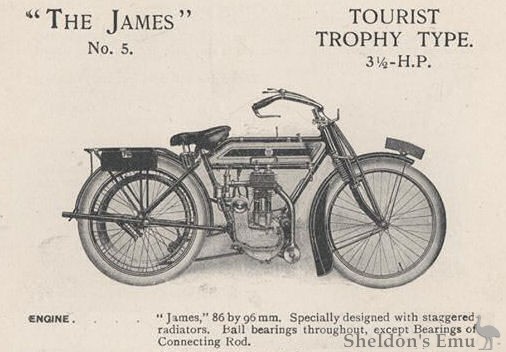
3½ h.p. James dropped frame tourist trophy model.
THE JAMES CYCLE Co., LTD., Birmingham.
The original James motor cycles, which are known as the safety type, were recently described and illustrated in our columns, and we need only call attention to one or two of the leading alterations and improvements. The front mud guard has been considerably improved, and should now catch almost all mud splashes in this direction. A plate clutch is now fitted in the rear hub in place of the cone type, and various detail refinements have been introduced throughout. The saddle position is quite near the ground and the centre of gravity is very low, making it an eminently safe machine on greasy winter roads.
The two new diamond frame models made in the T.T. and Tourist types, the latter with pedals, are on standard lines throughout.
The long stroke James engine, with its staggered radiating ribs, has been redesigned as regards the position of the magneto, which is gear-driven and placed very high up behind the cylinder. The crank case is practically smooth.
A very taking machine is the T.T. model, with its dropped rear frame, the top of the saddle being only some 30in. from the ground This is not designed as a racing monster pure and simple, but as a fast and lively touring machine for those who want something with a little more pace on the level and up hill than the standard model affords.
The 1911 catalogue listed the Model 1 and Model 2 "Safety" Motor Cycle with a 3½ h.p. engine and hub centre steering.
1912 saw the appearance of a more conventional 4¼ hp 557cc machine. The fins were staggered at 90 degrees, giving rise to the term "pineapple fins". The Model 2 was available with a Villiers hub clutch, the Model 3 with a Sturmey Archer hub.
A Two-speed James.
The 1912 James motor cycles will retain the same sized engines, that is to say, 86 bore by 96 stroke, but the combustion chamber and valve ports have been re-designed, and the diameter of the exhaust pipe increased, with beneficial results The magneto also has been slightly raised to give greater belt clearance. The frame will remain the same, but with the addition of a front wheel stand, a neat spring fork on Druid lines with scimitar blade side members, and a carrier specially designed to allow of the saddle being in the lowest possible position, and to carry special pannier tool-bags.
A special model will be made for sidecar work, in which the sidecar attachment lugs will be built into the frame. The firm will also supply their own sidecar chassis to which any body may be fitted.
The chief feature of this new model is a neatly designed two-speed gear box, combined with a composition lined cone clutch. The power is transmitted from engine to gear box by means of a short chain, the rear sprocket being mounted with a frictional device to prevent harshness in the drive. Thence it passes either directly (for the high gear) or through a geared counter-shaft for the low to a second sprocket mounted loosely on the outside of the primary gearshaft, thence to the rear wheel by a second chain. Both gearshafts are mounted on ball bearings, and the change of gear is effected by a lever attached to the top tube in a convenient position. This lever works in a horizontal plane and actuates the usual type of dog clutch in the gear box At present the gear box is situated just behind the saddle-pillar, but in future it may take the place of the bottom bracket. We have been promised a run on this machine at an early date, aid hope shortly to give our impressions of it on the road.
1911 Olympia Show - The Motor Cycle September 28th, 1911.
JAMES. No. 69.
James Cycle Co., Greet, Birmingham. – A two-speed chain-driven machine was among the late arrivals at the Show. It is fitted to a Canoelet sidecar, the whole turnout being very attractive. The foot -starter is returned to its place by a spring; it can also be used as a footrest. The leather-to-metal clutch is controlled from the left handle-bar. The sidecar clips are brazed to the frame. The magneto is controlled by a lever on the tank, and is placed behind the engine. The two-speed lever is carried on a lug brazed to the frame. The tyres are 2¼in. studded, and the forks Druid pattern with curved lower links. A Lycett pan seat is fitted, and the front mudguard has side flaps. Other models shown have belt drive and fixed gear. They can also be fitted with two and three-speed gears, the latter either Armstrong or Sturmey-Archer.
1911 Olympia Show - The Motor Cycle November 23rd, 1911. Page 1272.
Sources: The Motor Cycle; MotorCycling