
Canoelet Sidecars
Manufactured by Mead & Deakin, Tyseley, Birmingham. Produced from 1911 to 1923 and likely other years.
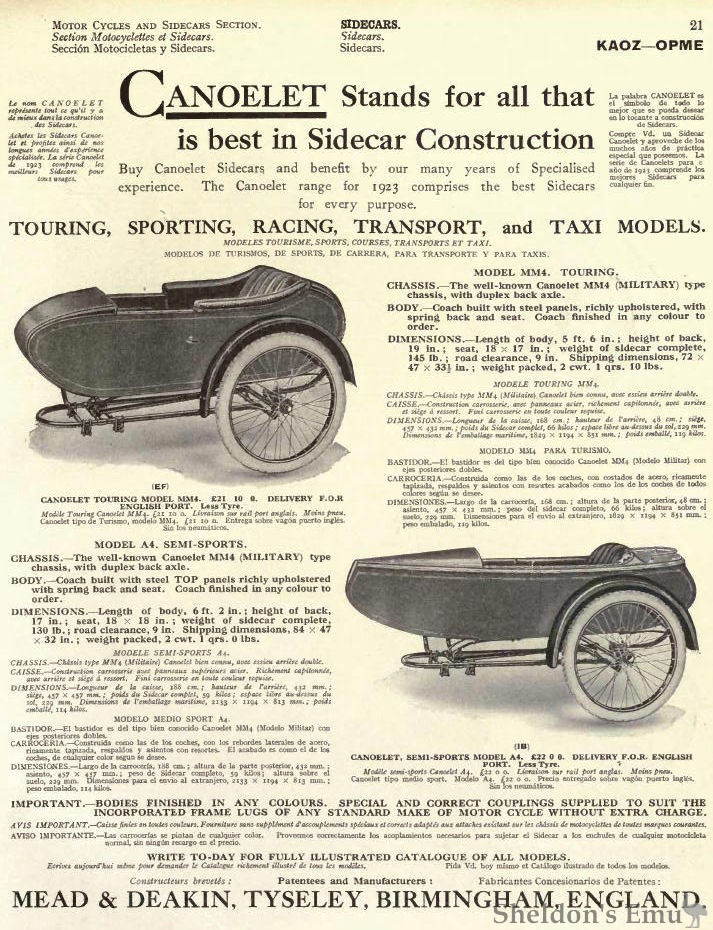
"Canoelet Stands for all that is best in Sidecar Construction - Touring, Sporting, Racing, Transport and Taxi Models."
Hazlewood fitted Canoelet sidecars to several models from 1920 to 1923.
Canoelet Sidecar.
The accompanying illustrations show a very original sidecar made by Messrs. Mead and Deakin, 61, Ladypool Road, Sparkbrook. Birmingham The frame consists of a tube bent hairpin fashion, the bend is in front, and the two ends are turned upwards at the back almost to the top of the body, which is attached at this point to laminated C springs and shackles. There are two transverse tubes at the back of the frame, a continuation of the lower of these is attached to the motor cycle near the centre of the back wheel, while the upper is bent forward and clipped to the saddle pillar. This arrangement, with special clips of quite original design, gives a very rigid frame. The body is coach built and very comfortable, the angle of the seat being adjustable; there is ample room and protection for the feet and a glass screen is fitted. The weight is 77 lbs. Another 15 lbs. must be added for screen and luggage carrier. The front clip consists of a slotted sleeve cone shaped at the end, which, when screwed up. grips the tube firmly in any position, somewhat after the manner of a carburetter attachment, making further adjustment unnecessary. A neat luggage carrier is fitted in the rear, which when not wanted folds up against the back of the sidecar. The stand when not in use takes the place of a rear mudguard stay. The vertical mudguard stay has a flange at the bottom to carry any mud which may run down the stay from the bearing. A delivery body is made which is interchangeable with the ordinary sidecar.
1911 Olympia Show - The Motor Cycle November 9th, 1911. 1912 Models.
CANOELET, No. 190.

Side view of the new Canoelet sidecar, which has many original features embodied in its design.
Rear view of sidecar showing the luggage platform folded up and the sidecar stand in operation.
Mead and Deakin, Sparkbrook, Birmingham. – The Canoelet sidecar, which we illustrated and described in our issue of the 9th inst., is to be seen on this stand. Three examples are shown, one attached to a Humber two-speed motor cycle, and a commercial body attached to a 5-6 h.p. Clyno. This body has no less than three separate partitions for carrying goods, as well as a place in the rear for petrol and oil. Thus the petrol is kept separate from any goods that may be carried. This body is interchangeable with the pleasure body, the chassis being the same in each case.
1911 Olympia Show - The Motor Cycle November 23rd, 1911. Page 1270
From Taxis to Lightweights.
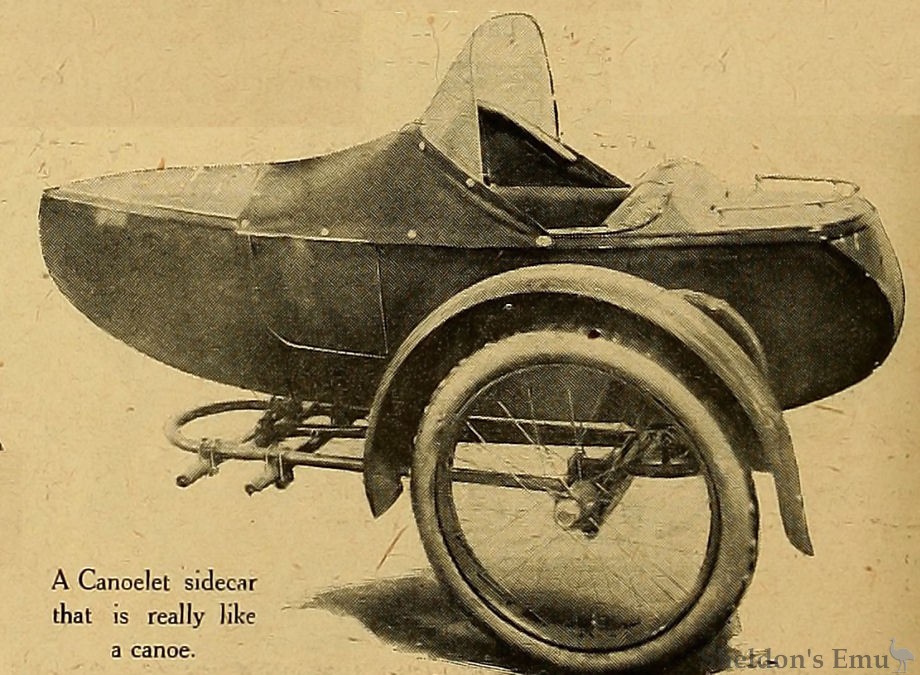
A Canoelet sidecar that is really like a canoe.
Mead and Deakin. Tyseley, Birmingham.
The selection of Canoelet sidecars offered by Mead and Deakin is exceptionally complete and is very wide in its appeal, no fewer than eight being staged. All the models are distinguished, too, by their graceful lines and beautiful finish. Another point which marks the care in production is the variety in chassis design, which seems to have been considered in conjunction with the type of body used.
One of the most attractive of all is the M.M. 4 touring model, finished in mauve and equipped with deck and windscreen and a hood of light design, the latter being a new pattern. The A4. a semi-sports model in the Indian red, elaborately lined with gold and fitted with torpedo apron and screen, should satisfy the owners of Indian Scouts and similar fast machines, for the body can be finished in any colour.
In great contrast to these models is the Taxi sidecar, a huge affair, but no doubt comfortable, selling at £85. For the owner who requires the minimum of body weight there is a little black and gold sidecar, clean cut in design - as indeed all the Canoelets are - offered for £16 5s.
Olympia Show 1922, The Motor Cycle November 30th 1922, page 868.
Sources: Period advertising; The Motor Cycle.