
A New F.N. Clutch.
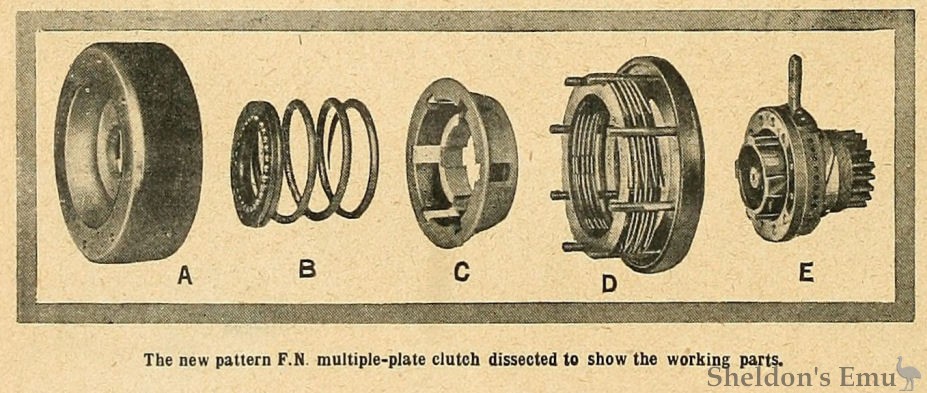
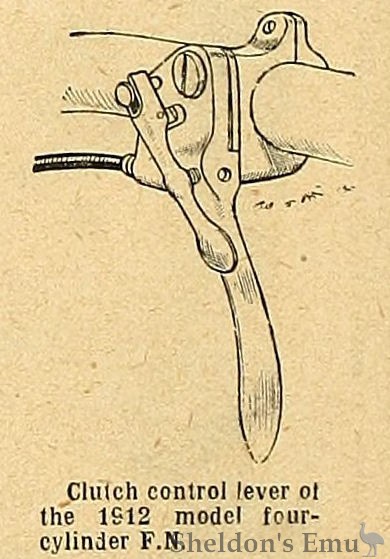
The F.N. Motor Agency have just placed on the market a well designed and well made plate clutch, which may be easily fitted to all ancient and modern four-cylinder F.N. motor bicycles. The illustration accompanying this notice shows the clutch in pieces, and it will be seen that in design it follows standard practice. The whole device takes the place of the usual flywheel, A being the new flywheel which contains most of the mechanism, B is the ball thrust bearing and spring, and C is the small plate carrier connected to the driving mechanism E. The external ring D carries the larger plates and is screwed on to the flywheel. E is the driving and operating mechanism on which is attached the main driving pinion in the transmission, while the arm is for the attachment of a Bowden wire which operates the clutch from the handlebar by means of the quick pitch screw to be seen clearly on E.
1911 Olympia Show - The Motor Cycle September 28th, 1911.
F.N.
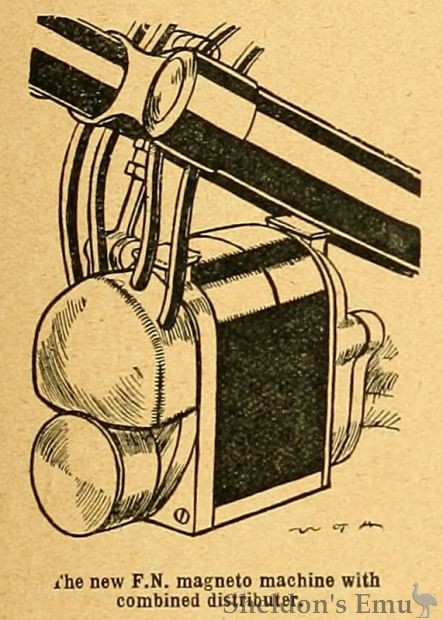
The alterations to the four-cylinder F.N. for 1912 are comparatively few, the machine having given universal satisfaction, the makers have not found it necessary or advisable to make more than a few minor improvements. The magneto machine is provided with a distributer combined with the magneto, as is the usual practice on cars fitted with four-cylinder engines; previous models have had a separate distributer for the four sparks, with the usual motor cycle type contact maker. The sparking plugs are specially short, and to obviate any possibility of short circuiting owing to the reduced length of the porcelain insulators, special ebonite connections are fitted to the terminals of the plugs. A special type of B. and L. combined drip feed and hand lubricating pump is fitted in the fore part of the main tank. The front mudguard is now provided with metal side wings, and a strong tubular carrier and stand are fitted; these supersede the combined carrier and stand which was fitted to order for the British market. Now the stand is pivoted to studs on the frame, and does not depend on the rear wheel spindle for attachment; it also forms the stays for the mudguard. The carrier is a solidly built up article and strong enough to carry a passenger on if desired.
The saddle position is slightly lower, and 10 gauge spokes are used for the driving wheel. The 1911 2¼ h.p. light-weight was always provided with an outside adjustment for the bevel gear. This convenient refinement has now been added to the four-cylinder model for next year and enables the small bevel pinion to be accurately meshed with the large gear wheel with comparative ease. Other minor improvements are increased leverage to the rear brake and Bowden wire to operate it from the handle-bar. The 2¼ h.p. lightweight two-speed model remains unaltered.
1911 Olympia Show - The Motor Cycle November 9th, 1911. Page 1177
5 h.p. Model: Four cylinders, 52 x 57 mm.; automatic inlet, over exhaust; F.N. automatic carburetter; shaft drive; F.N. two-speed gear.
F.N. (England), Ltd., Great Portland Street, W.
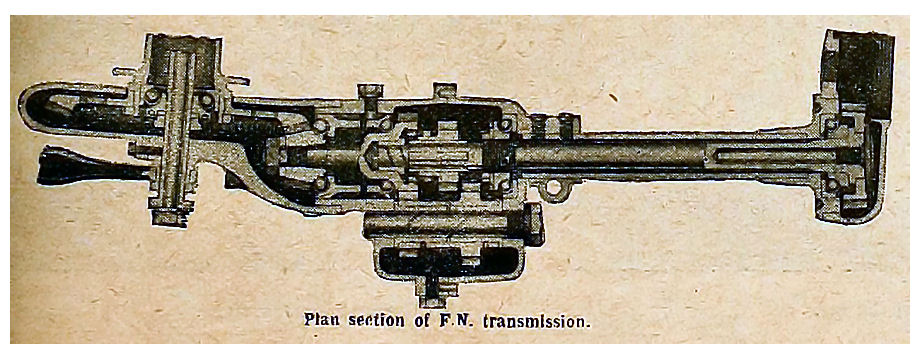
Ten examples of the F.N. are exhibited, two of them nickel-plated all over. Several alterations have been made in the new four-cylinder model, and. the lines of the machine have been somewhat altered so that they could conform with the English ideas of a standard machine. The engine remains practically unaltered, except for the strengthening of certain reciprocating parts. Two plates have been added to the clutch, and a kick starter is now fitted. A neat two-speed gear is incorporated in the casing of the shaft drive. This gear is of the sliding type. The high gear is direct, and is engaged by a sliding dog; the low gear is engaged by a sliding gear wheel. The shafts run on adjustable ball bearings, and the portion on which the dog slides is castellated. The gear casing is of cast steel, and has an inspection door. The frame is somewhat lower, and has a dropped top tube, giving a saddle position nearly four inches lower than in previous models.
A front wheel stand has been added, and the carrier and part of the rear mudguard are detachable to facilitate tyre repairs. Pannier toolbags are now fitted. The tank is shallower but wider, and holds 1½ gallons of petrol and nearly half a gallon of oil. It now has an enamel finish instead of the oxidised finish so well known on these machines. Large glass-topped filler caps are used; a strainer is placed inside each filler cap, and, in addition, a filter is fitted between the tank and the petrol pipe. Lubrication is arranged on the sight feed drip plan; once the adjustment has been set it is only necessary to pull up the pump handle and the feed is automatic. A gear and shaft drive cut in section demonstrates the extreme simplicity of the gear. The carburetter is of the semi-automatic type. An extra air valve of novel design with a delicate action is situated over the jet and controlled by a handle-bar lever.
2½ h.p. Model : Single-cylinder, 65 x 85 mm.; m.o.v. side by side; F.N. automatic carburetter; shaft drive; F.N. two-speed gear.
This model remains unaltered except for the finish, the tank being now enamelled and plated rims being fitted. Side extensions are now fitted to the mudguards, and the saddle position is very low.
The ten motor cycles shown comprise a 2½ h.p. and 5 h.p. in section, a 2½ h.p. and 5 h.p. finished in French grey, a 2½ h.p. and 5 h.p. plated all over, a 2½ h.p. and 5 h.p. finished in black with gold lines, and two 5 h.p.'s fitted with somewhat novel sidecars.
1912 Olympia Show
The Motor Cycle November 28th, 1012. p1393
If you have a query or information about FN motorcycles please contact us.