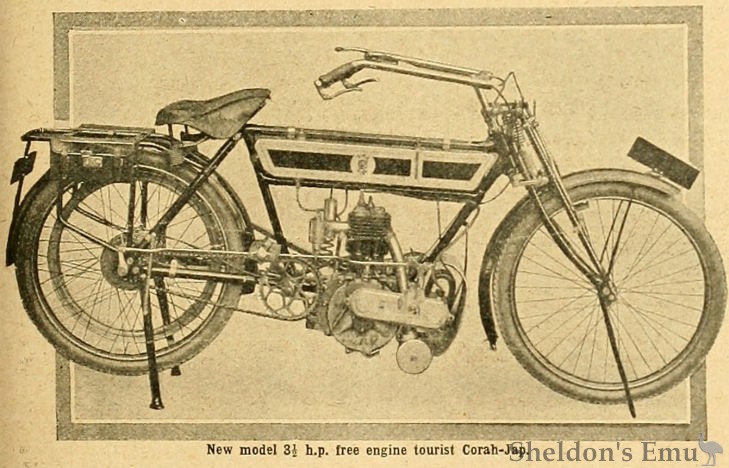


1910 There were three models. Two were fitted with a 3½ hp JAP engine and either belt or two-speed P and M gear. The third had a 2½ hp JAP engine.
1911 The singles were listed with 3½ hp or 4½ hp Corah engines with a rotary valve and shaft drive, two speeds and both front and saddle suspension. The drum-shaped valve was driven by a vertical shaft and bevels.
1912 The marque continued with the larger machine having two speeds and chain drive. The 3½ hp TT model had an ohv JAP engine.
1913 JAP engines were adopted as either a 3½ hp single or 6hp twin with a two-speed gear; or a belt-driven 3hp twin. They had their only entry in the TT, but did not do well due to a very poor first lap.
1914 Production continued for that year then stopped.
1910 Cycle and Motorcycle Exhibition
Corah Motor Mfg. Co.
King's Norton. Stand No. 72A.
This is a very attractive exhibit, introducing as it does the first serious attempt to produce a motor-cycle fitted with a piston valve engine. the engine generally follows
standard lines, but the valve chamber is enlarged to accommodate a small piston, which is rotated by suitable gearing. This piston is pierced by two channels, connecting
respectively the induction and exhaust pipes with the cylinder. The bore and stroke are 85 mm. x 88 mm., and, being of standard size, its efficiency can be readily compared with
other types. The machine is fitted with a two-speed gear, and has worm drive and spring shaft. The mudguards are of special design, and the Corals spring forks and a spring seat
pillar are also fitted.
CORAH, No. 132.
The Cork Motor Mfg. Co., King's Norton. – This machine is fitted with Corah patent forks. The magneto is placed on a bracket in front of the engine, protected by an aluminium guard. The carrier is easily detachable to facilitate the mending of punctures. The Albion free-engine clutch or fixed gear can be had as desired. The handle-bars are quite novel, the Bowden wires being partly inside, and adjustment being provided for them at two points.
This model can also be had with the same engine as is fitted to the tourist machine. Aluminium footrests with rubber studs are provided. There being no carrier, the toolbag is placed over the tank, and knee grips are fitted. All models have both front and rear stands, and reflex lights are fitted as a standard. The firm is also showing a sidecar with a Turner body on a Corah chassis. There are C springs both in front and rear, and the body is fitted with hood and screen. This body is illustrated on this page.
This machine, designed for sidecar work, is to be seen outside the Show, and is used for demonstration purposes. The general lines are as already described.
1911 Olympia Show - The Motor Cycle November 23rd, 1911. Page 1275
Source: Graces Guide
If you have further information or a query related to this page, please contact us.