
Indian Improvements.
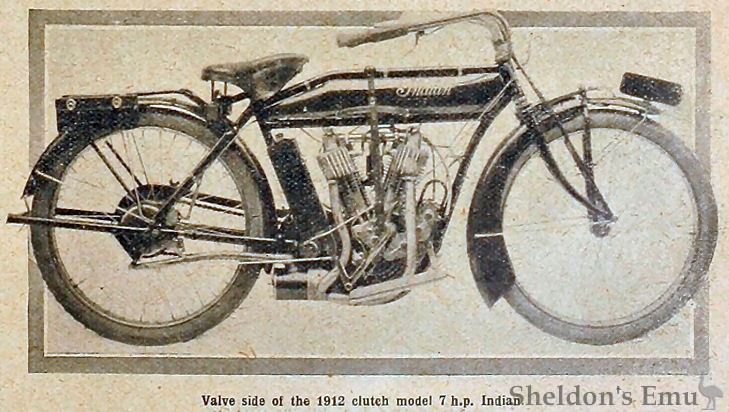
The Hendee Co., so we were informed by their London manager, Mr. W. H. Wells, have decided to market two Indian models only for 1912, viz., the 3½ h.p. single-cylinder and the 7-9 h.p. twin. The standard models will both have the free engine clutch on the counter-shaft and a slightly altered frame. Both the single and twin will be supplied with the counter-shaft two-speed gear and free engine device to order, but the change speed gear cannot be supplied for the standard models after they have once been purchased as single-geared machines. A foot starting device is a feature of all patterns, and this is illustrated in the photograph of the complete machine. On the engine-shaft a free engine clutch enables starting to be effected by means of the chain and chain wheel shown. The crank is pushed forward, one downward thrust of the pedal revolving the engine one complete revolution. Folding foot-boards and no pedalling gears are also features of the new machines.
The rear driving chain is neatly protected by a metal guard on the lines of the protector already fitted to the 1911 models. This guard is readily detachable, and should increase the life of the chain by keeping it free from mud and dust. The brakes are two, on the rear wheel. One is an internal expanding and the other an external contracting band brake; they are Raybestos faced and fitted on the right side, thus facilitating the removal and lubrication of the driving chain. Both brakes are foot controlled, as in the 1911 T.T. models. The hollow spindle fitted to the front wheel this year will also be used for the rear wheel in 1912. This enables the wheel to be removed from the machine in one minute. An innovation, so far as motor cycles are concerned, is the adoption of Timken roller bearings to the hub of the rear road wheel. The 1912 petrol tanks hold two gallons of spirit. The tool case on the Indian is metal, arched over the top tube of the frame, and occupies a space midway between the saddle peak and the steering head. The case contains a leather tool roll, which is made to fit snugly in the case.
The standard finish is blue, with tyre rim edges nickel-plated.
1911 Olympia Show - The Motor Cycle November 9th, 1911. Page 1177
INDIAN, No. 107.
Hendee Mfg. Co., Great Portland Street, W. – For next year two types of Indian machines are being made, viz., the 3½ h.p. single and 7 h.p. twin, both of which are alike in all respects except the number of cylinders. The standard colour of the machine is blue. Amongst the improvements which may be noted: are the size of the petrol tank and the provision of a foot engine starter. This is extremely neatly designed, and is arranged to be absolutely proof against the likelihood of danger from back firing. The pedal bracket for this purpose is attached in front of the crank chamber, and drives a claw clutch sprocket on the crankshaft through a chain. This claw clutch is held out of engagement with its meshing teeth by mechanical means, except when the engine is being started. The large sprocket is fitted with an ingenious pedal clutch arrangement which in the event of a back fire occurring causes the pedal to be thrown free. Both models are supplied with single gears and free-engine clutches, this clutch being operated in all types by a lever placed on the right-hand side of the machine and frictionally held to a quadrant. In the two-speed geared machines the clutch has been considerably increased in frictional surface. The chain from the counter-shaft to the back wheel is covered with a neat, quickly-detachable case. Both brakes are on one side of the rear hub, one being an internal expanding metal-to-metal type and the other a contracting band lined with Raybestos. This arrangement considerably facilitates the removal of the back wheel when necessary. The carburetter on all models is the well-known Indian, with annular float chamber and fitted with a pilot jet for slow running. A novelty in connection with the 1912 Indian is the folding footplates.
1911 Olympia Show - The Motor Cycle November 23rd, 1911. Page 1255