At the age of 12 Bruno Rossati began working eleven hour days.
"Now, approaching 91, I find myself reminiscing about my youth, still riding my motorcycle every day.
Letter re Ladetto

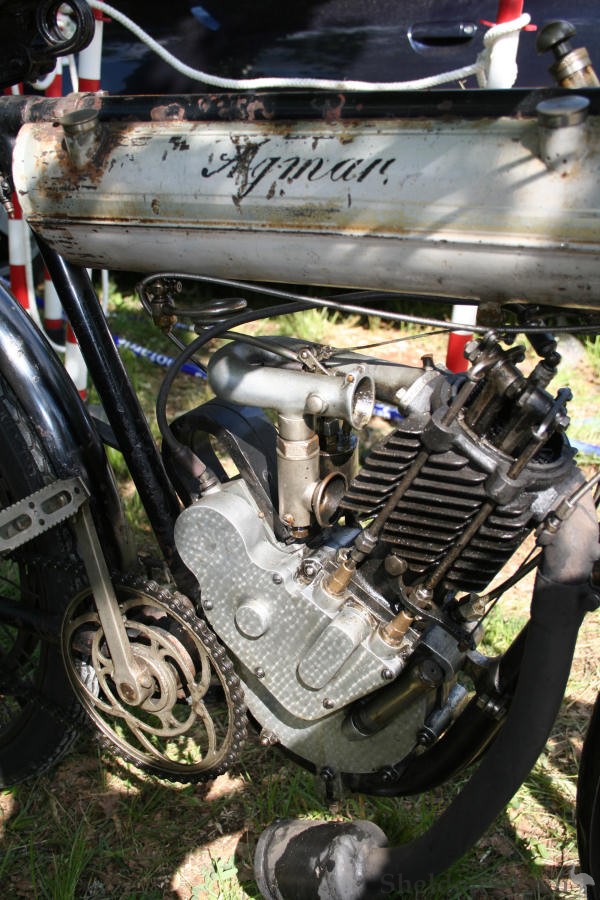
The name "Agmar" on the tank is that of the owner.
A Brief History of the Marque
Manufactured: 1905-1914
Founded by Luigi Semeria, the company produced its first motorcycle in 1907. It is a machine with a 262cc engine with large valves and a conical combustion chamber, rated at 2.75 hp.
In 1913 their catalogue listed a single cylinder 344cc model of 1 CV, a twin-cylinder 494cc model of 4.5 hp and a twin-cylinder 7 hp 688cc model. In 1914 they revealed a 344cc model delivering 2.75 CV, together with a single cylinder 262cc of 2.25 hp and a twin-cylinder 731cc engine with power of 6-7 hp. Later that year the war came and their business ceased.
Reports from the 1911 Olympia Show
The 2¼ h.p. S.I.A.M.T.
THIS interesting little machine, which has recently signally distinguished itself in Italy, the country of its origin, is being handled in England by Mr. Scales, 336, Gray's Inn Road, W.C.
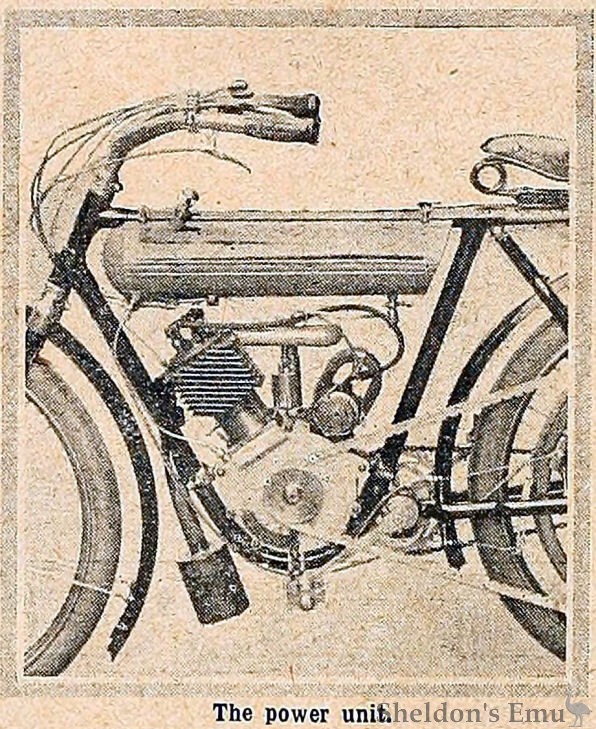
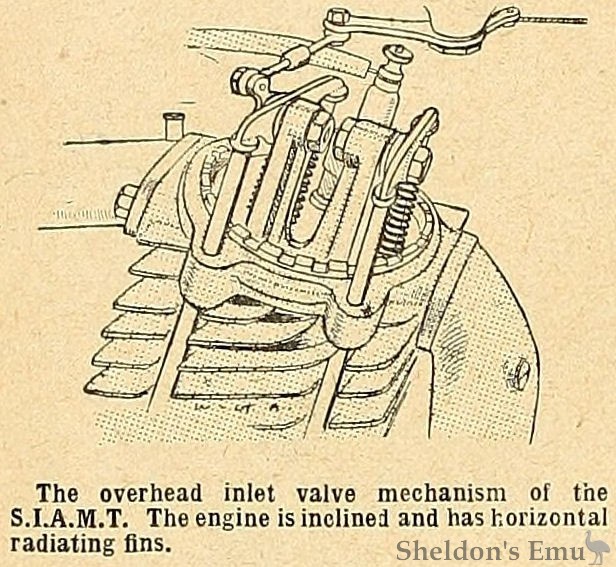
In describing any vehicle propelled by petrol vapour it is customary to begin with the engine. In the case of the S.I.A.M.T. we make no exception, and feel we can safely state that this is the most interesting part of the machine. The cylinder head is of quite an unconventional design, being screwed into the cylinder. It is guaranteed compression tight, carries both valves, which are of the overhead type, the sparking plug, and has radiating fins cast wherever there is space for them. The edge of this detachable head is castellated, and a special spanner is supplied for its removal. To be able to detach the head easily is naturally a great boon ; not only can the carbon deposit be easily removed from both head and piston, but the whole can be held in a vice while the valves are being ground in. The engine dimensions are 68x72 mm. The radiating fins are, since the engine is tilted slightly forward, cast parallel with the ground. The inlet valve rocker is mounted on an eccentric, and the engine is controlled by its means, as no throttle is fitted. The carburetter is of Italian design, and has an extremely long induction pipe, which it is claimed tends to better vaporisation. One end of this long pipe is bolted to the cylinder, while the other passes beyond the carburetter and culminates in an open gauze covered end, behind which is a butterfly throttle controlling the air supply, To detach the carburetter it is only necessary to undo the holding on bolt of the petrol pipe and drop the carburetter away from its union to the inlet pipe. The petrol enters at the top of the float chamber. The high tension magneto is the N.U., and is gear driven.
Triple Lever Handlebar Control.
All control is worked by a Bowden triple lever on the handlebar. An adjustable pedal bracket is provided. two brakes are fitted, one applied to each side of the belt rim. The levers working these are so placed on the handlebar that both brakes can be brought into action by one grip of the hand. Points of convenience are well studied; these are a tapless oil pump, a good stand, and a sensibly designed pair of spring forks. Considering that the machine is not specially designed for the English market, it conforms excellently to English ideas.
In the recent Mont Cenis hill climb in the class for machines up to 290 c.c, it won the Stampa Sportiva Cup, and gained the first seven places in the class. The winner's average speed up the fourteen mile climb was 34.6 m.p.h. It also gained a first and second in the Como Brunate hill-climb. All these wins, we are informed, are records.
1911 Olympia Show - The Motor Cycle October 5th, 1911. Page 1043
S.I.A.M.T.
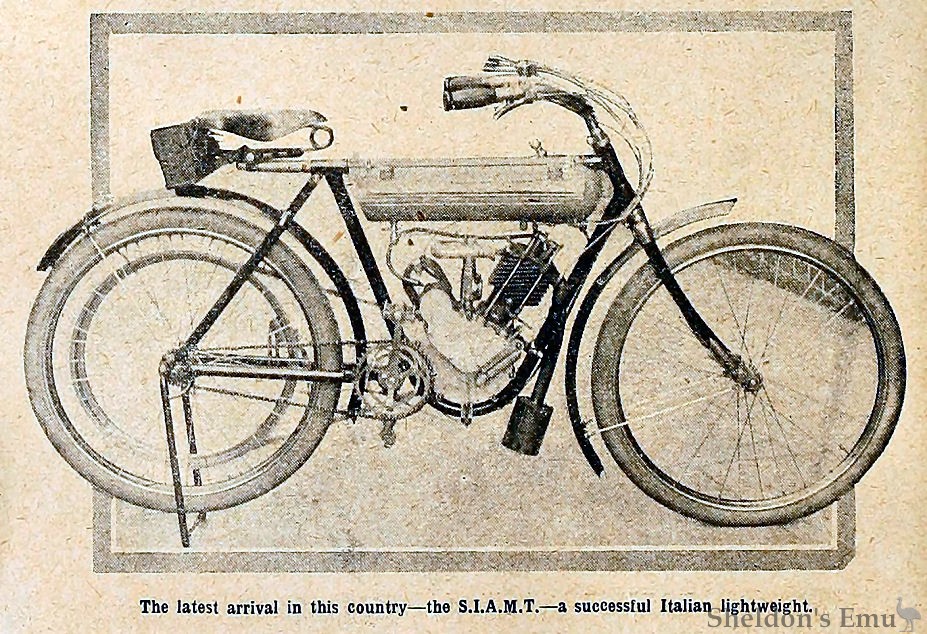
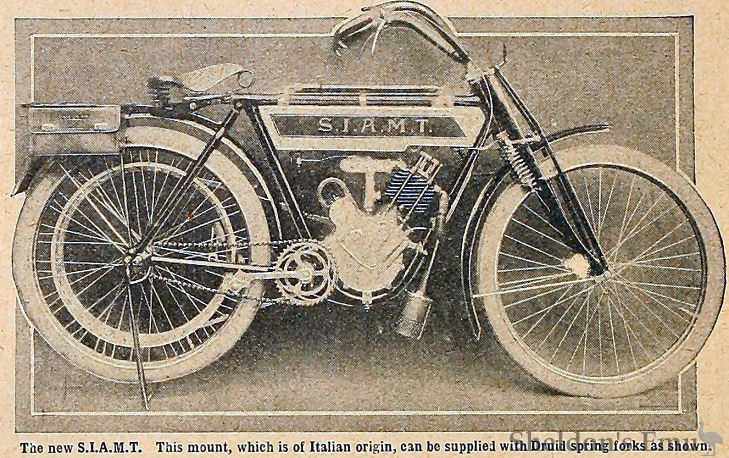
The latest arrival in this country - the S.I.A.M.T. - a successful Italian lightweight.
The successful little S.I.A.M.T. is one of the most interesting lightweights which is to be seen in the exhibition. Its engine (68 x 72 mm.) is a distinct departure from the standard. The whole of the various details were fully described and illustrated in a recent issue; therefore a brief mention of one or two of the more recent additions will suffice. In connection with the overhead valves, stops are provided to prevent a broken valve from falling through into the cylinder, while recesses are made in the cone joint formed by head and cylinder (in the cylinder itself), also with this intent. The top of the piston is hollow, and when the head is removed and the piston is at the top the resultant space is cup-shaped. It is easy, therefore, to clean off any carbon deposit which has formed without dismounting the engine. The exhaust port is of ample dimensions. All control wires terminate in loops or eyes, wider at one end than the other, and so arranged that it is only necessary to push forward the control stud to allow it to slip through the wide end of the loop, when it is required to detach the wire. The lever carrying the belt rim brake shoe is forked at its lower end, the stud on which it works passing through the lever, which is held in position by a spring, with the result that to loosen the wire, one has only to detach the brake and the wheel may be withdrawn – a matter of a minute. The machine in general has been greatly improved in detail since we last saw it, and now thoroughly conforms to English ideas. A square-sided tank, good stand and carrier, a comfortable saddle, and other refinements are fitted, while Druid forks may be had if desired.
S.I.A.M.T.
We should like to add to the description of this interesting Italian motor cycle that, although both valves are situated in the combustion head above the piston, the valve heads cannot fall into the cylinder in the event of a breakage, as two small knobs are fitted to the valve chamber in such a manner that if a valve broke the head would catch the knob and therefore fall no further. The magneto is the "U.H." not "N.U." as originally printed, and the combustion head itself is not screwed into the cylinder. It has a ground seating, and it is the castellated ring which screws into the cylinder, so locking the combined valve chamber and top of combustion head firmly in position. Reference to the illustration published on October 5th, page 1042, will render this quite clear.
1911 Olympia Show - The Motor Cycle November 23rd, 1911.
Report from the 1912 Olympia Show
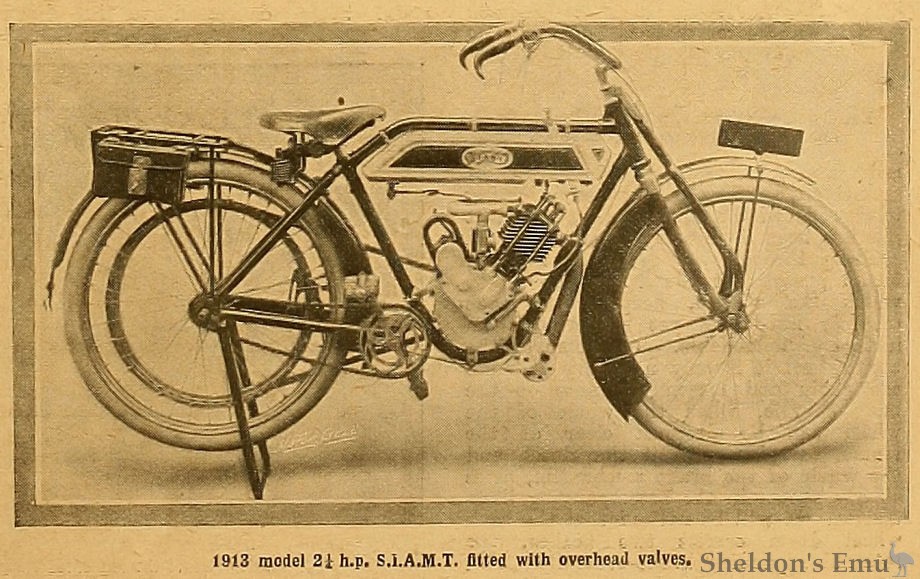
1913 model 2 ½ h.p. S.I.A.M.T. fitted with overhead valves.
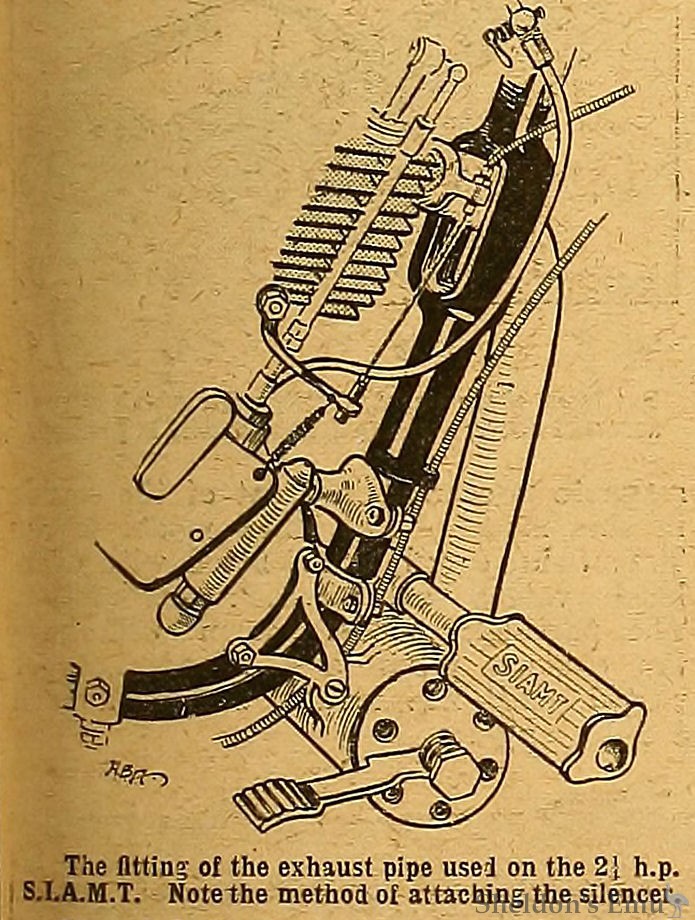
The fitting of the exhaust pipe used on the 2 ½ h.p. S.I.A.M.T. Note the method of attaching the silencer.
Radium S.I.A.M.T. (Stand 23) - The interesting S.I.A.M.T. motor bicycle has been considerably improved, and has now been made thoroughly to conform to English ideas.
The loop frame is maintained, but the top tube is dropped so as to allow of a very low saddle position. Spring forks are fitted: though the model illustrated has S.I.A.M.T. forks; Druid forks will be fitted to order. The engine, with its ingenious detachable head, which carries the valves and valve tappets, remains unaltered, but the new exhaust pipe which is 1 3/8in. internal diameter, is now brought through an eyelet in the tube of the frame to a new aluminium silencer, fitted with a foot-operated cut-out.
The silencer union also carries a bracket, through which the adjuster of the Bowden exhaust lifter passes: Aluminium footrests are fitted.
It will be noticed that the front mud-guard is provided with side shields, and that similar shields are fitted to the lower half of the rear mudguard. This mudguard is halved, and the carrier is attached to it, so that three parts of the mudguard can be swung out of the way, allowing a large portion of the circumference of the tyre to be exposed. The carrier is strongly constructed, and suitable for carrying luggage. Both brakes are hand operated, and are applied, one to the inside and the other to the outside of the belt rim. The tank has also been improved in outward design. The finish of the engine is particularly good. The Villiers two-speed hub can be fitted if desired. The Radium S.I.A.M.T. Co. are shortly introducing a 3 ½ h.p. twin, 68 x 68.8 mm. = 498 c.c. This machine has obtained several successes in open competition since its introduction into this country, and many more in Italy, its country of origin.
The Motor Cycle, November 21st 1912
Ozebook, MC Storico Conti and others have images of SIAMT 500cc V-twins.
Sources: MC Storico Conti, ozebook, Tragatsch p273, The Motor Cycle, et al.