
Hobart.
The Hobart Bird Co. are listing four models for 1912, two of which are quite new. The 2½ h.p. 70 x 76 mm. ladies' machine remains much as this year, except that the dressguards are more easy to detach, as they slide on in one piece (for each side), and are held by wing nuts all fitted in accessible positions. The Armstrong three-speed hub will be fitted as standard, and foot-rests are now brazed to the frame in a convenient position. The 4 h.p. twin also remains, unchanged in its main features, but is now fitted in an improved frame specially constructed to withstand the strains of passenger work, and having sidecar lugs brazed to it.
On this model the Lake and Elliot two-speed and Brown and Barlow carburetter will be standard fittings. The 3½ h.p. single is quite new, and has an 85 x 88 mm. vertical engine, with side by side valves fed by a B. and B. carburetter, and carrying either a Bosch or Eisemann magneto in front. This power unit is carried in a strong frame with dropped top tube, and allows a very low saddle position. The Villiers hub clutch is fitted, and instead of being operated by the usual long rod, which is liable to fracture through vibration, two short rods joined by a double lever pivoted on the rear engine plate are employed. The 2½ h.p. gentleman's model has a vertical 70 x 76 mm. engine. This is a very neat little machine on standard lines, and may be classed as a lightweight. In this case the magneto is fitted behind the engine. Druid forks, side flaps carried right up to the crown head, handle-bar magneto control, and a foot-operated cut-out are standard on all models. As will be seen, the firm market a very complete range of machines, and great care in design and attention to details is noticeable in all four types.
1911 Olympia Show - The Motor Cycle November 16th, 1911. Page 1212
HOBART, No. 105.
Hobart Bird Co., Ltd., Coventry. – The 3½ h p. Hobart is a neatly-designed machine on standard lines with a dropped frame. It is fitted with Druid spring forks and Eisemann magneto, the latter being placed immediately in front of the engine, where it is driven by chain. Lubrication of the engine is of the automatic type, and consists of a Benton and Stone sight-feed drip lubricator, through which oil is drawn by the vacuum in the crank chamber. A Villiers clutch hub is fitted as standard to this model.
The 2½ h.p. Handy Hobart is a neat little machine on much the same lines as the 3½ h.p., of which it is practically a reduced facsimile, except that it is fitted with a Best and Lloyd drip-feed lubricator worked by a spring plunger pump. The saddle position is very low, and altogether the aspect of the machine is very neat and practical. It is supplied also with a fixed gear. Although rated at the same power, the ladies' Hobart has a different engine, which is 2 mm longer in the stroke and is placed in an inclined position. The requirements of ladies have been very well studied on this machine, as all the moving parts are covered in by easily-detachable shields, which are secured in position by wing nuts. The saddle position is low, and a good point which ladies will appreciate is the fact that the width between the centres of the footrests is unusually narrow. This machine is fitted with an automatic Benton and Stone sight-feed lubricator.
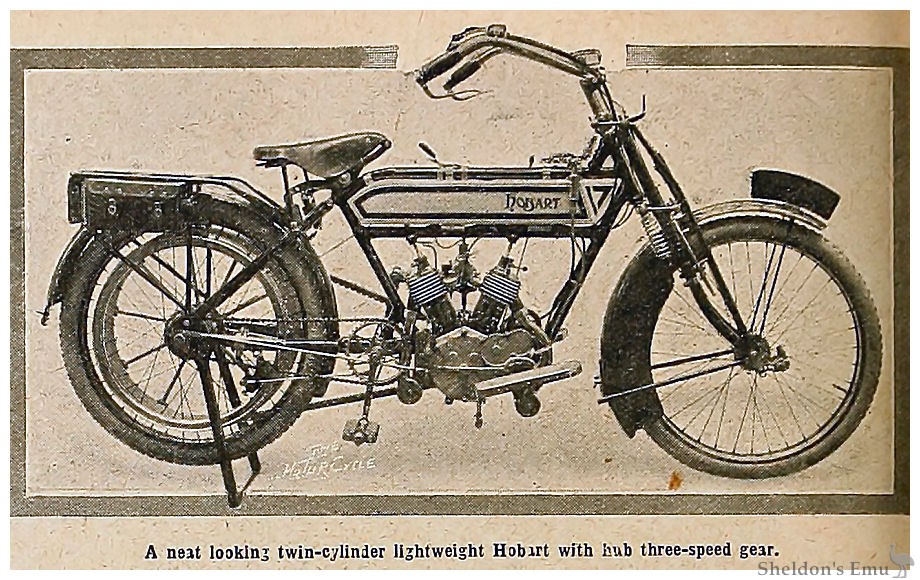
The three-speed Armstrong hub is operated by a lever at the side of the inclined petrol and oil tank, immediately behind the steering head. A new model for 1912 is a 4½ h.p. twin, the bore and stroke of which are 68 x 76 mm.; this is essentially designed to be a sidecar machine, and is fitted with the Millennium two-speed and free-engine clutch hub. A Best and Lloyd lubricator is used, otherwise the specification of the machine is the same as that of the 3½ h.p.
1911 Olympia Show - The Motor Cycle November 23rd, 1911. Page 1274
2¾ h.p. T.T. Model : 65 x 100 mm.; overhead m.o.i.v.; Bosch magneto; B. and B. carburetter; belt; Hutchinson tyres.
Hobart Bird and Co., Ltd., Coventry.
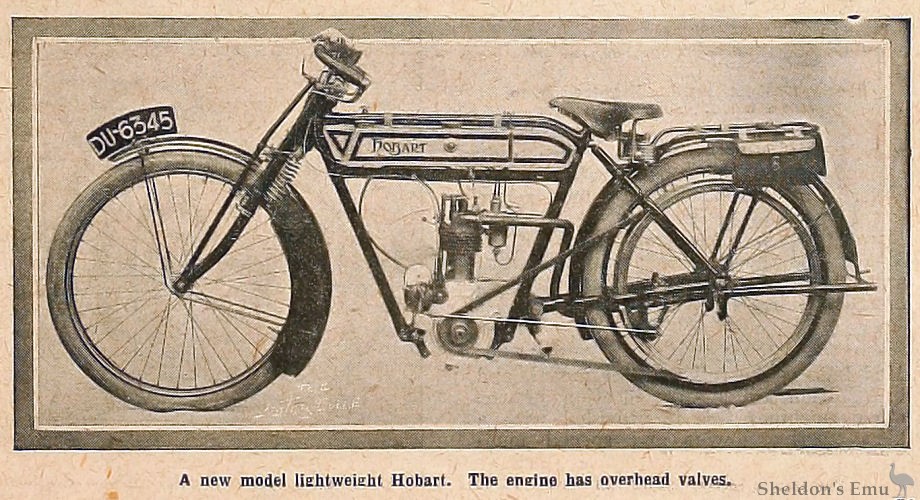
The 2¾ h.p. T.T. machine is quite a new model. The engine is fitted with very accessible overhead valves having adjustable tappet rods and very strong rockers. The tank is of the torpedo shape, and lubrication by automatic drip-feed. This machine is said to be capable of 50 m.p.h.
The popular ladies' model 2½ h.p. has a new frame in which the engine is fitted vertically instead of being inclined as before. The engine is improved in detail and is slightly larger (300 c.c.) than before (292 c.c). The three-speed is a Sturmey-Archer. All controls, including the magneto (an enclosed Bosch), are on the handle-bar.
3½ h.p. Model: J.A.P., 85.5x85 mm. (488cc); overhead valve; Bosch magneto; B. and B. carburetter; belt; Hutchinson tyres.
The motive power of the 3½ h.p. model is an improved J.A.P. engine with over-head inlet valve. The Villiers F.E. hub is standard on this machine. A front wheel stand is fitted, and the carrier is provided with pannier plates to carry the toolbags. Large glass-topped filler caps take the place of gauges. By loosening two screws the back mudguard can be turned back to facilitate tyre repairs.
4 h.p. Model: Twin Hobart engine, 68 x 76 mm.; Bosch magneto: B. and B. carburetter; belt; Hutchinson tyres.
The sidecar machine, a 4 h.p. twin, has been brought quite up-to-date and the size of the valves and exhaust pipes increased. The fittings are the same as in the other models. An Armstrong side-car gear is standard (this gear starts with the back wheel on the ground). The petrol consumption is said to be quite moderate.
1912 Olympia Show
The Motor Cycle November 28th, 1912
N.B. The 4hp model is a 552cc sidevalve twin.