Debenham Sisters
Betty and Nancy Debenham, with their dog, Poncho, were keen motorcyclists. Nancy won a Gold Medal at Brooklands in 1926.
The Debenham Sisters

1945-1948
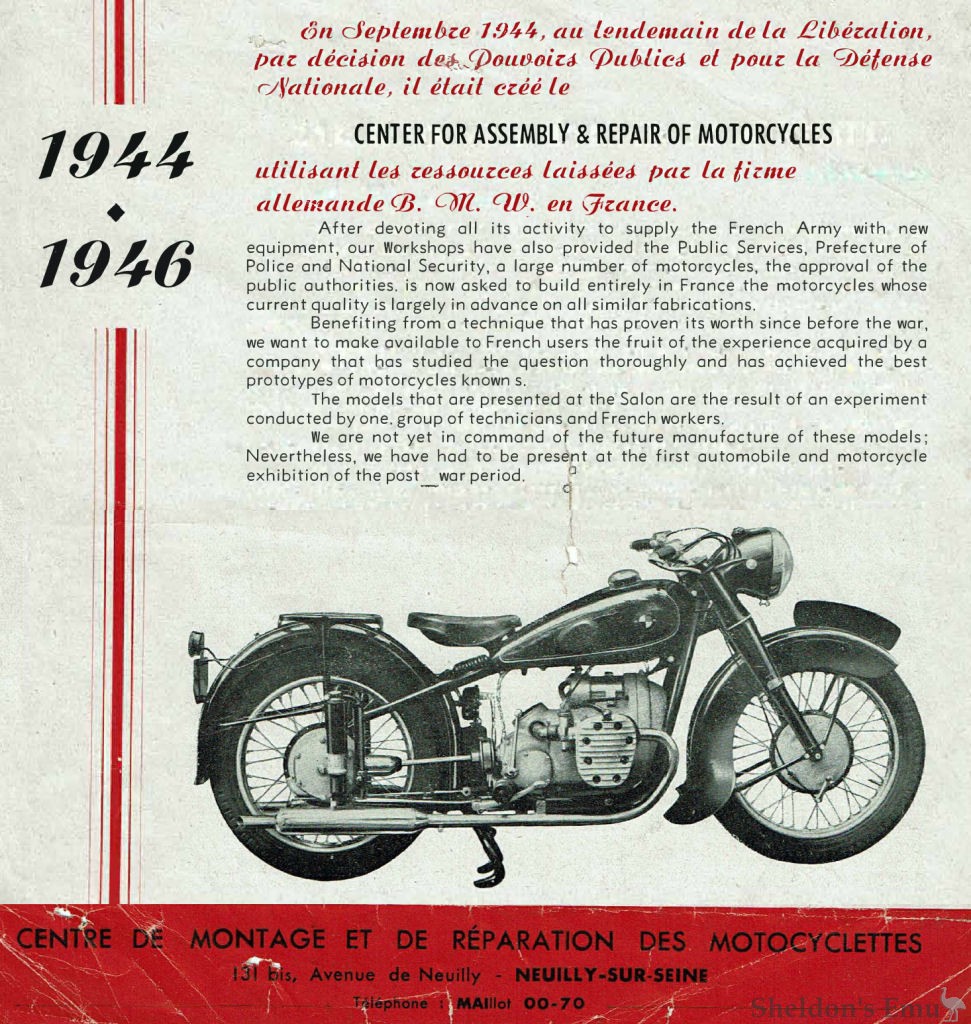
Centre de Montage et de Recuperation (C.M.R.), Neuilly-sur-Seine
Built motorcycle sidecar combinations and solos after the war from BMW parts in a German warehouse in Paris, using mostly BMW R 12 and R 71 engines.
During the war components were sourced from some twenty French companies, with BMW co-ordinating efforts from their offices on the Champs-Élysées.
In May of 1945 most of the Germans had fled and a number of French technicians took over production, with the the newly formed company moving to Neuilly-sur-Seine.
See also CEMEC
Sources: Tragatsch p105, wikipedia.nl
The following article is adapted from an archive of Histoire de la Moto, 1900-2000
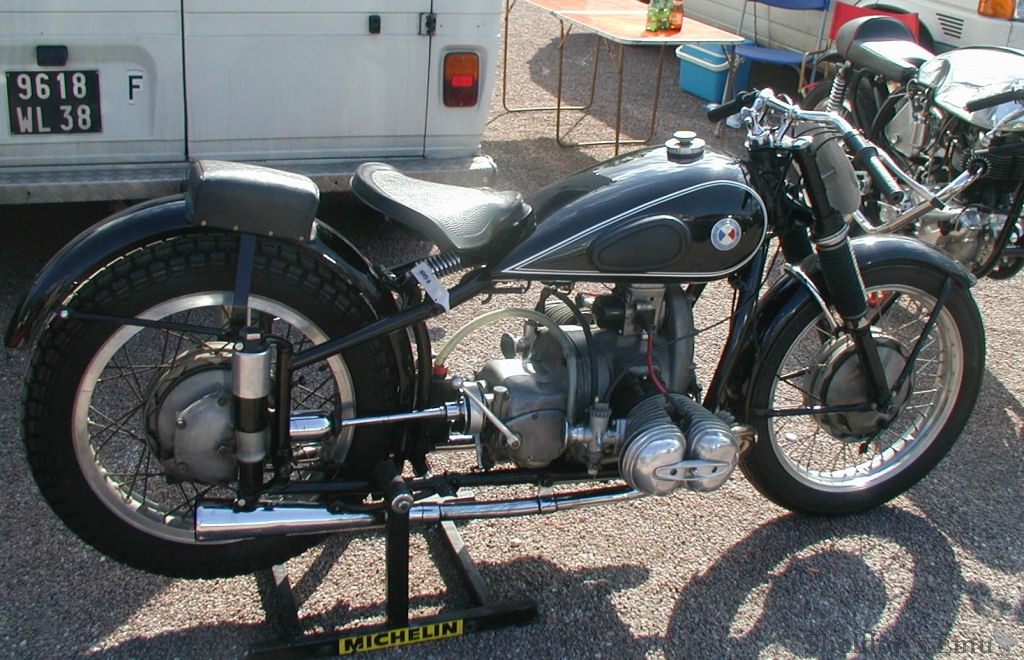
The "R73" represents a "bastard" name used by the CMR (Assembly and Recovery Center).
The name "R73" has even become widespread at BMW, whose Munich museum presents a horse-drawn version during its "travelling expeditions".
The CMRs had a reputation for fragility, made from salvaged parts, many of whose subcontractors were "anti-German" and did not hesitate to "sabotage" the various foundries. Consequently, of the 80 motorcycles manufactured, very few must remain in their original configuration.
On the other hand, in all European countries, "motorcyclists" realized that an R75 engine in a solo cycle part did not consume too much and was reliable and powerful. Its main drawback was its width, which provided ground clearance equivalent to that of a BMW R12 or the first Honda "Gold Wings".
Very few people know this, but in all the histories dedicated to BMW, it is specified that the German firm was on the verge of bankruptcy between 1950 and 1960 and that it was young dynamic engineers who got it out of the rut when they had the idea of rejuvenating the automobile range whose obsolete models were no longer selling, by designing the BMW 700 "luxus" or "LS" whose engine was similar to that of the R75 and R73. Models equivalent to the "4 horses Renault". This car was a real craze across the Rhine and competitions were organized which were precursors of the "Gordini cups" in France. The regulations evolved and many engine kits were studied for this purpose. Kits which were also mounted on the "basic" R75 "Russia" or "Sahara" engines, but also and especially on the R73.
Until the 1960s, dealers like Jacques Charrier sold R73s, specifying in their advertisements that these motorcycles were "all BMW".
There were minor developments when manufacturing was taken over at CMR, but the most visible was the round tube frame between the steering column and the engine, whereas all BMW frames are elliptical tubes.
My R73 was one of the very few in France to be equipped with a very high compression "Nardi" kit. I had the honor of knowing Roger Sceaux at his "lock". Who, at that time (1975/1982) had given me good advice and he really appreciated the R73 and 750cc Suzuki 3 cylinders (for the sidecar).
At the end of 1945, CEMEC was tasked with manufacturing spare parts to continue using the remaining stock of parts. The C7 he designed was a 750cc side engine . By adding cylinders and overhead valve heads similar to those of the R75, it became the "C8", which would be produced in around 30 units. As the operation was no longer profitable, CEMEC filed for bankruptcy. Ratier then took over, notably with the "C6S". The tumultuous history and the provenance of the parts will give rise to a few "five-legged sheep" or, at the very least, to models whose registration document seems to be at odds with the corresponding vehicle. This is how JPBeaufays' motorcycle, opposite, has a "C8" registration document. When you think about it, fortunately it still has its original papers: Imagine the problem if it had to be registered as a collector's item.
Written by Claude Delau