

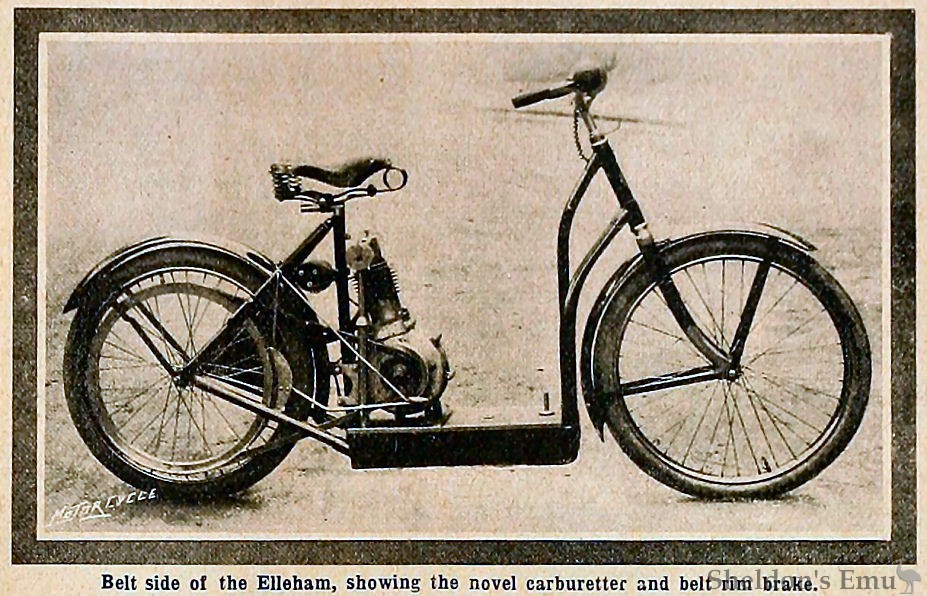
Belt side of the Elleham, showing the novel carturetter and belt rim brake.
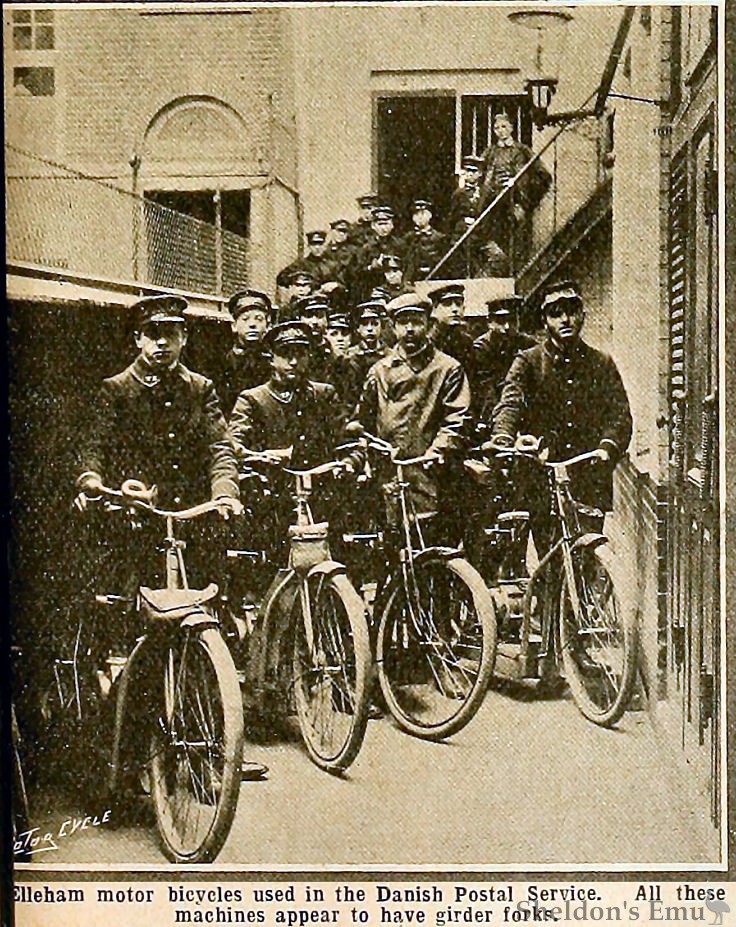
Elleham motor bicycles used in the Danish Postal Service. All these machines appear to have girder forks.
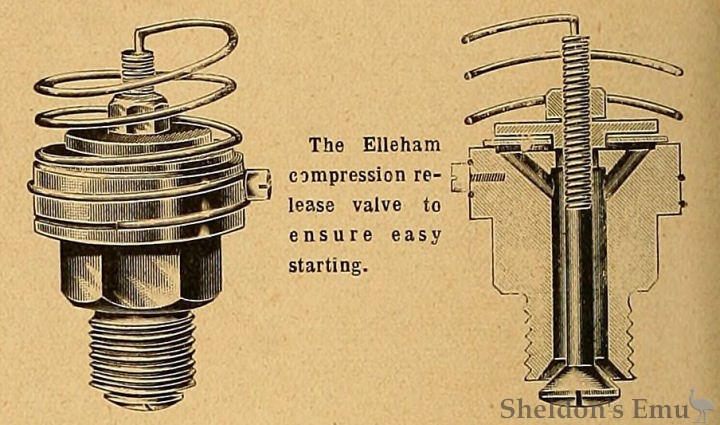
The Elleham compression release valve to ensure easy starting.
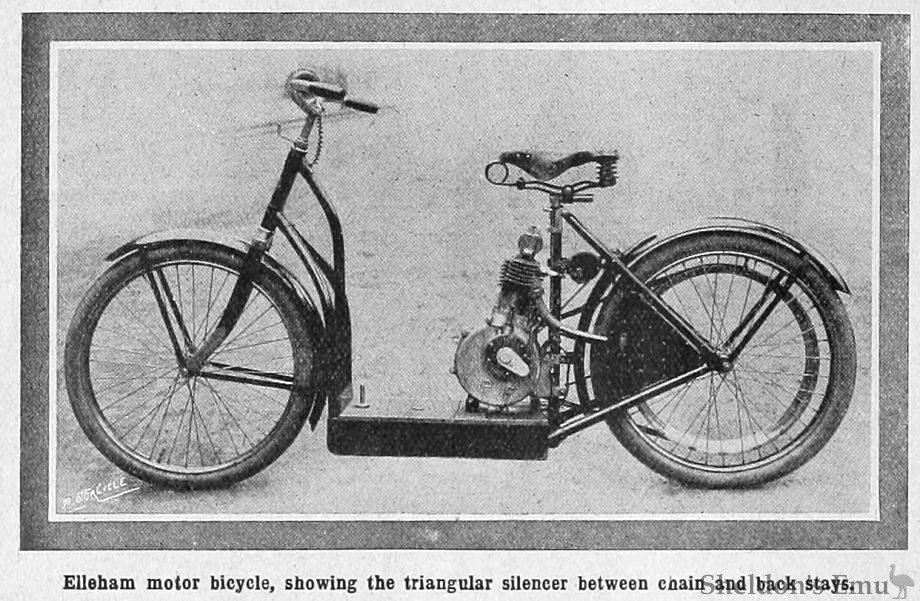
Elleham motor bicycle, showing the triangular silencer between the chain and back stays.
A NEW type of motor bicycle has lately been introduced into this country by Mr. H. J. Harding, 211, Northumberland Park, Tottenham.
The machine is the Elleham and the country of origin is Denmark. It will be seen on glancing at the illustrations that the machine is a distinct departure from standard lines.
The frame is open, and this consists of a malleable iron casting fitted with lugs brazed on to the frame members, which also serves the capacity of petrol tank, oil tank, and battery compartment. The result is that the rider is seated in a low position, and can mount and dismount with the greatest ease. The frame also gives a certain amount of elasticity, and is claimed to be sufficiently rigid. The engine on the type at present sported is a 2 ¾ h.p. Peugeot, fired by Hellesen dry batteries, make and break connect, and plain coil. In the cylinder head release valve which, to a certain extent does away with the necessity for an exhaust valve lifter. The valve itself remains open in its normal position, and when the pressure becomes too great inside the cylinder it is at once closed. On the down stroke of the piston the valve again returns to the open position, and an additional valve on the top of the casting closes, so that no air is drawn in on the induction and firing strokes. The principal effect of the valve facilitates easy starting, and it is also claimed to be an aid to flexibility, since it allows a portion of the mixture in the cylinder to escape before sufficient pressure is obtained to close the valve completely.
When the engine is running fast the speed of the piston on the compression stroke is so rapid and the compression increases so quickly that the valve is closed approximately at the beginning of the stroke. The valve is, of course, rather wasteful with petrol, but the makers claimed that this difficulty is quite balanced by the additional flexibility produced in the engine.
The carburetter also is a distinct novelty. To the inlet valve cover the usual inlet pipe is attached, to which in turn is fastened a chamber containing a turbine or fan running on a spindle fitted on needle points and carrying a small pulley. On this pulley is an endless coil of wire running around a similar pulley fitted at the end of a long tube which extends into the petrol tank. To start the engine the finger is smartly pulled along a milled protuberance on the end of the fan spindle which sets the latter whirling rapidly round, and by means of a capillary attraction a certain quantity of petrol adheres to the endless wire, thus impregnating the chamber with petrol vapour. The machine is then gently wheeled along, and the suction of the piston keeps the turbine revolving rapidly and the coiled wire continually ascending and descending, thus supplying the engine with an ample supply of gas. The air is drawn in through an opening in the front of the chamber and through holes in the pipe running from the chamber to the carburetter.
As previously mentioned the oil tank is carried underneath the foot-board, and through this projects a plunger which serves to inject the oil into the crank case. A safety tap, however, is fitted, so that the pump cannot be used accidentally. The forward half of the footboard is hinged, so that the battery can be easily reached.
At present, the machine is only fitted with one brake, and this acts directly on to the rear belt rim, and is operated by the right heel of the rider. On a recent occasion we had a short run on the machine, and were favourably impressed with the comfortable position in which the rider was seated and the practical absence of road vibration. Mr. Harding himself is an adept at demonstrating the capabilities of the machine in question. We saw him turn in exceedingly narrow roadways, with the engine firing all the time, and describe figure 8's in a side street in the city in a most surprising manner. At present the machine does not altogether conform to English ideas in such details as exhaust valve lifter and spring forks, and other small refinements are not yet supplied. These matters, however, have the attention of those responsible for the introduction of the machine, and, as soon as the company is able to get delivery, attention will doubtless be paid to them. The machine will be on exhibition at the Stanley Show, and any enquiries in the meantime should be made to Mr. Harding. A short preliminary description of the Elleham motor bicycle appeared in The Motor Cycle of September 12th, 1904.
It is interesting to note that a large number of these machines are in use in the Danish Army and in the Copenhagen Postal Service.
The Motor Cycle November 13th, 1907. Page 903