

1908 - William Brough began the legend that was later to become Brough Superior, the engineering genius of his son George. He began making production motorcycles in 1908. George and William were initially partners in the company.
1898 - Brough built a small car, soon to be followed by a tricycle fitted with a 2½ hp De Dion engine.
1902 Appearance of first motorcycle, with an engine suspended from the downtube, and braced forks.
1906-1908 - Various improvements were made to the design, and several models were produced. The 1908 model had a vertically mounted 3½ hp engine and sprung forks. That was soon joined by a 2½ hp and a 5hp V-twin. The engines were all produced in-house.
1910 - Brough developed and built an advanced experimental engine. It had a rotary valve above the cylinder, which was driven by bevel gears, a shaft, and spur gears above the head and valve.
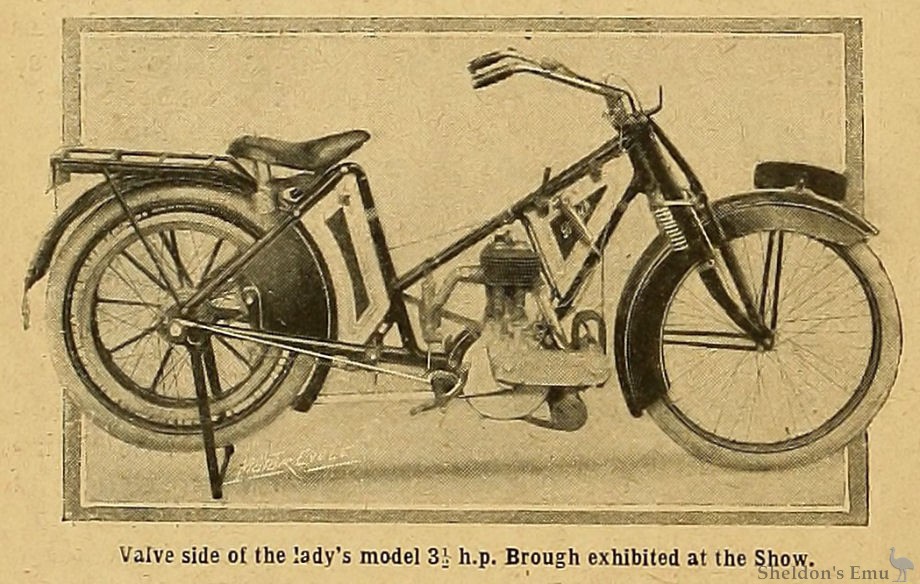
1912 - A larger, 6hp V-twin model was available for touring and racing. The 3½ hp single was enlarged and a two-speed counter-shaft gearbox added. There was also an 8hp V-twin engine for the Brough Monocar and there was also a ladies' version, with an open frame and a 3½ hp engine.
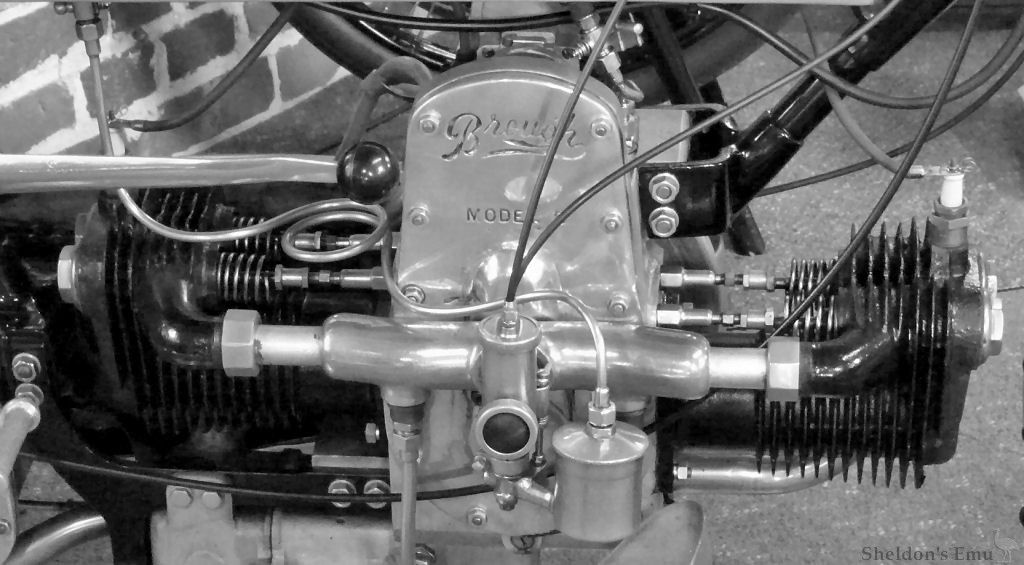
1913 - George Brough was entered in the Senior TT, on a model with a flat twin engine, but for the race an ABC twin engine was used as their own was not ready. Unfortunately George was forced to retire early from the race. Later in the year, the firm announced their own 3½ hp 497cc flat-twin model with ohv, the U. H. magneto clamped to the crankcase top and the two-speed gearbox to the crankcase underside. Chain drive was used from engine to gearbox while the final drive was from an adjustable pulley by belt. It was also fitted with Druid forks.
1915 - Only the flat twin was listed, in two further forms. One had a three-speed gearbox and the other was for racing.
1916 to 1923 - The standard models were joined by a larger 5hp version. In 1923 they were joined by a larger 5hp version of 810cc.
1919 - George left his father's business in 1919 after an argument to begin his own company, establishing Brough Superior in the same city of Nottingham.
1924 - The larger version continued along with the 947cc model.
1925 - Production of Brough motorcycles ceased.
Brough.
W. E. Brough and Co. have produced a very neat and interesting 6 h.p. twin. The two cylinders are set at 50° and have a bore and stroke of 77 by 85 mm. The cooling ribs are tapered off towards the bottom, giving a neat pear-shaped appearance, and an air space is formed between the valve ports and cylinder wall. The valves are mechanically operated and are placed side by side. The operating mechanism is decidedly novel. It will be noticed that only two cams are used to operate the four valves, and the makers claim that, by placing them one above and one below the crankshaft, considerable strain is taken from the bearings. A platform is cast on the front of the crank case to carry the magneto. Concave, flat-topped, or convex pistons can be fitted, thus making the engine suitable for passenger, touring, or racing work. We are informed by George Brough that the new 6 h.p. is wonderfully speedy for its size, and that he has his eye on some of C. R. Collier's latest records.
The 3½ h.p. will be increased to 85 by 88 mm., and will have other slight modifications, whilst a 2½ h.p. 75 by 76 mm. lightweight is being introduced. A two-speed gear of the counter-shaft type is also being manufactured for 1912.
1911 Olympia Show - The Motor Cycle October 26th, 1911. Page 1128
Ladies' Motor Cycles at Olympia.
Another machine of this type is the 3½ h.p. Brough, which is absolutely bristling with good points. The frame is strengthened by means of duplex down tubes, which are exceedingly neat and graceful as well as strong. Of special note are the extra air-cooling arrangement, the easily detached front wheel, and the efficient guarding which all point to the practical mind of the designer. It is fitted with the Armstrong three-speed gear and handle starting, and would be an ideal sidecar machine for a lady.
1912 Olympia Show. The Motor Cycle, December 5th, 1912.
Sources: Graces Guide, The Motor Cycle.
If you have further information or a query related to this page, please contact us.