Debenham Sisters
Betty and Nancy Debenham, with their dog, Poncho, were keen motorcyclists. Nancy won a Gold Medal at Brooklands in 1926.
The Debenham Sisters

Bradbury.
The principal item of interest in the Bradbury models will be the well-tried two-speed gear. The following models will be marketed, all having the same sized engine, and differing only with regard to the gear employed; two-speed chain-driven with Bradbury gear, two-speed belt-driven with N.S.U. gear, three-speed belt-driven with Sturmey-Archer gear, single-geared with belt-drive, and single-geared with Villiers free engine clutch.
We illustrate the new Bradbury two-speed gear and kick starter, the gear box being placed on the chain stays immediately behind the engine. The drive both from the engine to gear box and from gear box to back wheel is by chain. The gears are always in mesh, and are thrown into engagement with dog clutches, the top ratio giving a direct and the bottom an indirect drive. The clutch, which is arranged on the left-hand side of the gear box, is a very simple type, and consists of a metal-to-metal cone, which is operated from the handle-bar through a rod. This rod is connected to a crank carrying a quick thread screw, the nut for which is formed by a bracket boiled inside the gear box. This quick thread screw operates a plunger rod which passes through the primary gearshaft, at the further end of which the clutch is situated. The adjustment of this push rod can be controlled by a small grub screw, placed, as shown, concentrically in the quick thread screw.
The gear is lubricated through a sensibly large cap screwed into a special lug cast at the side of the gear box.
The kick starter consists of a semi-circular gear wheel, formed in one with a pedal crank, which is returned to its normally upright position by a helical spring wound round its supporting pivot. The semi-circular gear wheel meshes with a pinion carried loosely on the primary gearshaft and engaging with a couple of under-cut ratchet pinions. The engine is started by kicking the pedal downwards and backwards.
The control of the gear is by rocking pedal, this being placed on the near side of the machine, and, although not formed integrally with the footrest. is nevertheless well protected by it. Both are carried in an extension lug from the side of the aluminium crank chamber, one of the best points of the arrangement being that in the event of a "spill" the footrest would take all the brunt, and derangement of the two-speed pedal near become very unlikely. The pedal gives the low gear when rocked forwards and high gear when rocked backwards. Free engine position is obtained midway, and is easily felt for, since the crank to which the gear control rod is fixed works over a quadrant and carries a plunger which engages with notches cut therein. This is shown in the second sketch. The engine chain is contained inside a quick detachable casing. Handle-bar control of the magneto is only one of the refinements of the 1912 Bradbury.
The box is supported by a very simple form of bracket, by means of which it is readily removable from the chain stays; all that is necessary for this purpose being the undoing of five bolts and the disjointing of the engine chain and clutch rod.
The combined lamp and generator bracket has been thoroughly webbed for strength. A lubricating oil squirt intended primarily for use with the gear box is supplied. The foot brake is of commendably large size, and is arranged above the chain stay. This brake acts on a special belt rim spoked to the off-side of the back wheel. The rear mudguard, with its double extension, is fitted as a standard to all models, and contains also a combined number-plate and reflector tail light, which we illustrate on this page.
1911 Olympia Show - The Motor Cycle November 16th, 1911. Page 1217
The Bradbury Sidecar.
Improvements have been made in the Bradbury sidecar, the first of which relates to its fittings. The lug, which is fitted to the down tube of the bicycle frame, terminates in a cone which fits into an internal cone machined in the sidecar bracket. These cones relieve the security bolt of all direct strain, and form a very neat and quickly detachable device. In the sidecar itself special attention has been paid to accommodation for luggage and tools, the vehicle being exceptionally well provided in this respect, there being first a D-shaped basket clipped to the back of the seat, a flat box underneath the cushion, a shelf inside the torpedo front, a deep and commodious pocket in front of the passenger's seat, and a couple of small baskets on each side of the chair, situated under the elbow rests.
1911 Olympia Show - The Motor Cycle November 16th, 1911. Page 1222
BRADBURY, No. 118.
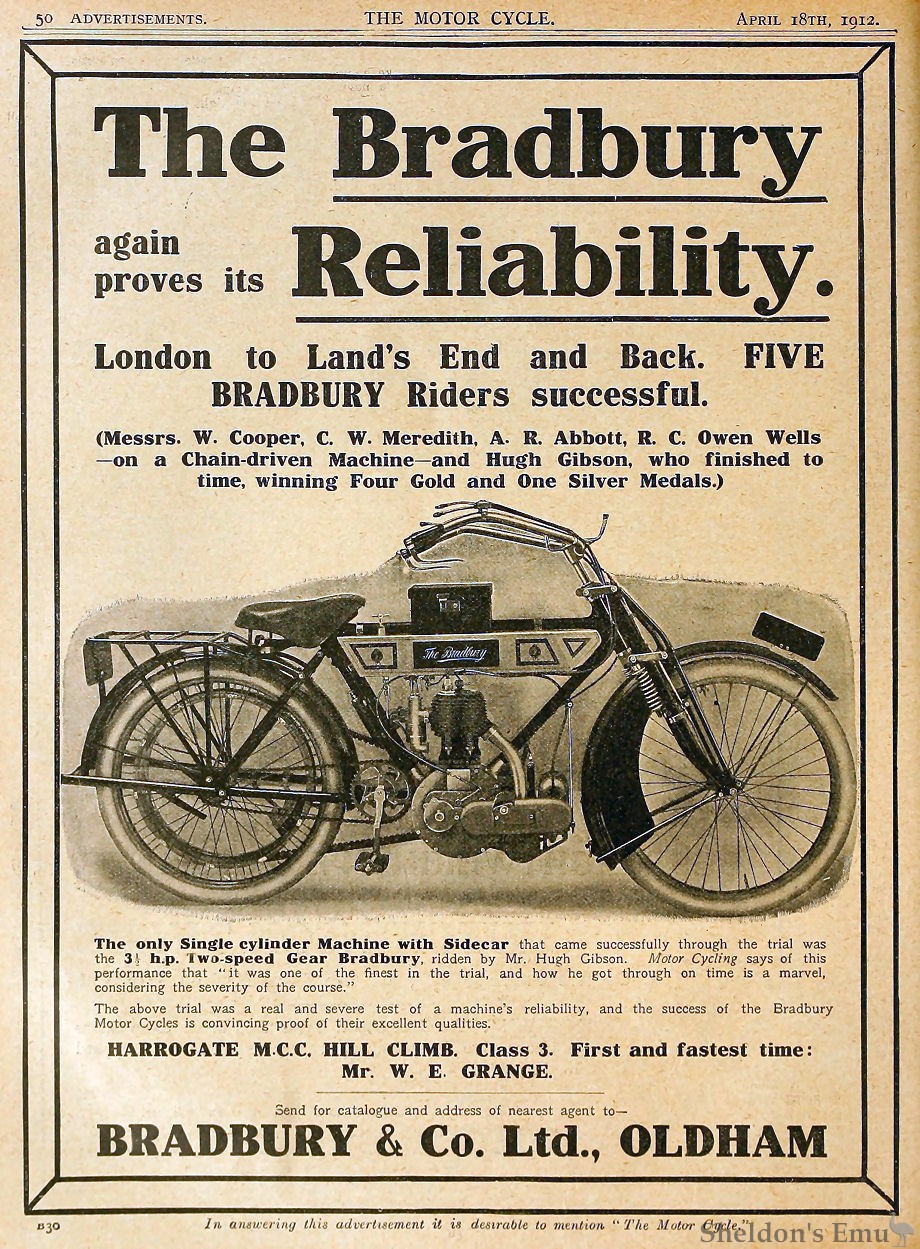
The new 3½ h.p. Bradbury, with chain drive and counter-shaft two-speed gear.
Bradbury and Co., Ltd., Wellington Works, Oldham. – The range of models shown on the Bradbury stand is extremely complete, as in addition to the two-speed chain-driven model specified above, which has been fully described in The Motor Cycle, there are no less than four others, viz., a belt-driven single-geared machine, a T.T. model on similar lines, a two-speed belt-driven mount with N.S.U. engine-shaft gear, and a belt-driven clutch model with Villiers hub clutch. The T.T. model is an extremely neat little machine with shortened wheelbase, low frame, dropped handle-bars, and large engine pulley. The foot brake is arranged on the bottom bracket, and is large and immensely powerful, being operated by the heel. This model is fitted with fixed girder forks, but spring forks can also be supplied Large side flaps are fitted to the front mudguards on all models, and a commodious square tool box is carried on the top tube. The magneto is the latest, type Bosch.
1911 Olympia Show - The Motor Cycle November 23rd, 1911. Page 1254