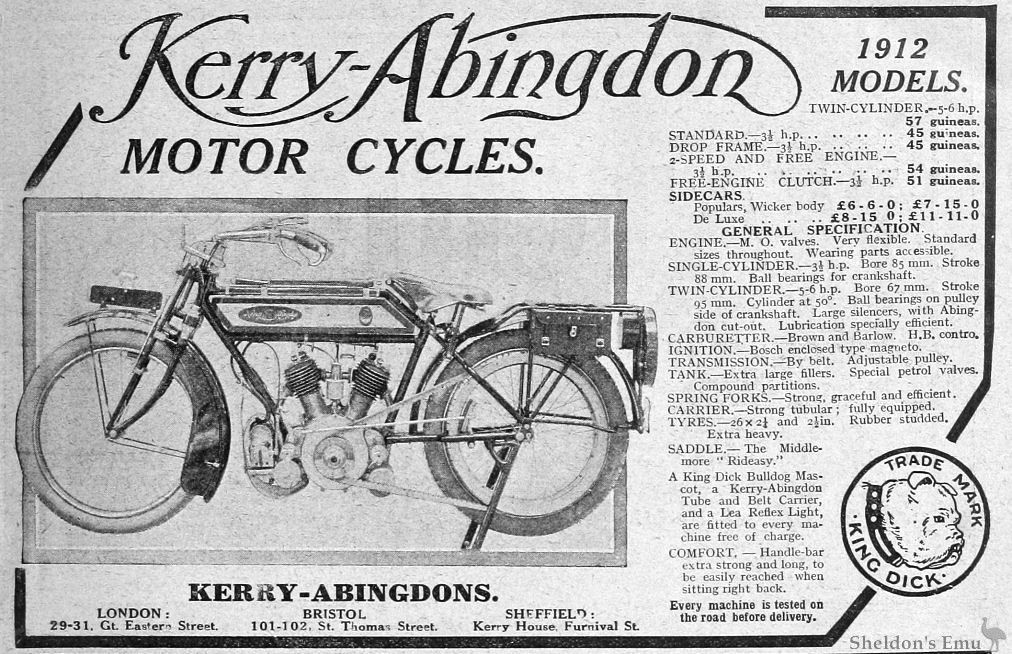
1912 Models
TWIN-CYLINDER 5.6 h.p. @ 57 guineas.
STANDARD 3½ h.p. @ 45guineas.
DROP FRAME 3½ h.p.45 guineas.
2-SPEED AND FREE ENGINE 3½ hp 54 guineas.
Thanks to the courtesy of Mr. Lewellyn Jones, we are enabled to give a few preliminary details of the 1912 Kerry-Abingdon motor cycles.
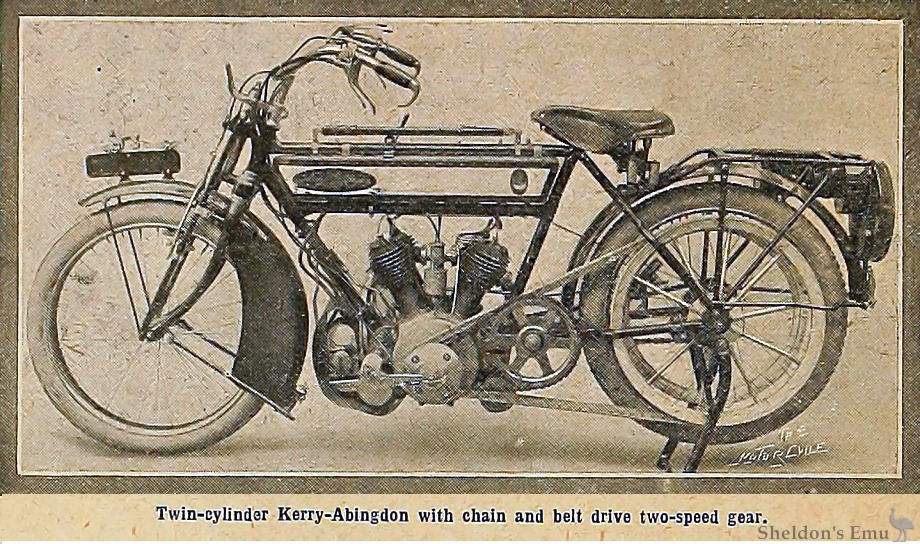
The chief novelty for 1912 will be a 5-6 h.p. twin-cylinder, fitted with side by side mechanically operated valves, bore and stroke 67 x 95 mm. The engine will have a ball-bearing crankshaft and a special lubrication system. The piston is liberally grooved so that the oil can have access to it, and a duplex priming device is fitted. A dropped frame will be used for this and one of the 3½ h.p. models.
The 3½ h.p. type will have a new engine, and will be sold with clutch or with two-speed gear and clutch, the two-speed gear being the Kerry-Abingdon type of change speed mechanism, which was described in The Motor Cycle this year, but which has been slightly improved in detail. Yet another model will be shown fitted with an Armstrong three-speed gear.
A novelty fitted to all 1912 Kerry machines will be a new kick-up stand, and another innovation shown by the firm will he a plate clutch specially designed for lightweights, the most interesting portion of which is the adjustable pulley. The movable flange has four sets of holes of different depths, which engage with four pins on the outer shell of the clutch, thus giving very easy adjustment without the necessity of using any tool.
1911 Olympia Show - The Motor Cycle November 2nd, 1911. Page 1153
The East London Rubber Co., Great Eastern Street, E.C.– This model is sub-divided into four types, with ordinary standard frame, the " Cob," with the rear portion dropped, the two-speed model and the T.T. roadster fitted with specially tuned-up engine designed for high-speed work. In all cases the machines are turned out fully equipped for the road, with pannier toolbags, circular belt and tube case at the rear, reflex light, and an excellent kick-up stand engaging with a sensible spring clip on the mudguard. All K.A, engines are now provided with springs under the tappets to reduce noise. The priming device is worthy of notice, as when the needle valve is unscrewed no petrol can flow until a plunger is depressed at the top of the needle valve screw, which is likely to prevent the device from being tampered with, A plate clutch model is also supplied, the clutch mechanism being carried outside the hub, the rear forks being specially widened for this purpose. The two-speed gear, we may remind our readers, works with belt drive on the high gear and chain drive on the low. The gears are changed by means of a dog clutch mechanism in the rear hub. The multiple disc clutch is carried on the engine-shaft.
The twin-cylinder model is made in two types, with the ordinary type of frame and with the dropped frame, and also with a multiple disc clutch in the rear hub, similar to that fitted to the single; otherwise its features are the same. A number of sidecars are also on this stand. A large number of machines are exhibited, and altogether the East London Rubber Co.'s stand is an imposing one. We may add that in cases where a two-speed gear is fitted, handle starting is provided.
1911 Olympia Show - The Motor Cycle November 23rd, 1911. Page 1282
3½ h.p. Model : 85 x 88 mm.; side by side m.o.i.v.; B. and B. carburetter; chain and belt; two-speed gear.
The East London Rubber Co., Great Eastern Street, E.C.
The most prominent feature on this machine is the two-speed gear, which is arranged so that a belt transmits the power on the high ratio and a chain on the low. In both cases the transmission is direct. The belt pulley and a small chain sprocket are connected to the engine-shaft by means of an enclosed leather faced clutch, which is worked from the left handle-bar grip. This clutch therefore applies to both high and low gears. Behind the bottom bracket a chain counter-shaft is arranged, with its driving sprocket on the side of the machine opposite to the driven one. The belt rim and the final drive sprocket are therefore on opposite sides of the back hub. The change of gear is effected in the hub by a clutch device worked by a small lever on the side of the petrol tank, which connects either of the two drives. When the top gear is in operation the low gear chains run idly, and nice versa. The front forks are of the Kerry type with enclosed springs.
A case with a quick detachable lid for spare belt or inner tube is fixed at the back of the carrier, at each side of which is a pannier toolbag of good size. The 3½ h.p. machine is also shown with a single gear.
6 h.p. Model : side by side m.o.i.v.; B. and B. carburetter; chain and belt; two-speed gear.
This model is shown attached to a sidecar, and has exactly the same form of transmission system as that adopted in the one previously described. The sidecar is of pleasing shape, and special attention has been paid to luggage and tool-carrying capacity, there being a deep pocket behind the back of the seat and a cupboard underneath it. The twin engine has separate silencers, both of which are fitted with cut-outs. In all models a front wheel stand is fitted, which also acts as a mudguard stay.
1912 Olympia Show
The Motor Cycle November 28th, 1912. Page 1396