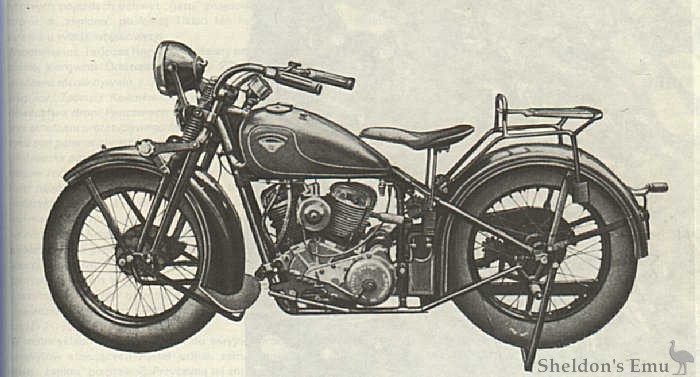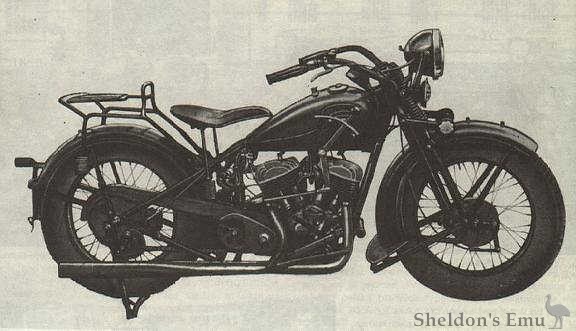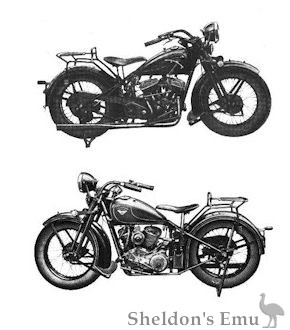


This is a 'story' about one of Poland's most famous pre-war bikes: CWS M 111. This is part of an e-mail message send to a guy in Germany who was interested. I hope, I soon find time to post you more data about this bike (if necessary), and some info about other bikes.
Before bikes I think I should write something about the situation in Poland at that time. It was a lot different from the one in the States, and from the one after the war. It may help US readers to understand what happened there.
In 1918 Poland gained independence after almost 150 years of German-Austrian-Russian rule. We had to fight for the frontiers for next 3 years. There was no moto-industry left by the invaders. We had to create everything on the land destroyed by the Great War. Poland was a free capitalistic country at that time and soon the first private manufactories appeared. Some most complicated parts (e.g.: electric parts) we had to import (mostly from Germany - Bosch) but later all the parts were Polish. Polish projects were original, comparable to western bikes, reliable but a lot cheaper. Unfortunately the Second World War stopped the rapid development of Polish moto industry.
All right, here is the description:
The mark:
As a prototype (in 1932, project was from first half of 1931) it was called 'CWS M III' (what means Model 3 - first was CWS M55 series S-0, not a good bike, second was from series S-III). Somebody in a very important document wrote the roman 3 crabby and it looked as Arabian 111. At the end of 1935 because of the new touring model Sokol 600 RT M 211 they changed the name to a more 'commerial' name, Sokol 1000 M 111 (which later became the name whole later family of motorcycles).
The bike:
CWS was made mainly for the army which wanted heavy, reliable, home motorcycles - no matter how expensive to build they would be. (The prize - 4200zl was comparable to a small car). The bike was perfect - no matter how tough the road (or off-road) was. Starting cold bike at -40 deg Celc. was NOT difficult. By using special injector you pumped some fuel to both cylinders (through special valves) what helped you start the engine. The gas was on the left. The army wanted the bike with the basket to help the crew pushing her in extreme conditions with the engine. Left gas (basket on the right) was thought by the army to be better. On the right there was an ignition stearing.
Frame (basket and bike): double, closed, was made of steel 'construction pipes', front suspension - springing, rear - hard.
Engine: twin V-45*, four stroke, side-valve, 995,4 cc. Compression increased (compared with M 55) to 5:1, continuous power: 18 KM at 3000 rev/min, max power 20-22 KM at 4000 revs.
Primary transmission - gear drive (so durable that today - after using it for 60 years there are no wear and tear marks) , multiple disk (5 steel, 6 copper-asbestos), wet clutch (operated with a pedal on the left). Hand operated (on the right) three-speed gear box didn't need reducer (first gear: 16,73:1 [or 8,34:1], third: 5,01:1 [or 5,22:1]).
Secondary transmission: chain.
Mechanic drum brakes (also for the sidecar wheel), with parking brake.
Weight: 270kG solo, 375 with sidecar.
Top speed: 100km/h
Fuel cons.: 7-7,5 l/100 km
Oil cons.: 0,3 l/100 km
There were no important changes in production until September 1939 - on that time all the factories were destroyed or taken by Nazis.
The army stated that the CWS M 111 were better than American (used till that time) motorcycles. It really was a true statement.
CWS M 111 was used (bought) mainly by the army. The bike was black with gold and light-cream addings, or khaki with gold stripes. There were also different camouflage paintings made by the army.
A project for sidecar wheel drive was not put into production although the prototypes from 1938 (M 121) were doing very well off-road.
About 3400 bikes were built (1933-39)
Marek Kowalski -- dwusuw at polboxdot com
Minor edits April 2023.
Note: There is also a British make, C.W.S.
Sat Feb 07 2015
kuba1975 at tlen.pl
sokol cws m111. 1000,sokol600 i 600rt needed
cws sokol
I am looking for any part or whole motocycle sokol 1000 / 600 for restoration. Location and condition of parts or motorcycle doesn't matter. I can arrange pick up everywhere. Pls feal free to email me
Poland,Opole
Wed Jan 05 2011
1gator.shop<at>charter.net
brass jelly pan
C.W.S. TYSELBY B'HAM
I have a brass jelly pan with C.W.S. TYSLBY B'HAM on the side.
Is this a product from your company? Can you give me any history?
Thanks, CA
NC US
December 30, 1998
Hi Sheldon,
Here is some new stuff:
CWS M 55 - the first bike produced by national
industry (National Engineering Works).
The constructor - engineer B. Fuksiewicz - worked earlier for 'Centralne Warsztaty Samochodowe' (Central Car Workshops) - CWS - that is from where the name of the bike comes.
The army needed a heavy bike based on Indian (engine) and Harley (frame/suspension). Designers were told to copy American parts and only change overall dimensions a little to pretend originality. No resistance tests were made, fit tolerance was selected during assembling. It was not good for the quality of the bike.
First prototypes were maid in 1929 (1928?), and serial production of CWS M 55 S-0 was launched.
Most of the parts were made in home factory, some (especially wheels and fuel tanks) in other polish works. Number of imported parts was reduced to minimum - only electric installation (Bosh), bearings, tires, carburetor and speedometer.
During road tests of S-0 version a number of serious defects occurred. Valves were breaking, valve seats were being knocked out, springs and frame pipes were cracking and stiff fuel and oil pipes were breaking. Also the starter was placed unfortunately (as in Indian) - between bike and sidecar. The army was not satisfied and started to complain about the bike.
A new model (S-III) was made in 1930 and had a few modernizations (frame, fuel tank, timing gear). The engine worked better, was more durable and stronger (16 hp).
50 S-III's were bought by Warsaw post. The bikes worked well, but still there were some failures. The factory didn't hurry with repairs so the chief for motorcycle matters (engineer K. Rogozinski) made a demonstration. He took 8 broken CWS's, tied them together and pulled them with his Harley trough the city to the works. Bikes were repaired and engineer Rogozinski became (a month later) a manager of Motorcycle Department in the National Engineering Works.
In 1932 production of CWS M 55 was stopped. There are no documents saying how many bikes were made. Probably a few hundreds (about 200 bikes).
CWS M 55 S-0:
Engine: Splash lubricated, V-twin (46*), four
stroke, side-valve, 995,4 cc, low compression (4:1). Cast iron cylinders
and pistons.
Constant power: 13,2 hp (2000rev/min), max:
14 hp (2500rev.)
Additional hand powered oil pump was to help the engine in hardest condition.
Primary transmission: toothed gear
Clutch: multiple-disk, wet, operated by left pedal,
Gear box: 3-speed, operated by long hand lever on right side,
Secondary transmission: chain,
Frame: double, closed, made of construction pipes (bike and sidecar),
Suspension: front - springing (H-D system), rear - hard,
Brakes: drum brakes - small front and bigger rear one (12 m from 15 km/h to 0 - with full ballast),
Fuel tank: 20 l,
Oil tank: 5 l,
Battery: 6V, 12 Ah,
Mass: 200 kg (260 kg - with sidecar), max: 470 kg,
Top speed: 100 km/h (75 km/h - with sidecar),
Fuel consumption: 10-12 l/100 km (with sidecar and full ballast),
If you are unsure with anything, have any questions or comments please write me. I also send you some pictures of CWS M 55.
I also have a question: what is an English name for the type of front suspension shown on the pictures, I couldn't find it in any dictionary, so I only wrote 'springing', I'd like to be more precise.
Best for the New Year,
Marek.
If you have a query about CWS motorcycles please contact us