The Swedish Hedlund


The Hedlund Story ...

The origins of the Hedlund motor can be traced back to 1955, when Nisse Hedlund, a young engine tuner from Stockholm, and Gunnar Hagstrom, a talented Swedish engineer, produced two 500cc motocross engines for the Swedish Monark company.

In 1958, Hedlund and Hagstrom built two more engines, one of which was sent to the Husqvarna factory. Husqvarna were suitably impressed with the engine and invited Hedlund and Hagstrom to help them develop their new "ex-cam engine". The first and only prototype was completed on June 7th 1960, (Hedlunds 27th birthday) , but it was considered to be too expensive and the project was scrapped. The engine is now in Husqvarna's own museum.

Hedlund continued to produce his own push-rod and over-head cam (OHC) engines throughout the sixties, some of which were destined for the Husqvarna motocross team. However, Husqvarna stopped producing their four-stroke machines in 1963, leaving their leading factory rider, Rolf Tibblin, without a bike for the 1964 season. He teamed up with Nisse Hedlund and between them they produced their own complete motocross machine in time for the 1964 season. Within a couple of years, four stroke machines were being completely overshadowed by the new lightweight two-stroke machines and even Tibblin defected to the Czechoslovakian CZ team.

Hedlund turned his attention to other forms of motorcycle sport and in 1967, he tried to get his engine accepted for speedway racing. Bengt Jansson was given the job of "test-riding" the speedway Hedlund appearing on a number of tracks both in Sweden and in the UK during 1968. The engine was also put through its paces in an ice racing chassis and in a Hagon long track frame. A picture of Jansson sitting astride the Hagon/Hedlund long track bike appeared in the May 1969 issue of Speedway Post. The project was a short lived one though and ended with Hedlund and SVEMO at loggerheads.

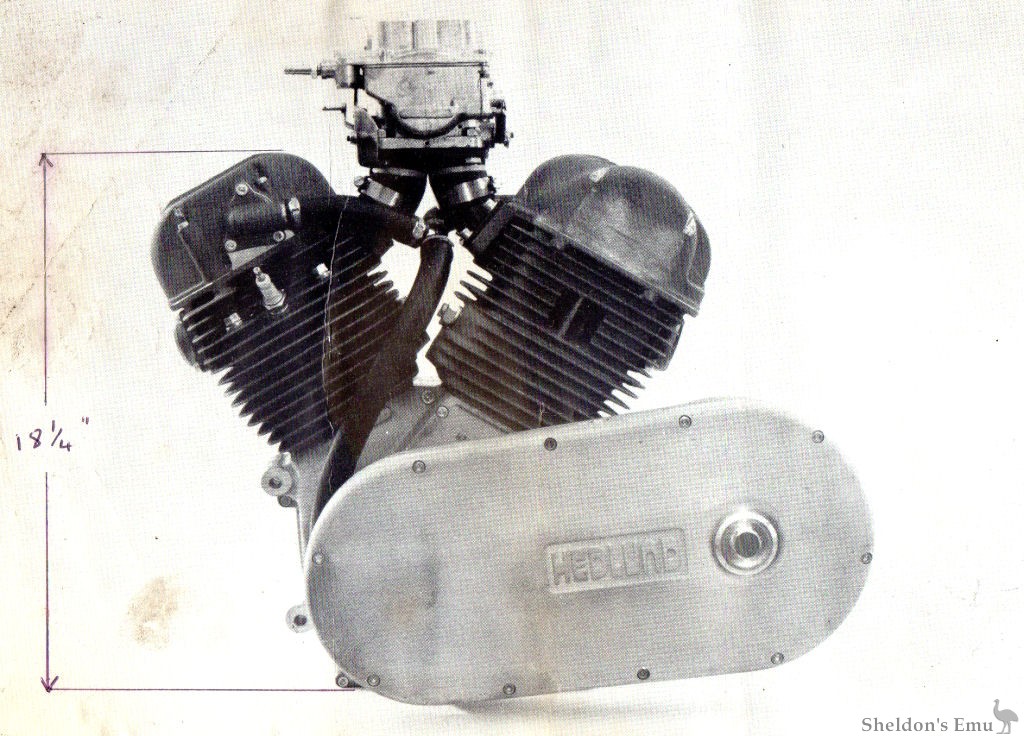
The 497cc Hedlund was one of very few speedway engines to feature double over-head cam shafts (DOHC). It was also built as a unit construction, i.e the clutch was housed within the crankcase. The long track version also had a two-speed gear box within the "unit". Compression could be altered and power varied between 44 - 50 bhp. The Hedlund was in fact a true union of European engineering - It was designed and built in Sweden using a Swedish "Stefa" magneto, the Matchless con-rod and Norton clutch came from the UK and the "Mahle" piston was made in Germany.


The Swedish Hedlund motor, built between 1967 - 1968 and was a DOHC engine. The Hedlund was tested by Bengt Jansson who also ordered Alf Hagon to build for him a special grasstrack machine, with the Hedlund engine installed.

Throughout the Workshop pages, you?can find many different types of valve systems that include: OHV; SOHC; DOHC and in combinations that include 2V; 3V; 4V and even 5Valves.

However, there are (as far as we know), only 4 engines that icorporate a DOHC system in combination with a 2Valve set up. These are:
The MSM from Australia
The old JAWA iceracer DOHC 2V
The? EICOH from Japan
The HEDLUND from Sweden.

There is another engine with the same layout (DOHC 2V) but this engine is used only for iceracing and it is the SIWA made in Austria by the Wartblichter Brothers - hopefully some information on this one will be forthcoming.

Further just for your information DOHC system are made in 2 types, - (A+B)
By the type A the camlobes are operating the valves directly by tappets.
By the type B the valves are operated by normal valverockersarms.
Both the EICOH and HEDLUND are of the type B.

In the head, both cams are connected by gears, but the inlet camshaft is also chaindriven from the cranhshaft. The small Stefa magneto is mounted at the end of the exhaustcam. All moving parts in the head run at high quality needle bearings. Also very interesting, is the fact that the HEDLUND is a unit construction, (like the Maely) and the total weight of the engine including the clutch and layshaft is only 35 Kg.

The crankcase is made of elektron, and because this is very corrosive, the crankcase is protected by a goldcoloured Eloxal. For speedway there is only a simple layshaft mounted in the unit but for grasstrack racing there is the possibility to fit a 2 Speeder.

Bore X Stroke = 99 x 80 mm
Power??????????? = 50 Bhp @ 6500 Rpm
Carburettor???? = Dell'Orto
Clutch??????????? = Norton

Torbj?rn Hedstr?m has developed a collection of Web Pages dedicated to the Hedlund motor covering the story in much more depth. His Pages,