1921 The first machines appeared as conventional lightweights with Brampton forks, a 269cc Villiers Mark IV engine and a choice of single speed or two-speed Sturmey-Archer gearbox and chain-cum-belt transmission. The catalogue included a French translation. Towards the end of the year, a utility vehicle was added which had either the same Villiers engine or a 292cc JAP, and was sold under the Indian Prince name.
1923 There were no listings for that year.
1924 The name returned, for one more year, on machines with either 147cc or 247cc Villiers engines and the same transmission options. Some machines were produced with 346cc engines.
Indian Prince motorcycles were produced from 1920 to 1924.
1924 There were 147cc or 247cc Villiers engines with the same transmission. Both models dropped from the listings after that year.
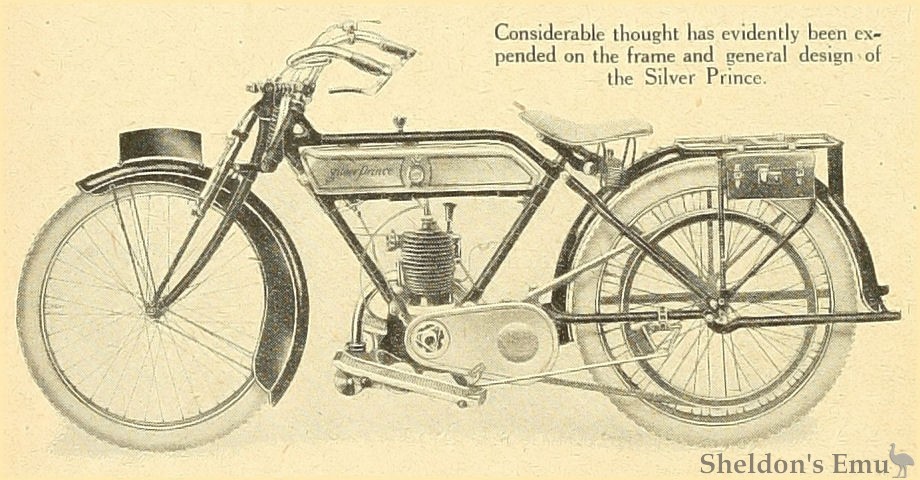
Considerable thought has evidently been expended on the frame and general design of the Silver Prince.
A Well-thought-out Lightweight.
Recently we inspected one of the Silver Prince lightweights, which are produced by the Tyrus Cycle Co., of Johnstone Street, Birchfields, Birmingham, and were much taken by the general appearance of this new machine and the methods employed to produce it. Usually the smaller makers do not pay a great deal of attention to the question of designing in order to facilitate production - and this applies also to larger firms - but the Tryus company carefully thought out the design before attempting to market the Silver Prince machine. For example, all the tubes used in the back portion of the frame, i.e., the four stays, are identical in their bends. Then the guards are better carried out than on the average low priced motor cycle, the front guard being of 4in., and the rear 5¼in. section.
The tyres are 25x2¼in., while the belt line is the same in both single-speed and two-speed models, which not only facilitates production, but, should the owner of a single-speed model desire a two-speed gear, this can be fitted without structural alteration to the frame.
A Villiers engine is fitted, and the two-speed models have Sturmey-Archer or Albion gears - Brampton forks, Dunlop tyres, and belt rim and inverted lever brakes are included in the equipment. The prices are 46 guineas, single gear; 57 guineas with plain two-speed gear; and 63 guineas with two-speed, clutch, and kick-starter - the weights being 147 lb., 153 lb., and 168 lb. respectively.
The Motor Cycle March 24th, 1921. Page 366
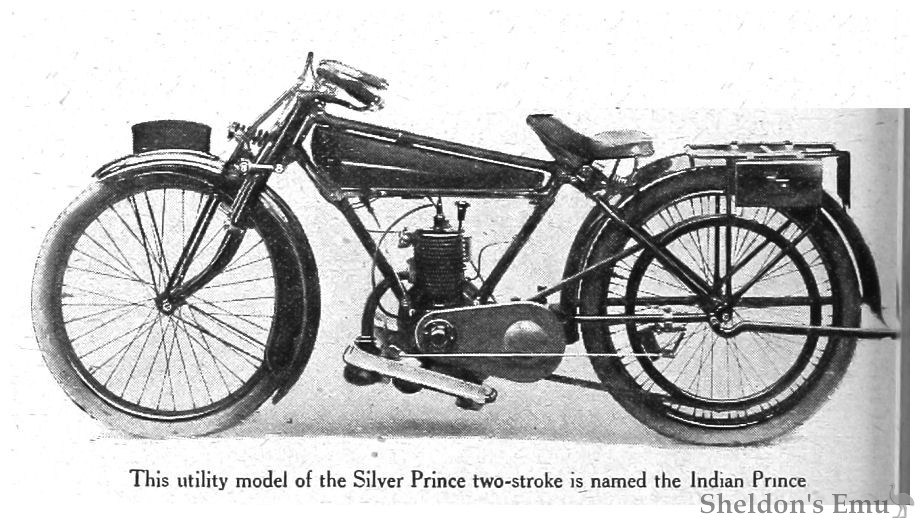
This utility model of the Silver Prince two-stroke is named the Indian Prince
1921 Olympia Show Report
SILVER PRINCE
Although a newcomer to Olympia, the Silver Prince motor cycle is not an entirely new machine. Illustrations ot the current year's models have already appeared in these pages, and we were constrained to comment upon the excellent finish and detail work. The 1922 models which will be on this stand include two and four-stroke lightweights of conventional types. In addition, a new model, which it is proposed to name "The Indian Prince," with a two or four-stroke engine, will also be shown.
The Motor Cycle, November 24th 1921
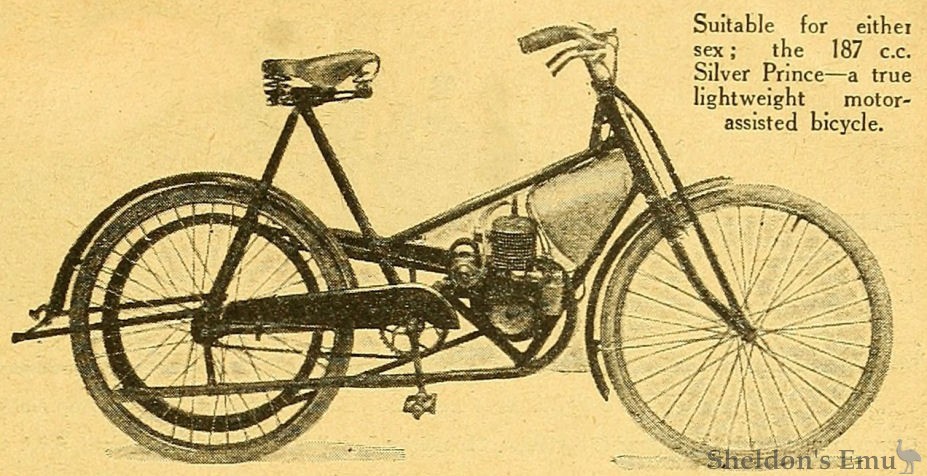
Suitable for either sex ; the 187 c.c. Silver Prince – a true lightweight motor- assisted bicycle.
Tiny TwoStroke Engine in a Special Open Frame Pedal Cycle.
WEIGHING less than 70 lb., and selling complete at 25 guineas, the Silver Prince featherweight is likely to attract a large number of cyclists who wish to extend their normal radius of action.
The little engine which is fitted is of the three port type, having a bore and stroke of 63x60 mm. respectively (187 c.c.), and plain bearings throughout. The crankshaft is carried in single long bearing with an outside flywheel well clear of the pedalling gear; direct belt drive with a ratio of 7 to 1 is employed, and the tank has a capacity of just over a gallon of petrol and oil mixture.
In its latest form this miniature motor cycle has a lower frame, the saddle of which is the same height from the ground as that of an ordinary lady's cycle. With the exception of a strengthened head lug and somewhat heavier gauge tubing, all parts are standard cycle sizes, the front forks are stiffened by auxiliary girders, chain and belt guards are fitted, and an expansion chamber of considerable dimensions will be part of the standard specification.
The tyres are 26 x 1½, and brakes consist of an Eadie back pedalling brake in the rear wheel, and an ordinary cycle brake in front. We took the opportunity of a short trial run on an experimental machine, and found it extremely flexible and easy to handle. In addition to this the engine is wonderfully well balanced, and appears to have ample power for all normal hills.
The Motor Cycle, June 22nd, 1922. Page 843
If you have further information or a query related to this page, please contact us.