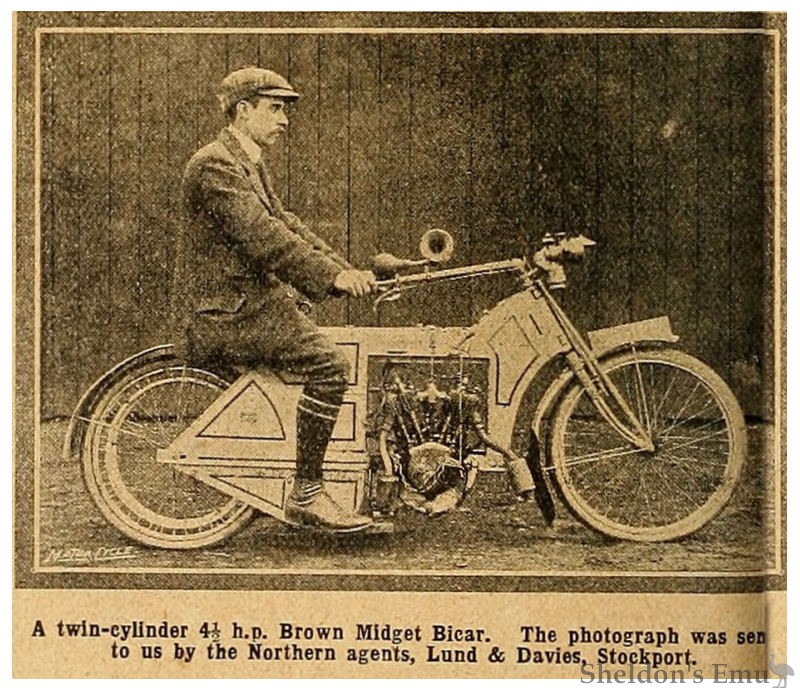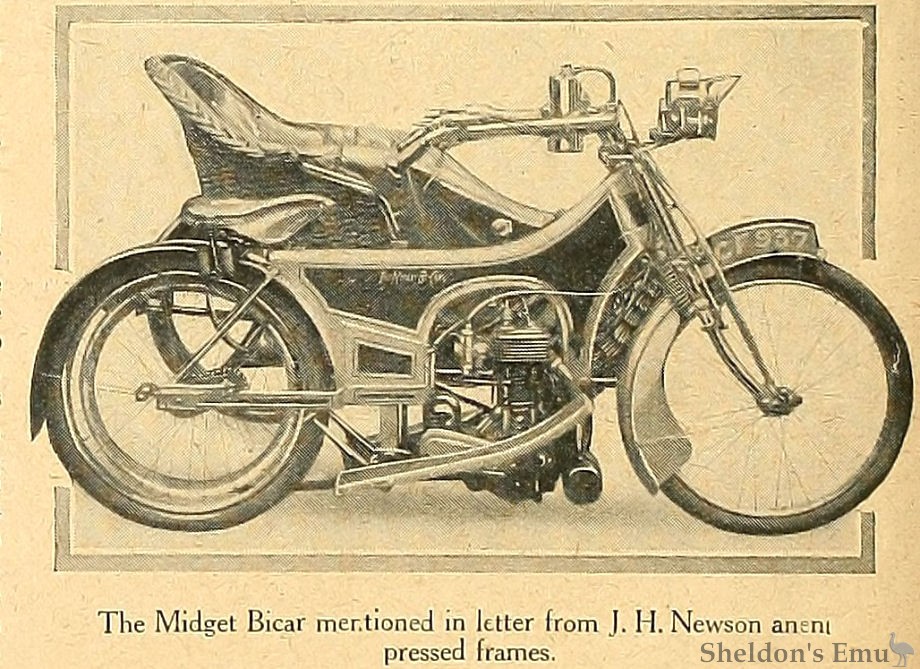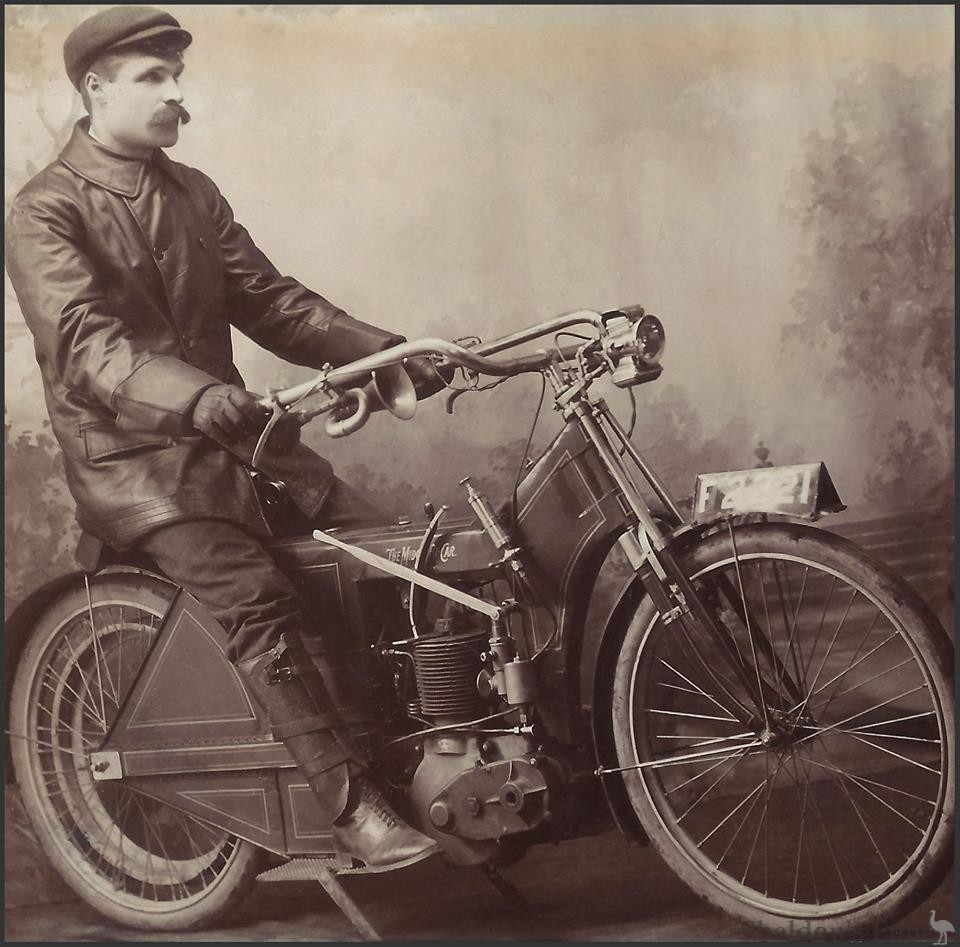


These motorcycles produced from 1905 to 1909, by J. T. Brown of Oxford Road, Reading (50 miles W. of London).
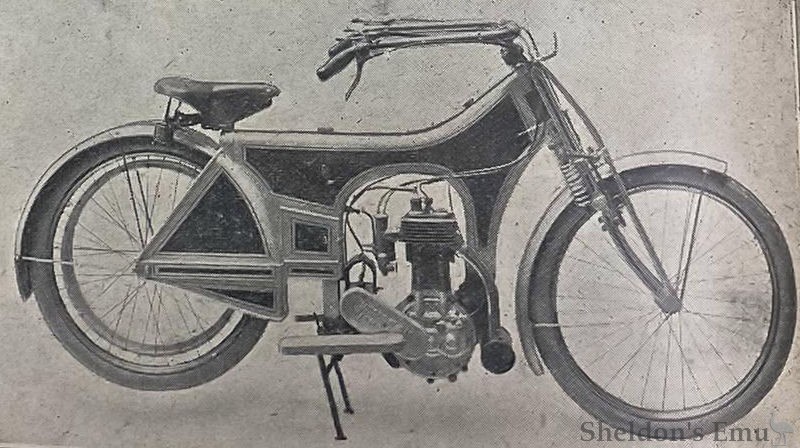
Very few of these machines were either built or sold - even in the United States, where they were constructed under licence. This was probably in part due to the unusual feature, in the Edwardian era, of an enclosed engine, something which was relativley rare until the 1980s. The engines were rated at 3hp for the single and 5hp for the V-twin.
The machine was displayed at the 1908 Stanley Show
1908 - The design had been licenced to the Walton firm in the United States who used American-built V-twin engines. It continued to be offered in the UK with a choice of 3½ hp single or 5hp V-twin engine.
1909 - A two-speed option was added.
1910 - Machines were fitted with 3½ hp or 4¼ hp Fafnir engines and Druid forks.
1911 - They used a 3½ hp Precision engine with a 4½ hp listed for sidecar work.
1912 - The smaller engine was used on a ladies' model and there was also a 2½ hp lightweight machine.
1914 - The marque was discussed in The Motor Cycle during the latter half of that year.
N.B. The firm is unrelated to Brown Bros. of London.
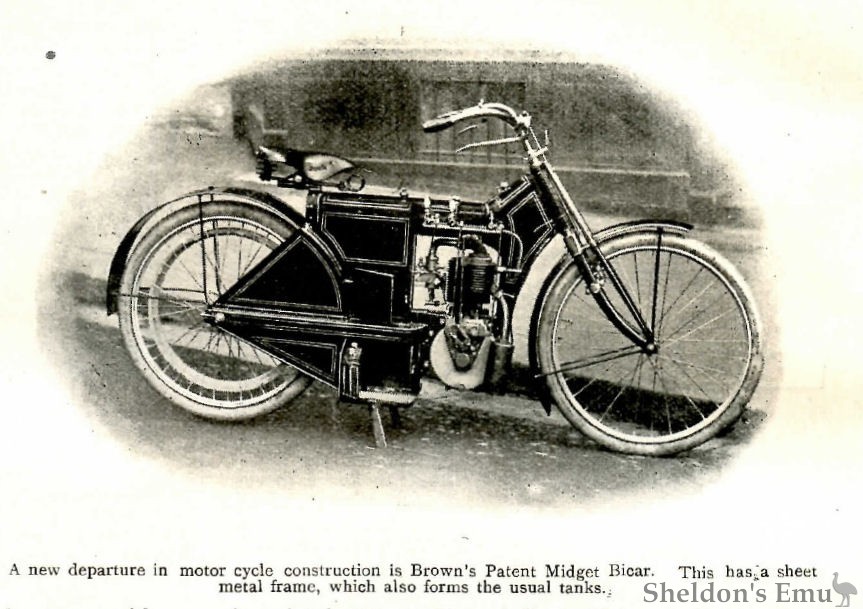
A new departure in motor cycle construction is Brown's Patent Midget Bicar. This has a sheet metal frame, which also forms the usual tanks.
A decided innovation in the construction of motor bicycles is to be found on the Midget bi-car made by Mr. T. Brown, Reading, the chief point about the machine being that it is constructed almost entirely without the employment of tubes, the frame and tank being constructed of sheet metal. The only tubing about the machine is the steering pillar, handle-bars, and front forks. All joints and the frame are riveted and solid. The machine is long and low, has no pedals, and is provided with footboards.
To these footboards legs are fitted, which can be put down or raised again at will, and can be kept in position by a small clip. The motor power is a 3 h.p. Fafnir engine of the latest type, transmission by belt, which is in the main part protected from mud and wet. On some of the models which were exhibited at the Stanley Show the Mabon free-engine clutch was fitted, which was controlled by means of a foot lever. On the opposite side to this pedal there is another foot lever which operates the back rim. brake. The advantages claimed in the particular design of the machine are increased capacity for petrol and the carrying of accumulators, etc. On one of these machines there is a tray fixed to the door of the accumulator compartment, which when it is open brings the accumulator out of the case, so that it can be easily inspected. The undoing of a single wire clip releases the batteries. Means of adjustment are provided for altering the tension of the belt on the same principle as the usual chain adjuster.
Midget Bicar.
J. T. Brown and Son, Reading. Stand No. 85.
This exhibit consists of three motor-bicycles and a "Roc" clutch. The bicycles are distinctly interesting. No tubes are used in the frame, it being entirely built up of pressed steel. The various members are joined and enclosed by sheet steel, thus forming petrol tanks, oil tanks and tool cupboard. The engine is a "Fafnir," carburetter an Amac, and ignition by magneto. A two-speed gear may be fitted at a small extra charge. The single-cylinder single-speed machine is priced at 30 guineas, and the 2-cylinder, with 5 H.P. Peugeot engine, at 45 guineas.
J. T. Brown and Sons.
Reading. Stand No. 269, Annexe.
The Midget Bi-car is a motor-cycle with a personality. It is in appearance quite distinct from the majority, and by its claims commends itself to the notice of riders who require something different from the standard type. The open frame type, suitable for either lady or gentleman, has all its parts enclosed, thus giving protection from dust and wet, while presenting a decidedly neat appearance. This machine is handled as a car, by means of the automatic variable pulley, and free engine device. The engine fitted is a 3¾ H.P. "Precision," equipped with B. and B. carburetter and Eisemann magneto, and the machine is completed with Druid spring forks, Dunlop tyres and belt, and Brooks saddle. A neat side-car is also shown.
3½ h.p. Midget Bicar, standard model. The engine is a Precision 85 x 88 mm., magneto Eisemann.
J.T. BROWN AND SONS, Oxford Road, Reading.
The general lines of the Midget Bicar are already well known, its chief divergence from standard lying in the use of a pressed steel frame, which comprises the petrol and oil tanks. The latest model is shown with an open frame, suitable either for ladies' or gentlemen's use, and is fitted with a 3½ h.p. Precision engine situated in the usual position, and very neatly housed, so as to be well protected from mud and dust, and yet easily accessible. The engine is fitted with a patent variable pulley of special construction, which is operated by a vertical lever very handily placed within the reach of the rider's hand This pulley gives a free engine position, and three changes of gear, namely 4½ 5½ and 6½ to 1. The starting handle is arranged on the chain stays, and starting is effected through a chain and a free-wheel clutch, so that with the aid of the free engine position the machine can be started in car fashion.
A neat little fixture consists in the employment of a small subsidiary tank under the lubricating oil tank, in which a small quantity of paraffin can be carried for priming the engine. Used in conjunction with the change of gear is an arrangement by which the rear hub is caused to slide forward or backward by means of pressure applied to the pivoted footboards. prevent movement when it is not required a locking screw is provided close by the saddle. In changing gear, therefore, the rider slightly slackens the belt by pressing on the rear end of the footboard, places his gear lever in the required notch, and then tightens his belt by pressing on the forward part of the footboard until the desired tension is reached. The machine is fitted with Druid spring forks and large wide mudguards, a notable feature being the inclusion of a small cupboard in the frame for carrying spare parts, tools, etc.
The saddle is a large Brooks, and the machine is fitted with a central stand, which is very easy in action. A front wheel brake operated by hand is used together with a rear rim brake actuated by a pedal.
The ordinary type of Midget Bicar is also shown with the original type of frame. but otherwise with a similar specification. On this machine we noticed a neat toolbox had been incorporated in the rear mudguard.
The Midget Bicar.
The Brown Midget Bicar, for the design of which Mr. J. T. Brown, Reading, is responsible, still retains its unusual but wholly successful sheet steel frame, built up on ash stays. The illustration of the ladies' model, now provided with doors to allow easy access to the engine, shows the position in the frame the wood stay takes. Two bars of wood used are with the grain running different ways, and the bars are firmly bolted together. While at Mr. Brown's works we were shown a photograph of one of these machines, the front forks of which were completely smashed up owing to a collision with a wall, while the frame was untouched. The chief novelty in the Midget Bicar is in the expanding pulley gear. Formerly the back wheel was moved backwards to tighten the belt by tilting the footboards, the wheel being locked in place by a hand lever on the top tube.
The new mechanism, however, does the whole process of contracting or expanding the pulley and adjusting the belt tension with the aid of one lever. This when pushed forward operates the pulley, and when pulled up or pushed down slides the rear wheel backwards or forwards. The lever works up or down in leather-faced guides, and is provided with an expanding grip brought into play by twisting the knob at the top. Moving the lever backwards or forwards gives the lateral movement to a fork which operates the expanding pulley. The loose flange of this works in an ingenious manner, and is locked by means of a ratchet and pawl; the operating fork pulls on a spindle which immediately releases the pawl and allows the pulley to be expanded to one of the three notches, or, if desired, at once to its extreme limit, which is, of course, the lowest gear. When pressed in, the flange engages the pawl into one or other of the three notches, and the pawl prevents it from slipping back against the pressure of the belt. The models shown on Stand 87 will be a 4½ h.p. single-cylinder for sidecar, a 3½ h.p., and a 2½ h.p. lightweight, while one lady's machine will also be exhibited. Precision engines will be used on all models.
1911 Olympia Show - The Motor Cycle November 9th, 1911. Page 1178
MIDGET BICAR, No. 87.
J. T. Brown and Sons, Oxford Road, Reading. – The main feature of this machine consists in the sheet steel frame strengthened by ash, while the speciality on the variable gear models is the expanding pulley gear described in The Motor Cycle of November 9th. Long footboards are fitted to all machines, and the width of the rear mudguard deserves special attention. The outward appearance of the machine is particularly neat owing to the peculiarity of the frame.
In addition to the above, there is a 3½ h.p. ladies' machine, the frame of which was illustrated in The Motor Cycle at the same time as the new variable gear, with which, we may add, this particular model is fitted. The machine specially brought out for sidecar work is the 4½ h.p. 89 x 95 fitted with the variable gear. Mention must also be made of the lightweight 2½ h.p. 70 x 76. Except where otherwise stated the main features are the same in every case.
1911 Olympia Show - The Motor Cycle November 23rd, 1911. Page 1283
Sources: Graces Guide, The Motor Cycle
26-Jan-24
lynne6180 at gmaildotcom
1906 Midget Bicar from J T Brown
Hello
I have been looking into my family history and then came across your website.
I thought you might like to see this. Victor Grandy the purchaser was my grandfather and a very keen motor enthusiast. He was involved with Brooklands Racing Circuit and as you can see from the receipt he bought a Midget Bicar in 1906. On the same day he applied for a driving licence in Reading. Sadly I don't have any photos of the bike. By 1913 he was chauffeur to the Duchess of St Albans
All the best, Lynne
If you have further information or a query related to this page, please contact us.