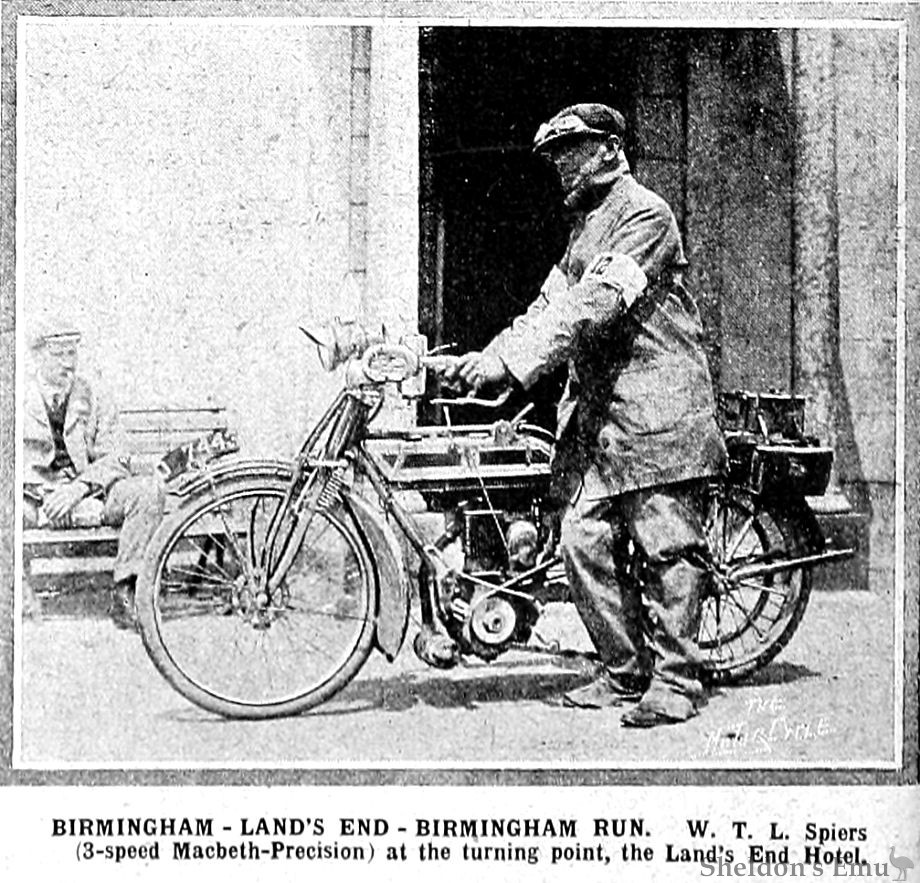

The Macbeth was produced in Birmingham from 1904 to 1913.
They then stopped motorcycle manufacture and returned to the retail trade and bicycles.
1911 At the late Olympia show, Macbeth was exhibited. Fitted with either their own or a Precision 3½ hp engine, they had a two-speed Roc gear option, belt drive and Druid forks.
1913 The make was listed that year as a 3½ hp model with an Armstrong three-speed hub gear, with belt drive.
The Macbeth Company have adopted the Minerva engine, and, in addition to the usual fittings turned out by the engine makers, they have added a spare tank for fuel between the seat tube of the rear mudguard. The frame is a bold design, but does not present any very special features calling for particular notice. (Stand 115.)
Stanley Show, The Motor Cycle Nov 25th 1903
Macbeth.
The Colmore Depot, Birmingham, will exhibit on Stand No. 102 a number of well known makes, including Scott, Douglas, Matchless, Zenith, Premier, Enfield, and Chater-Lea. In addition they will also show two examples of the Macbeth motor bicycle, a 3½ h.p. machine built upon standard lines. One will be a fixed gear model and the other a two-speed. This is another case of a well known name in the push-cycle trade being applied to motor bicycles, the Macbeth machines having been known for several years to the cycling public, particularly to London cyclists. We welcome the Macbeth machine as an addition to the industry, and have no doubt that in the hands of the Colmore Depot it will soon achieve a name for itself.
1911 Olympia Show - The Motor Cycle November 16th, 1911. Page 1213
MACBETH, No. 101.
Colmore Depot, Colmore Row, Birmingham. This is a most sensibly designed machine. The top tube is dropped at the rear. A Benton and Stone adjustable drip-feed lubricator, working by suction from the crank case, is provided. The two-speed gear is the well-known Roc. A cut-out, worked by a rocking pedal, is a particularly neat fitment, and there are comfortable footboards.
The luggage carrier is exceedingly strong and well designed, and pannier toolbags are fitted. The spring forks are the well-known Druid. A similar model is also shown with fixed gear, and the magneto advance handle-bar controlled. The magneto is the new type of enclosed Bosch and is placed behind the engine. We may mention that the Precision engine may be had if desired instead of the above, which is the firm's own. In addition the Colmore Depot show the following: A 2¾ h.p. Douglas, 3½ h.p. Zenith, 3½ h.p. New Hudson, 3½ h.p. Premier with Armstrong gear, and two sidecars. Also 7-8 h.p. three-speed chain-driven Chater-Lea with sidecar, and a 6 h.p. Matchless with sidecar.
1911 Olympia Show - The Motor Cycle November 23rd, 1911. Page 1277
Sources: Graces Guide, The Motor Cycle.
If you have further information or a query related to this page, please contact us.