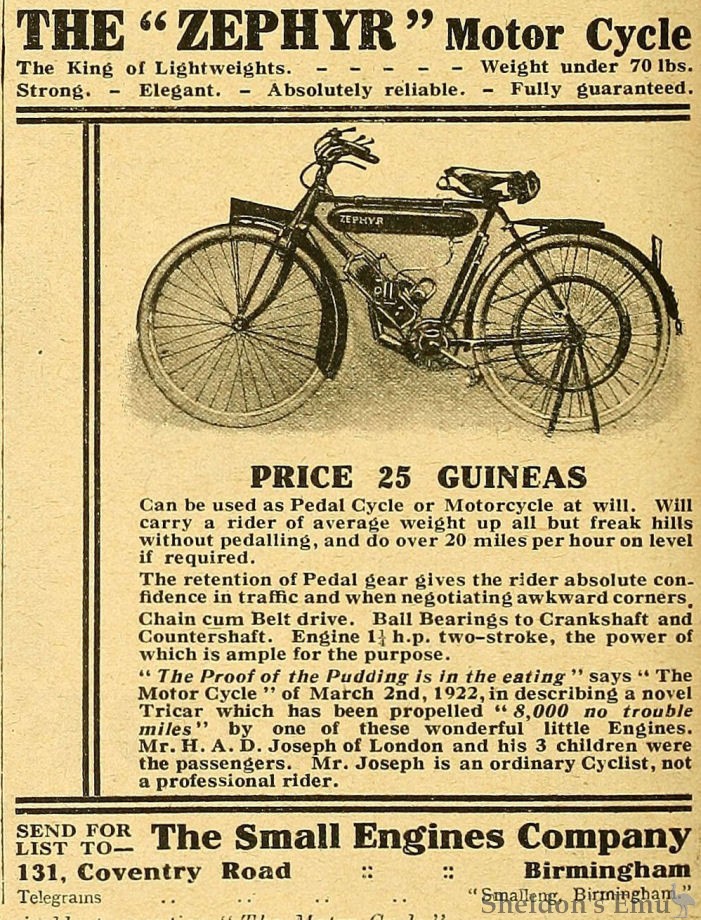

Manufactured in England between 1921 and 1923 by Small Engines Co of Coventry Road, Birmingham using Simplex engines of 110cc.
Zephyr was a motorcycle announced in 1917 and produced after the end of World War I, until 1922. This motorised pedal cycle reached the market after the end of the war, powered by 110cc Simplex engines*. It was also sold under the name of Airolite. The machine was very light, weighing only 70lb (32kg), and was therefore ideal for those who could not handle a heavy machine. A ladies' version with an open-frame version of the Zephyr was also available, and it is likely that this model too was marketed as Airolite; it remained on the market until 1924.
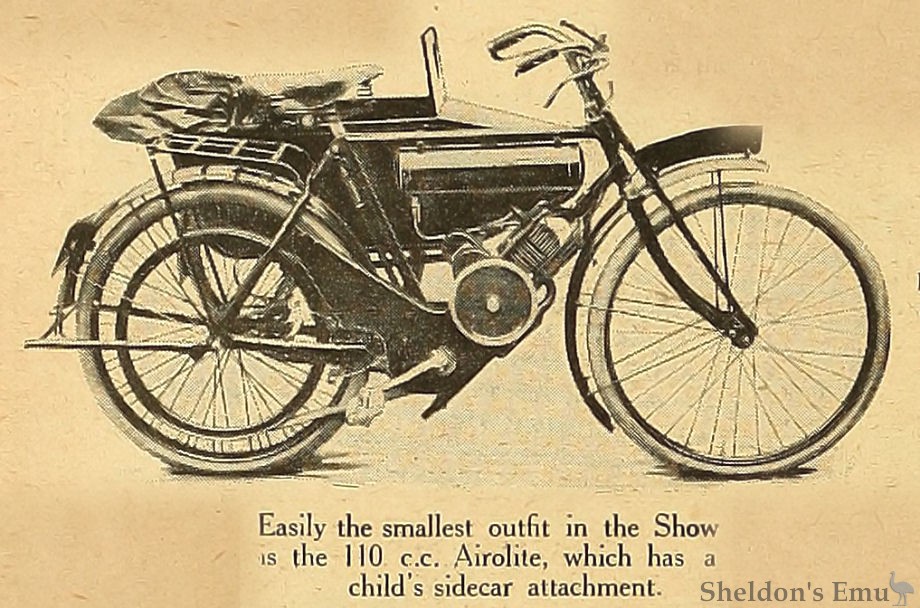
Easily the smallest outfit in the Show is the 110 c.c. Airolite, which has a child's sidecar attachment.
The 1922 Olympia Show.
AIROLITE. (Stand 20.)
A Very Miniature Sidecar.
1½ H.P. Model.
52x52 mm. (110 c.c); single cyl. two-stroke; petroil lubrication; Amac carburetter; chain-driven mag.; single-speed gear; no clutch or kick-starter; chain and belt drive; 28xl¾in. tyres. Price: Solo, £27/6;. with sidecar, £33/12.
Small Engines Co., 131, Coventry Road, Birmingham.
By the standards applied when considering a bigger machine, the Airolite motorised bicycle is not so attractive to look upon, but examination reveals that it is quite a workmanlike job.
The engine is a Simplex two-stroke which has a ball-bearing mainshaft. The countershaft is also mounted on ball bearings.
Simple spring forks have been incorporated as standard since the machine was introduced last spring, but otherwise it remains perhaps more like a pedal cycle than any other miniature in the building. An open frame lady's model is also on view, which, except for a necessary change in the shape of the tank and the addition of what in pedal cycle phraseology is called a gear case over the pedalling chain, is a replica of the other.
The reader is advised to brace himself up at this point, for an Airolite sidecar outfit is shown. But it is not so bad as it appears, for the sidecar, although fitted with a hood and windscreen, is only intended for a child up to ten years of age.
Olympia Show 1922
The Motor Cycle, November 30th, 1922. Page 823
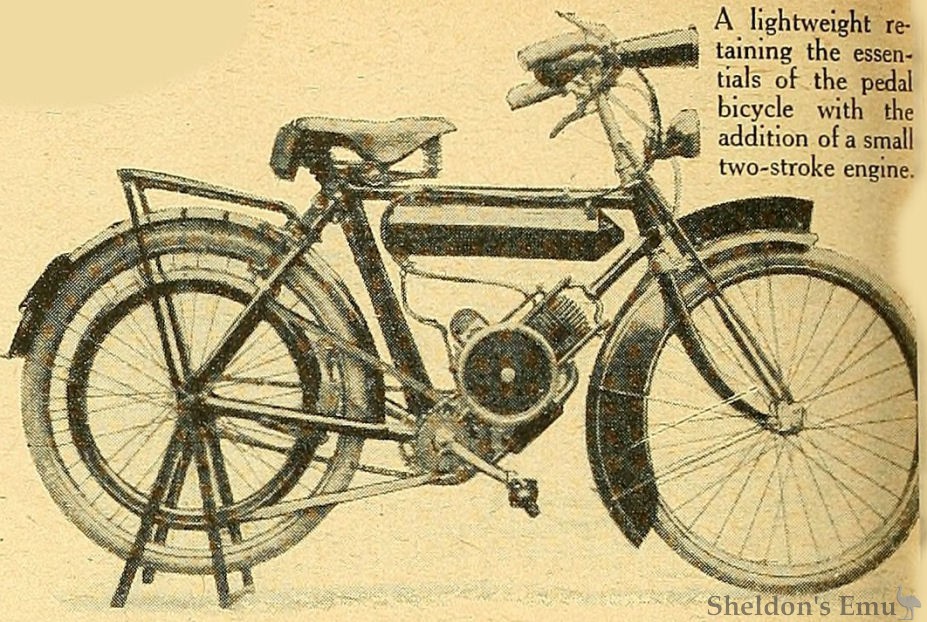
A lightweight retaining the essentials of the pedal bicycle with the addition of a small two-stroke engine.
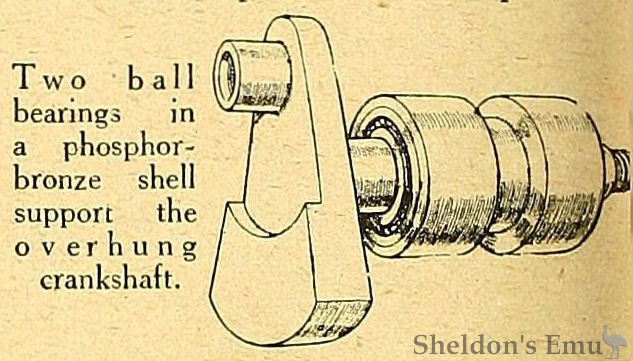
Two ball bearings in a phosphor-bronze shell support the overhung crankshaft.
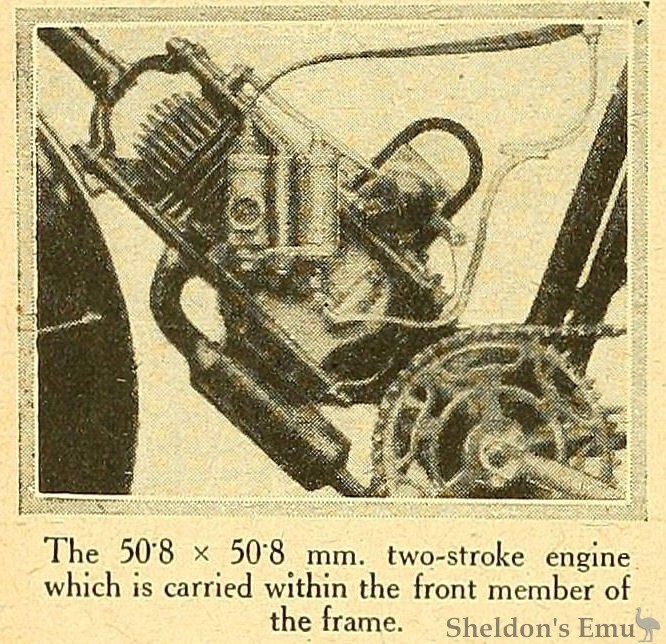
The 50.8 x 50.8 mm. two-stroke engine which is carried within the front member of the frame.
The Airolite, a Pedal-assisted Two-Stroke Motor Cycle of 1 ¼ h.p.
THERE has always been a very considerable demand for a really light motor cycle to fill the intermediate gap between the pedal cycle and the lightweight motor cycle. From time to time various machines have been designed and marketed to fill this need, and the most recent addition to this class is the Airolite, which is about to be marketed by the Small Engines Company, of 131, Coventry Road, Birmingham.
The manufacturers are responsible for the Simplex 1 ¼ h.p. pedal cycle attachment, and it is a similar power unit which is now built up in the frame of the lightweight illustrated.
Having a bore and stroke of 50.8 mm. x 50.8 mm. (103 c.c), the engine is of the normal three port two-stroke type, but an overhung crankshaft is employed and is carried on two ball bearings in a phosphor bronze shell. The bearings are widely spaced, and the gap is bridged by part of the shell which surrounds the crankshaft, and forms an additional plain bearing and compression This engine unit is held four long bolts which form the down tube of a strengthened cycle frame. It can be very easily detached or moved with its clamping plates for the purposes of chain adjustment. On the rear plate is mounted a Fellows "Baby" magneto, and from the crankshaft there is a chain drive to a ball-bearing countershaft. This countershaft, which also carries the belt pulley for the final drive, is mounted on an extension of the pedal crank bracket, and in no way interferes with the pedalling gear. The cycle parts are neat and strong, and are specially manufactured by a very well-known firm of cycle and motor cycle manufacturers.
Including luggage carrier, tool bag, number plates, etc., the whole machine weighs less than 70 lb., and sells at the very moderate figure of 27 guineas.
It is claimed that the tiny engine will propel a rider of normal weight up all ordinary hills without pedal assistance, and that it will attain a speed 15-20 m.p.h. on level roads. Such machine should meet with a very large demand, for there is an immense number of potential motor cyclists who have no desire for high speeds, and are somewhat afraid of the weight of the more usual type of motor cycle. With a view to appealing to this public the controls have been simplified as far as possible.
The Motor Cycle, May 18th, 1922. Page 644
Notes
Listed as both 103cc and 132ccc in separate articles.
Sources: Graces Guide, The MotorCycle