

OEC built motorcycles between 1922 and 1954.
The firm, founded by Frederick J. Osborn, originated as the Osborn Motor Manufacturing Co. Later the name changed to Osborn Engineering Company, and simply known as OEC. This was sometimes, and with very good reason, read as 'odd engineering contraptions'.
1901 Osborn built his first powered machine using a 4hp engine.
Post World War One. The company built 499cc single-cylinder and a 998cc V-twin machines, with Blackburne engines, for Burnley and Blackburne. They did not appear as manufacturers in their own right until 1922.
1921 An OEC-Blackburne combination was produced for taxi work. This had wheel steering instead of handlebars and was a strange looking contraption, to say the least.
1922 OEC started to manufacture motorcycles under their own name. Then, the tank transfers changed from plain Blackburne to OEC-Blackburne, as the Blackburne was now concentrating solely on the supply of engines to the trade.
Throughout the 1920s various combination models appeared, such as OEC-Atlanta, OEC-Temple and OEC-Temple-Anzani. This was due, in part, to a close and successful involvement with race rider Claude Temple, for whom OEC built the frames and assembled the right cycle parts.
1926 During October, an OEC-Temple-Anzani took the World's Motorcycle Speed Record, at 121mph/194kmh.
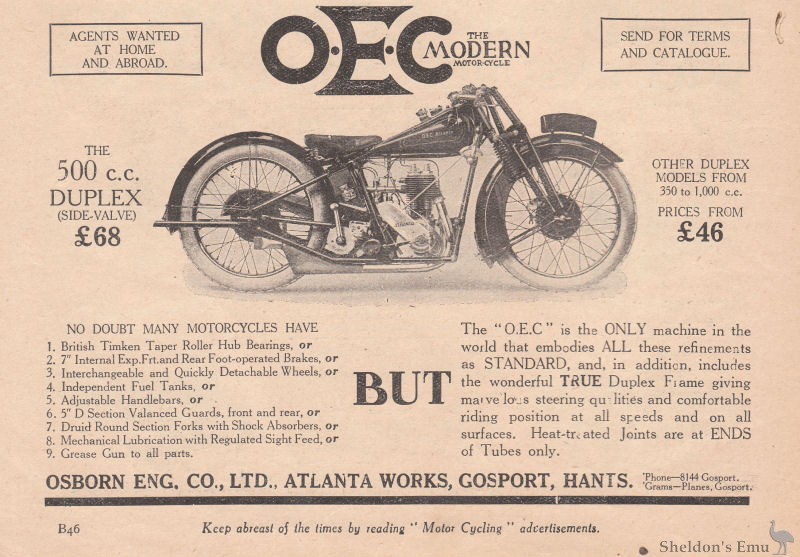
1927 That association led to an increase in the range, with models using the famous Temple name, and that year another novelty arrived in the shape of a patent duplex steering frame. This had bottom frame-rails extended forwards and outwards to give turning clearance on full lock. That, and other unique features of the design, resulted in it being called the OEC-Duplex - a name that was used until 1940.
1928 The range of motorcycles was so extensive that models had JAP, Blackburne, Villiers, MAG, Bradshaw and Atlanta engines. With numerous permutations of frames and forms, the company struggled to keep up with production demands.
1929 Unsurprisingly, that year brought cut-backs in the range. Those models on offer still had many options, so that there was no lack of variety.
1930 Joe Wright took the world speed record over 150mph/240kmh., but the name of the company was blackened when it transpired that the machine used was not, in fact, an OEC but a Zenith.
1932 The company moved to Portsmouth and continued to offer plenty of choice over the next few years.
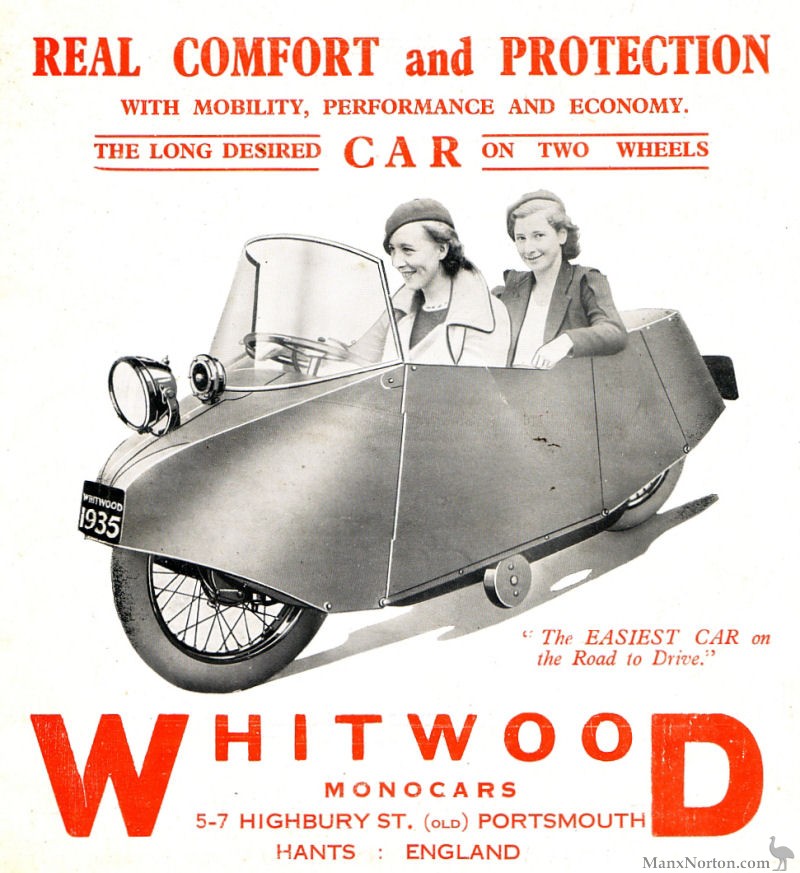
1934 OEC announced the Whitwood, a two-wheeled car. A model was announced that was fully enclosed, and from the side it resembled a small saloon car with a short bonnet - or a very large sidecar. It carried two people in tandem and had a stabilising, out-rigger wheel on either side. In many respects it resembled the Atlanta as, under the body, it had a tubular frame and the OEC duplex steering system, but controlled by a steering wheel. The engine and gearbox went under the seats and the engine ranged from a 150cc Villiers to a 750cc V-twin JAP.
1936 The above machine was much revised and the smallest engine became a 250cc JAP. The concept was unpopular, so the project was dropped. The firm produced the Atlanta Duo, a design that had led on from the Whitwood. It was a very low seated, foot-forward design with foot-boards, and although a choice of engines was available, it was not a popular model. The seat was 19-21 inches in height as the engine was lowered and the rider had foot-boards that stretched forward, to form leg shields. There was a choice of engines - single ohv as 245cc or 500cc, or 750cc JAP twins. The low-slung frame had plunger rear suspension, OEC duplex steering and a dual seat with backrest. The model did not sell well and soon disappeared.
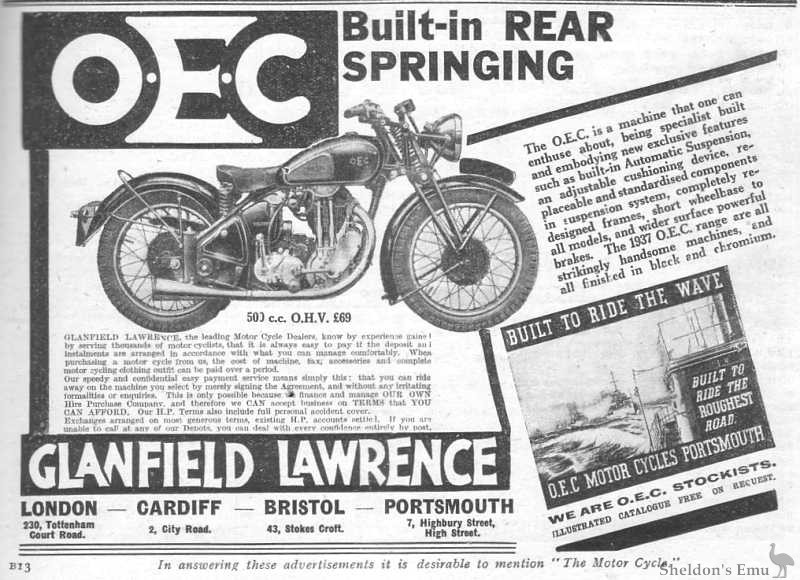
1937 OEC had been using Matchless engines, but now switched to AJS plus a JAP V-twin.
1938 Production was pared down to three models all using AJS single engines - the Commander 500, Commodore 500 and Cadet 350cc.
Production ended in World War II when the factory was bombed, but returned after the war with rear-sprung lightweights.
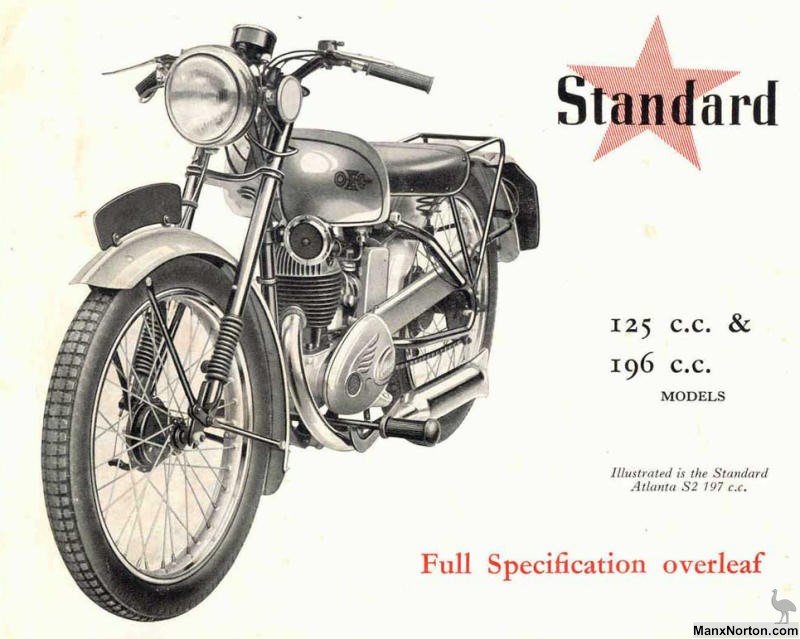
1949 After a considerable hiatus, OEC resumed building motorcycles with the production of two conventional lightweights, both using Villiers engines. The company continued to produce a small range for the next few years.
1954 The company's fortunes dimmed and production ceased.
Source: Graces Guide